Amid the monumental pines and giant redwoods stands a large figure, arms spread like wings. Around the corner, on an expanse of grass, another figure lounges, face turned toward a nearby pond bordered with pink and white daisies. Through a grove of pines, near a huge chestnut-leaved oak and a rare sapphire dragon tree, a man and a woman sit on a bench cradling an infant.
These are not regular visitors to the Royal Botanic Gardens, which cover 320 acres in Kew, a London suburb. They are a small sampling of the 30 sculptures by Henry Moore that have been installed in the gardens for the largest ever outdoor exhibition of the beloved British artist who was born into a coal mining family in 1898, served in both World Wars and spent his later years in the countryside outside London.
The title of the show, “Henry Moore: Monumental Nature,” says it all. The sculptures on view, created from 1948 to 1983, are primarily large bronzes that sit stolid and impressive in Kew’s verdant environs. They crop up unexpectedly — in shady groves, tucked behind (or inside) Victorian glasshouses, or framed by the busy lavender and towering Italian cypresses of a Mediterranean garden.
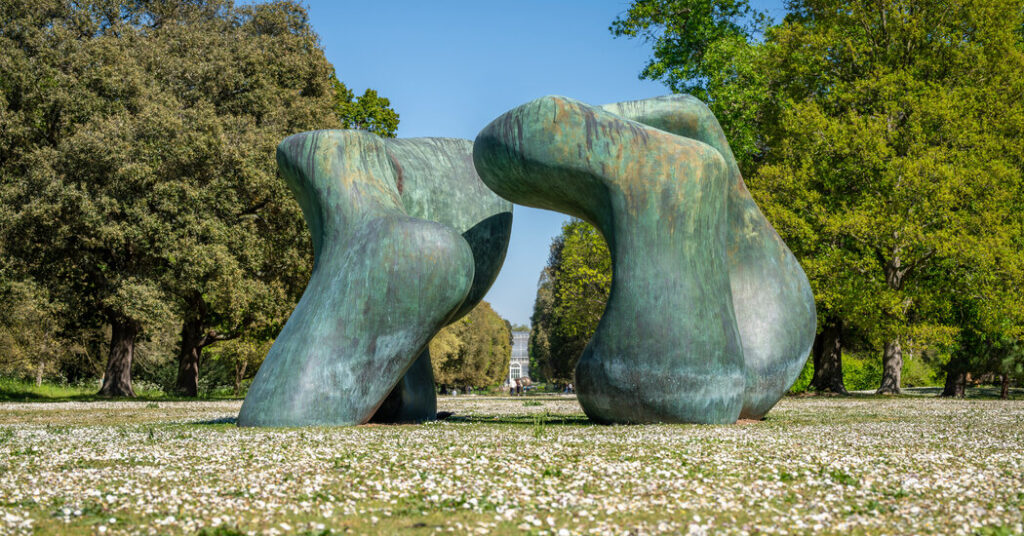
Other times, they are seen from distances down long vistas of trees, like hulking giants in patinated bronze, as with “Large Two Forms” (1969), a sculpture in two massive pieces that interlock like vertebrae, timeworn rocks or even abstracted lovers’ bodies leaning toward each other to embrace.
Just as arresting is a late work, “Large Reclining Figure” (1984), completed just two years before Moore’s death at age 88. The enlargement of a 13-inch model the artist made in 1938, this white fiberglass piece is the only non-bronze work at Kew, installed at the base of the Great Pagoda, a Chinese-style folly completed in 1762 as a gift for the gardens’ founder, Princess Augusta.
Yet what is “monumental” about the exhibition is not merely the size of the works, just as “nature” does not simply refer to the botanical setting. Instead, it signals a fundamental interplay between the natural world and the human-made that endured through the seven decades of Moore’s career.
Many of the artist’s forms are influenced by environmental aspects like trees, shells, seed pods, large craggy boulders, small bulbous stones and the stocky shapes of livestock seen across fields. And yet they are enigmatic and subtly indeterminate.
When they are overtly figurative, like “Draped Reclining Figure” (1952-53), their textured surfaces also resemble cliff edges or scored rocks, or perhaps a tree trunk’s bark. When pushing toward abstraction, as with “Double Oval” (1966) — two enormous, slightly differently shaped ovoids standing in front of each other — the forms are inescapably bony and human: the gaping “O” of a mouth, ball socket joints, vertebrae.
Of course, nature and humans are not only linked by complex ecosystems, but also share fundamental organic forms. Just think of branching networks in blood vessels, lungs and neurons, and rivers, fungi and trees. At Kew’s elegant (and blessedly air-conditioned) indoor exhibition space, the Shirley Sherwood Gallery of Botanical Art, a tightly curated display of 70 Moore works spanning drawing, prints, watercolors, plaster casts and maquettes shows how the artist fused humankind and its environment in endless transformations.
Beginning with early works from the 1930s, Moore’s signature line — smooth and undulating, enclosing rounded, bulging forms — is evident, whether applied to human figures, animal skulls, butterflies or bird cages. His lines are possibilities, translating one thing into another: a moon into a head in profile, a fallen tree trunk into a reclining woman, a stalactite into an amorphous tangle of mother and child.
In a nice, biomorphic touch, the curators have included four early 19th-century botanical drawings from the gardens’ archive, as well as a selection of wood samples from the its historical collection of botanical specimens. Hung alongside Moore’s drawings, the curves and ridges of a giant water lily and the dissected seed pods of a southern magnolia appear anew. Sitting next to rough and splintered samples of elm wood, tinder fungus and ebony, the artist’s “Reclining Figure” (1959-64), his largest wood piece, seems impossibly smooth and yet, looking closely, you can see the cracks that appeared over time as Moore’s natural material dried and shrank.
“Sculpture is an art of the open air,” Moore wrote in his 1951 essay “Sculpture and Drawings.” “I would rather have a piece of my sculpture put in a landscape, almost any landscape, than in, or on, the most beautiful building I know.”
Kew has realized the artist’s wish, while also bringing the work to life in a way that would be impossible in a static white cube space. Here, the colors of bronze — gold, rich brown, green, black and vivid blue — shift in the natural light. Voids and holes in the sculptures (as important to Moore as solid mass) frame the sky and clouds, endangered trees, blushing blossoms and people ambling near and far.
You could wander for hours, and the works would look different each time you passed them. I will go again in late summer, fall and early winter, to see what has changed: a reminder that nothing, really, ever stays the same.
Henry Moore: Monumental Nature Through Jan. 31 at the Royal Botanic Gardens, Kew, in London; kew.org.
The post A Show for All Seasons: Henry Moore’s Art, Reborn in Open Air appeared first on New York Times.