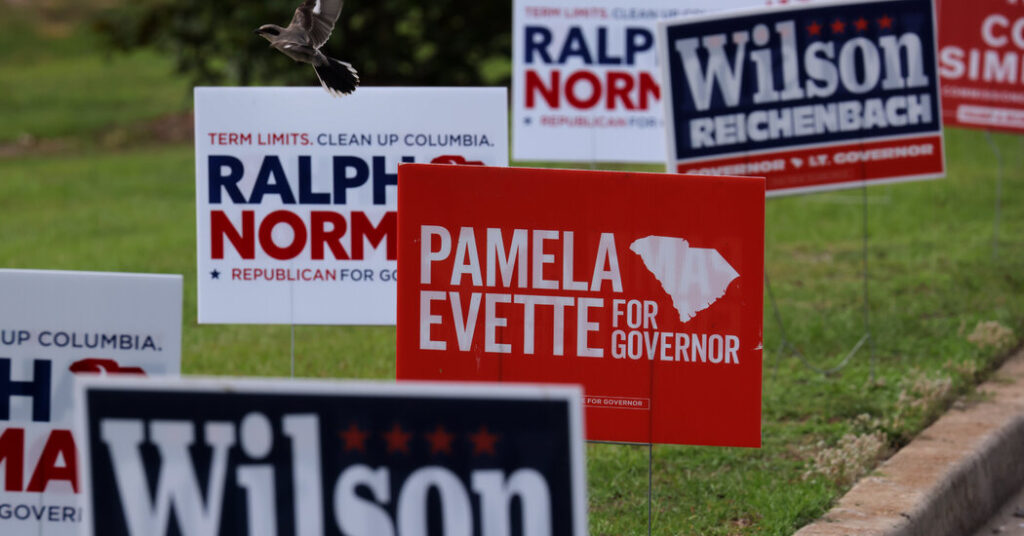
President Trump’s decision to endorse both candidates in Tuesday’s Republican primary runoff for governor of South Carolina has complicated what had appeared to be another test of his political sway.
Mr. Trump originally endorsed Lt. Gov. Pamela Evette on May 29, and she placed first in the primary on June 9. Ms. Evette’s prospects in a runoff against Alan Wilson began to waver, however, when two of the previous candidates in the race, Representatives Ralph Norman and Nancy Mace, endorsed Mr. Wilson. And a handful of polls fielded since the primary had Mr. Wilson, the state’s four-term attorney general, leading comfortably in the race.
On Friday, Mr. Trump reversed course, writing on Truth Social that he would back both candidates. That decision followed recent losses by Trump-endorsed candidates in Iowa and Georgia.
A sizable share of voters — around 45 percent — voted for candidates other than Ms. Evette and Mr. Wilson in the primary. A key question will be how the supporters of those other candidates break in the runoff, which creates several key areas to watch as results start being reported.
In the primary, Mr. Norman won several upstate counties in and around his House district, including York County, a major suburban county bordering Charlotte, N.C., and Greenville County, which cast the largest number of Republican votes. How much Mr. Norman’s endorsement of Mr. Wilson sways voters there could be a crucial factor in Mr. Wilson’s ability to build a winning coalition. Conversely, it would be a good sign for Ms. Evette if she can do well there despite the lack of endorsement.
Ms. Mace, who finished in fifth place in the primary, did not win any counties. But based on her endorsement, Mr. Wilson could also pick up support in areas she represents around Charleston, including Berkeley, Charleston and Dorchester Counties.
For Ms. Evette, holding onto support in Horry County, a rapidly growing coastal county that includes Myrtle Beach, is important. Horry was one of just two counties where she earned a majority of votes in the primary, winning it by around 14,000 votes — a larger total than her entire statewide margin.
Richland County and Lexington County comprise much of the Columbia metro area, where Mr. Wilson was born and later practiced law. He won pluralities in each of them in the primary, and will aim to build additional support. The two counties made up around 10 percent of votes cast in the primary.
The winner of the runoff will face Jermaine Johnson, a Democratic state representative, in the general election. South Carolina, which Mr. Trump won by 17 points in 2024, is considered solidly Republican and has not elected a Democratic governor since Jim Hodges, who held the office from 1999 to 2003.
The post Areas to Watch in a Complicated South Carolina Primary Runoff appeared first on New York Times.