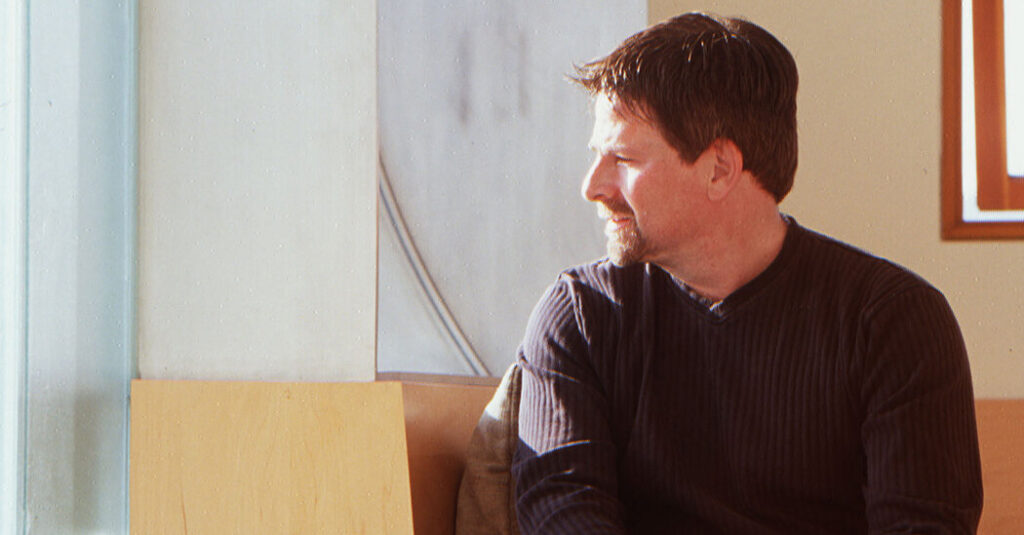
Lorcan O’Herlihy, a Dublin-born architect who brought new ways of thinking about high-density urban living to housing projects around his adopted city of Los Angeles, incorporating expanded communal spaces, pocket parks and rooftop gardens, died on June 14 at his home in Malibu, Calif. He was 66.
His firm, Lorcan O’Herlihy Architects, said in a statement that the cause of death was glioblastoma, an aggressive form of brain cancer.
Mr. O’Herlihy earned praise both as a worthy heir to generations of innovative Los Angeles architects like Richard Neutra and Frank Gehry and as a leading voice pushing urban design beyond the strictures of 20th-century modernism.
Los Angeles is an urban agglomeration built around cars and the single-family home. Mr. O’Herlihy believed that it was essential to think differently — to imagine multifamily housing that was affordable and inspiring, integrated into the urban fabric at a human scale.
“As global cities become denser and the need for housing greater, it is more critical than ever to design spaces that promote equity, human interaction and cultural evolution,” he told The Irish Times in 2019.
For an apartment building in West Hollywood called Formosa 1140, he persuaded the developers to set aside a third of the site for a small park that would be open to the public. Another nearby project, Habitat 825, extended the sidewalk into the envelope of the building, blurring the line between public and private space.
In a city riddled with oddly shaped, empty or underused lots, Mr. O’Herlihy proved adept at filling them.
For an apartment building in Koreatown called Mariposa 1038, he fashioned a pure white cube to maximize floor space and then pinched in the four sides to give it street-level character, topping it with a roof garden for the residents.
He insisted that such design should be available to all. His dozens of projects included housing for formerly homeless people, residents with special needs and low-income families.
“No one calls us to look for high-end housing,” he told The Los Angeles Times in 2018. “We get sites off the beaten track — when people really want efficiency.”
Like many architects, he took on commissions for single-family homes for private clients, including his parents, early in his career. But rather than scale up into luxury or commercial projects, he used those early works to build experience with residential architecture that he brought to multifamily projects.
“I believe that architecture is a social act,” he told the website Archinect in 2017. “You need to take an approach to architecture that pulls away from seeing a building as an isolated object, but instead see it as a tool that engages social and civic interactions.”
Lorcan O’Herlihy was born on Sept. 14, 1959, in Dublin, where his father, Dan O’Herlihy, studied architecture before becoming an actor. (The elder Mr. O’Herlihy received an Oscar nomination for best actor for playing the title role in Luis Buñuel’s “Adventures of Robinson Crusoe” in 1954.) His mother, Elsie (Bennett) O’Herlihy, managed the home.
When Lorcan was still very young, the family moved to Los Angeles for his father’s career. He later returned to Dublin to finish high school. In between, he lived for short stints in Moscow, Paris and Rome, where his father was on location for film shoots.
He received a degree in architecture from California Polytechnic State University, San Luis Obispo, in 1981, and earned a master’s degree in 2009 from the Architectural Association in London.
After working for the architect Kevin Roche in Connecticut from 1981 to 1983, Mr. O’Herlihy joined the office of I.M. Pei and spent three years in Paris working on the expansion of the Louvre; his focus was on the 70-foot-high glass-and-steel pyramid in the main courtyard.
Following his time with Mr. Pei, he took a break from architecture to pursue an interest in painting. In the late 1980s, he worked for the architect Steven Holl in New York before returning to Los Angeles, where he started his own firm in 1994.
He married Cornelia Hayes, an actress, in 1991. She survives him, along with their two sons, Daire and Darcy; his sisters, Olwen O’Herlihy Dowling and Patricia O’Herlihy Wisda; and his brother Cormac. Another brother, the actor Gavan O’Herlihy, died in 2021.
Mr. O’Herlihy’s breakout project was his own house, a jewel-box of a home that he built in 2003 on a 19-foot-wide lot in the Venice neighborhood of Los Angeles. Its clever design and innovative use of low-cost materials caught the attention of developers looking for a similar approach to multifamily projects. Within a few years, he had a long list of clients around Los Angeles.
Over time, people from outside the city began calling, too, most notably from Detroit, a city struggling with its own housing problems. In 2016, he set up a second office there.
Mr. O’Herlihy thought about his work not just in social and economic terms, but in the context of climate change and environmental catastrophe. In 2018, the home he had designed for his parents in Malibu burned down in the Woolsey Fire; he rebuilt it, this time using concrete and noncombustible material.
Across all of his projects, he emphasized low- or zero-emission materials and resilience to rising waters and temperatures. Above all, he said, building denser, transit-centric housing was imperative in the face of a rapidly changing climate.
“All of us as architects have to take it on,” he told The Irish Times. “We cannot not deal with it. If you do, you’re ignoring the most significant crisis that’s going to happen.”
The post Lorcan O’Herlihy, Architect of Innovative Urban Housing, Dies at 66 appeared first on New York Times.