“Rogue Trooper,” first published in the British comic anthology “2000 A.D.” in 1981, is perhaps the second most popular character to emerge from the publication after “Judge Dredd.” The property has inspired several spin-offs, board games and novelizations, along with multiple video game adaptations of varying quality. But a feature film adaptation has remained just out of reach — until now.
An R-rated animated film version of “Rogue Trooper,” from writer-director Duncan Jones, just premiered at the Annecy International Animation Film Festival. And it really is a marvel — both for the way it maintains the off-the-wall energy of the original comics and for being an independent film made on a much tighter budget than we’d probably imagine (and may never know). Of course, neither of those things would matter if the movie weren’t any good. But it’s an absolute hoot: an otherworldly war movie populated by anthropomorphic weapons, arcane mythology and the kind of go-for-broke 1980s fantasy movie spirit that is (sadly) in short supply these days.
“Rogue Trooper” begins with a “Star Wars”-ish crawl setting up the world and its stakes. Apparently, in the distant future, in some far-flung corner of the cosmos, two factions are battling over a planet — the Norts, who are framed as the bad guys because their subtitles are rendered in a Germanic font that practically screams “we are fascists”; and the Southers, who are more democratic but perhaps morally looser, since they are the ones who created the “genetic infantryman,” a blue-skinned, super-strong soldier whose lungs can withstand the toxic conditions of Nu Earth and whose memories are stored on a chip that can then be implanted into another cloned version after the current one gets shot, detonated or diced into little bits. (When this part of the crawl appeared, there was some tittering in the audience, considering Jones’ previous movie, “Moon,” concerned similar cloning operations.)
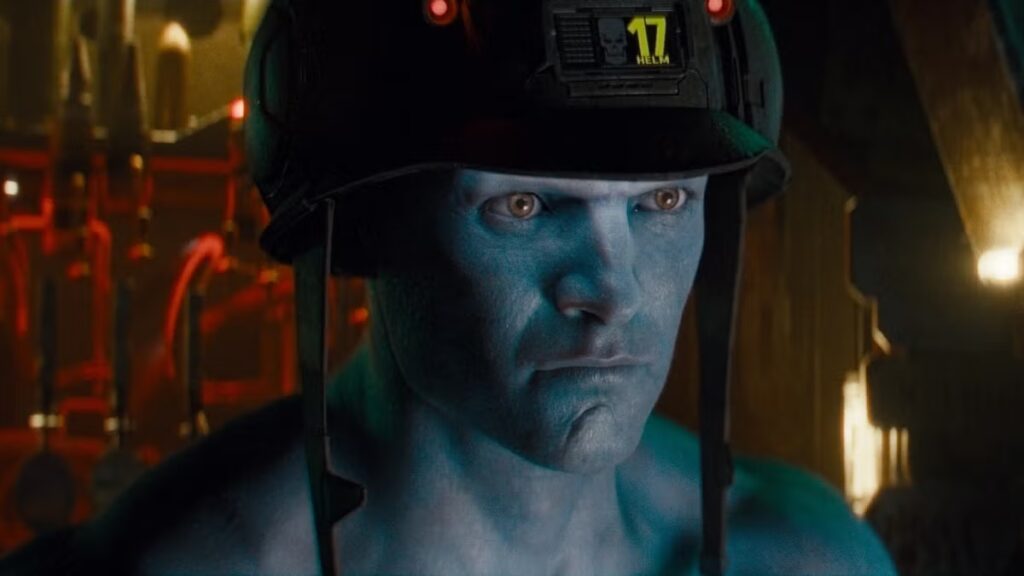
As the movie begins, a squadron of troopers is sent to the planet’s surface — this is a seemingly never-ending war, full of cruelty and despair. Soon enough, the lead trooper, 19 (Aneurin Barnard), realizes someone has betrayed them. Each of his squadmates is killed, and he keeps them alive by transferring their memory chips into different objects — a helmet, a gun and a backpack. Yes, one of the characters in this movie is an anthropomorphic backpack. Another is, essentially, a talking hat. It’s delightful.
What’s odd is that the characters take on more personality after they’ve been untethered from their corporeal forms. This might be because a bunch of blue soldiers tend to look exactly alike, which could be a commentary on the way conflict turns individuals into featureless cogs. But it’s also just a pitfall of computer-animated movies populated by a ton of similar-looking characters. This isn’t a phenomenon unique to “Rogue Trooper.” Admit it: it took you until halfway through the second “Avatar” to tell any of the kids apart. It’s okay. You’re in a safe space.
Once 19’s buddies are uploaded into their various objects, they set off on a journey to figure out who betrayed them and get them into new bodies, encountering unscrupulous scavengers (played by Jemaine Clement and Matt Berry), a fellow rebel trooper (Hayley Atwell) and a bloodthirsty assassin who looks like a rejected member of Daft Punk — and has the French accent to match (Peter Serafinowicz). And that’s just scratching the surface.
“Rogue Trooper” is gloriously overstuffed, packed with characters and bits of lore, technology and philosophizing (what does make you human, anyway? Especially after war has all but eroded your personality?). And that’s part of its charm.
There’s something about the movie that will undoubtedly be enriched by an encyclopedic knowledge of the source material, but that knowledge isn’t necessary to have a good time. There’s an appealing throwaway quality to much of the terminology and many of the ideas presented in quick succession across the movie’s just-over-two-hour runtime.
Sure, you can pick all that stuff up and roll it around, but you don’t have to. There’s always some new, whirling thing just around the corner to distract and enchant you. And something bigger to blow up.
What makes the movie more impressive is that it was entirely made independently. This is not the work of a giant studio or even a smallish studio; this was a pull-yourself-up-by-the-bootstraps type deal. And that is incredible.
Jones, of course, has experience with large-scale visual effects, having worked closely with Industrial Light & Magic and other effects houses on Universal’s mammoth “Warcraft” adaptation. But that movie came out a decade ago, which gives you a sense of how much the technology has evolved and productions have become nimbler.
Jones used the same core technology and philosophy behind “Warcraft,” employing performance-capture techniques to create lifelike creatures. With “Rogue Trooper,” though, he expanded that approach to create every character — human, alien, robot, whatever — using Unreal Engine, a game-development platform capable of rendering imagery in real time. (The Volume, the controversial “digital backlot” technology that Disney helped pioneer, is also powered by Unreal Engine.)
Does this mean “Rogue Trooper” occasionally takes on the uncanny look of an expensive video game cutscene? Sure. But that’s a feature, not a bug. Everything about “Rogue Trooper” is heightened and exaggerated. This is a movie in which Jones, serving as both writer and director, wrings real emotion out of a talking (sometimes telepathic) helmet. As the film progresses, you can feel him growing more confident in both his storytelling and the tools used to deliver it.
The third act is filled with visuals that feel lifted directly from the comic book, or at least share its strong sense of composition, dramatic lighting and bombastic design that has kept the character enduring for so long. “Rogue Trooper” even gets its own 1980s-style theme song that, if you squint, you could imagine Queen belting out on the “Highlander” soundtrack. The fact that it’s a brand-new track only makes it better.
This is a movie full of giant robots and blue soldiers and gargantuan crystals sticking out of the ground for no other reason than that they look cool. You could imagine some of the tableaus from the film airbrushed on the side of a van or on the cover of a heavy metal album from the late 1970s. This is not going to be to everyone’s taste. But the movie’s freewheeling energy (again: you can retain as much as you want and discard as much as you want), its charming characters and genuinely awe-inspiring visuals, made on a fraction of a typical Hollywood budget but just as ornate as anything in a blockbuster costing hundreds of millions more, make “Rogue Trooper” a unique and admirable object. Maybe it’s something you’d even go to war for.
The post Duncan Jones’ ‘Rogue Trooper’ Is a Hellzapoppin’ Comic Book Adaptation You’d Never Guess Was Made Independently appeared first on TheWrap.