The Trump administration temporarily lifted oil sanctions against Iran on Monday in a sharp reversal of U.S. policy that could provide Iran with an economic boon after years of having to sell at a discount to buyers who risked running afoul of the United States.
Treasury Secretary Scott Bessent said that the 60-day sanctions exemption, which authorizes the purchase of Iranian oil in U.S. dollars, giving Iran greater access to American currency, was the result of “ongoing productive” talks with Iran in Bürgenstock, Switzerland.
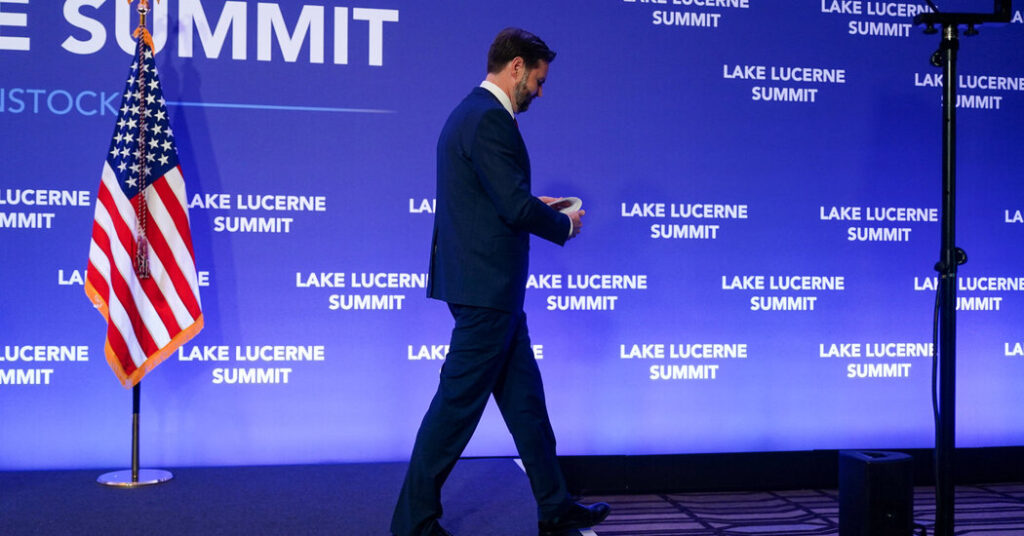
Vice President JD Vance, who has been leading the U.S. negotiating team in Bürgenstock, said that Tehran had agreed to allow United Nations inspectors to visit Iran’s nuclear sites. He called that development “a major milestone for the American people and the first step in permanently ending a nuclear weapons program in Iran.”
President Trump also made the claim, posting Monday on social media: “Everybody is fully aware that Iran will agree to have Major Weapons Inspections in order to ensure ‘Nuclear Honesty’ long into the future.”
But it was not clear if nuclear inspectors would travel to Iran. The U.N. nuclear watchdog, the International Atomic Energy Agency, did not immediately respond to the comments by Mr. Trump and Mr. Vance. And the spokesman for Iran’s foreign ministry, Esmail Baghaei, told Iran’s state news agency, IRNA, that Tehran had made “no new commitments” on nuclear inspections, and that any engagement with U.N. inspectors would take place “under existing procedures.”
At a news conference in Bürgenstock, Mr. Vance also described new lines of communication established to de-escalate tensions in the Strait of Hormuz and in Lebanon, where Israel and Hezbollah, the Iranian-backed militia, appear to have eased their attacks. Those two issues have complicated the delicate cease-fire between the United States and Iran.
“This is a work in progress,” Mr. Vance said, adding that the new process in Lebanon would help “ensure it doesn’t spiral out of control in the future.”
Overall, Mr. Vance said, the negotiations with Iran that began on Sunday had set a “very good foundation” for a final peace deal. Qatari and Pakistani officials, who mediated the talks, said that “encouraging progress has been made.”
U.N. inspections of Iran’s nuclear sites and the lifting of American sanctions would effectively restore key parts of a nuclear agreement that the Obama administration struck with Iran in 2015. Mr. Trump withdrew the United States from that agreement in 2018, and declared on social media as recently as April that it was “one of the Worst Deals ever.”
Iran began limiting nuclear inspections after Mr. Trump withdrew from the 2015 nuclear accord. Iran then blocked I.A.E.A. inspectors from its nuclear sites after Israel and the United States bombed the sites during a 12-day war in June 2025.
Iranian officials had accused the I.A.E.A. of providing political cover for those attacks because they came after the agency passed a resolution saying Tehran was not complying with its nuclear nonproliferation obligations.
The fate of Iran’s stockpile of highly enriched uranium has been unknown since the 12-day war. Iran says the material was destroyed or buried in the bombings. As part of a memorandum of understanding signed by the United States and Iran last week, Tehran had agreed to dilute that stockpile under the supervision of I.A.E.A. inspectors.
Iran has repeatedly declared that its nuclear program is only for civilian purposes and its president, Masoud Pezeshkian, said on Sunday that Iran would “never back down” from its right to enrich uranium. The head of the I.A.E.A., Rafael M. Grossi, was in Bürgenstock over the weekend, speaking to Switzerland’s foreign minister.
The memorandum of understanding also committed the Trump administration to temporarily lifting U.S. sanctions on Iran’s oil industry that it had imposed in an effort to throttle Iran’s economy. On Monday, the Treasury Department issued a 60-day license allowing the production, delivery and sale of Iranian oil as part of that preliminary agreement. The change could provide Iran with a windfall after years of being forced to sell discounted oil to buyers willing to risk breaching U.S. economic restrictions.
The Trump administration had signaled that it was prepared to provide Iran with financial rewards if it reopened the Strait of Hormuz, a critical oil shipping route that Tehran effectively closed during the war, driving up global energy prices.
“Iran has committed to free and open transit in the Strait of Hormuz and to permit International Atomic Energy Agency (IAEA) inspectors into their country,” Mr. Bessent wrote on social media on Monday.
Iranian officials said they had made progress in Switzerland in their push to access $24 billion in frozen assets. Iran’s central bank governor, Abdolnaser Hemmati, told Tasnim, an Iranian news agency, on Monday that “the necessary memorandums were signed” during the first day of talks to begin the release of assets.
U.S. officials have not confirmed if they will release Iranian assets. But Mr. Vance said that if assets are released, Iran would have to spend them on U.S. goods, such as soy and wheat, and would be prohibited from using them to fund terrorism.
“If Iranian assets are ever unfrozen, they’re going to go to make American farmers richer and to feed the Iranian people,” Mr. Vance said, crediting that idea to Jared Kushner, President Trump’s son-in-law and a key U.S. negotiator with Iran. The United States and Qatar would oversee the process, Mr. Vance added.
As he prepared to leave Switzerland, Mr. Vance said that some U.S. and Iranian officials would remain in the country to continue technical discussions. Both sides have committed to reaching a final agreement within 60 days.
“As much as this place is very beautiful, I can’t stay here for the next 60 days,” Mr. Vance said.
Iran’s top negotiators, Mohammad Bagher Ghalibaf, the speaker of the Iranian Parliament, and Abbas Araghchi, the foreign minister, arrived in Oman on Monday for discussions on a new mechanism to oversee ship traffic in the Strait of Hormuz, Iranian state media reported.
Iran has said it wants to charge “fees” in exchange for unspecified “services” it would provide in the waterway. Mr. Trump has said he wants the strait to be “permanently toll-free.”
Reporting was contributed by Shirin Hakim, Erika Solomon and Leo Sands.
The post U.S. Temporarily Lifts Oil Sanctions Against Iran, Citing ‘Productive’ Talks appeared first on New York Times.