The first time Mesfin Yana Dollar assisted with an open-heart surgery, his patient was a teenage girl from Ethiopia. She was scared and crying.
He went to her bedside at Emory University Hospital in Atlanta and spoke to her in Amharic, explaining he would be running the machine that would function as her heart and lungs during the surgery.
“I had the same surgery, and things are going to be just fine,” he told her, adding that as a teen he also had rheumatic fever that became rheumatic heart disease.
The girl told him, “You must be an angel.”
Years later, he still sees himself in every patient.
“I was on that same operating table,” Mesfin said.
Mesfin was born in a small village in Ethiopia in 1985. There was no electricity or running water, but he said he didn’t want for anything. He was surrounded by family and he was happy — until he got sick when he was around 10 or 11 years old.
At first, he felt like he couldn’t run as fast and he became short of breath easily. Then he couldn’t walk to school anymore, and his cough kept him awake at night. His parents tried tribal medicine and taking him to doctors in nearby cities. He still didn’t know what was wrong — but he didn’t want to feel like a burden to his family. One day, he got a ride to the capital, Addis Ababa, and walked into Mother Teresa’s Missionaries of Charity. That’s where he met American doctor Rick Hodes.
“I saw this young, short White man with a stethoscope hanging around his neck,” Mesfin said of Hodes, who lives in Ethiopia and helps patients with rheumatic heart disease and spine problems. “He was joking with the kids and joking with the patients.”
Hodes, Mesfin learned, is known for saving thousands of lives in Ethiopia, often finding creative ways to fund treatment for the poorest and sickest patients. Hodes has adopted children so he could put them on his health insurance and send them to the United States for spinal surgeries.
Hodes listened to Mesfin’s heart and lungs, then ordered a battery of tests before telling Mesfin that he had a serious heart condition. He would need surgery.
There was no open-heart surgery in Ethiopia at the time, so Hodes started working on finding a place for Mesfin to get surgery in the U.S.
“He showed up out of nowhere, diagnosed me, and now he’s looking into surgery,” Mesfin recalled. He credits Hodes with saving his life.
Mesfin flew to Atlanta when he was about 15 to get the surgery, which was funded in part by the nonprofit Children’s Cross Connection International. Jim Kauten, a cardiothoracic surgeon at Piedmont Heart Institute, repaired Mesfin’s mitral valve to improve his heart function. The surgery went well, and Mesfin returned to a host family nearby in Atlanta to recover.
His host happened to be a dentist, and he recommended Mesfin have his wisdom teeth pulled before returning to Ethiopia. He recovered from his surgery, had his teeth pulled and returned to Addis Ababa, where he stayed with Hodes so the doctor could continue to monitor his recovery.
Then the site of Mesfin’s wisdom teeth became infected. He developed endocarditis, a life-threatening condition. Hodes treated him in his living room with drugs, but Mesfin was getting sicker.
“I told Dr. Rick, you know what, you did everything possible,” Mesfin recalled saying. “This is the will of God, and if I die, there’s no problem now.”
Hodes said he would not let Mesfin die. He sent him back to Atlanta for emergency surgery. An ambulance met him at the airport.
Instead of a valve repair, the doctors replaced his valve with a mechanical one that would last longer. But this meant Mesfin would need blood thinners and monitoring for life — so he couldn’t go back to his home in rural Ethiopia, where care wasn’t readily available.
Mesfin’s cardiologist, Allen Dollar, decided to take Mesfin into his home — and the teen joined the Dollars’ growing family in Atlanta, which includes biological and adopted children. Mesfin eventually took the family’s name.
“It kind of reminded me of home because I have 11 brothers and two sisters,” Mesfin said. “This is as large a family as I had back in Ethiopia.”
‘A second life’
As a teenager at school in Atlanta, Mesfin studied hard to improve his English and quickly caught up to his peers.
“I was blessed with a second life,” he said.
Cardiovascular disease is a leading cause of death in young adults in Ethiopia, and rheumatic heart disease, Allen Dollar said, is a top reason. Rheumatic fever can develop when strep throat, or sometimes scarlet fever, isn’t properly treated.
“Until recently, there literally were no heart surgeons for 100 million people,” Allen said.
The hospital where he worked, Piedmont Heart Institute, started bringing more kids over for surgeries.
Allen said that Mesfin quickly adapted to the rhythms of American life.
“Mesfin was the most studious of any of our kids,” Allen said. “I never saw a kid study so much in my life.”
Mesfin knew he wanted to work in health care. He went to Georgia State University and studied to be a respiratory therapist. That’s where he met his wife, Iyerusalem. They have two sons. Mesfin worked in Atlanta for a couple of years before moving his young family to Texas. He trained to be a cardiac perfusionist at the Texas Heart Institute and eventually got a job at the Mayo Clinic in Minnesota, where his wife now works, too, as a cardiac sonographer.
At the Mayo Clinic, Mesfin, 40, runs the heart-lung machine for patients during some of the most complex open-heart surgeries in the world.
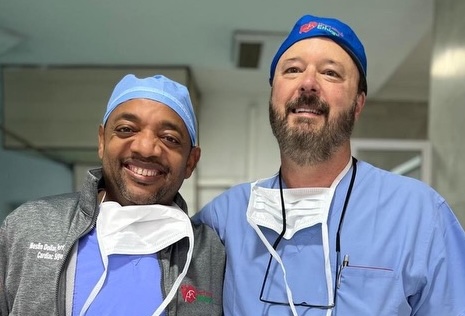
He and the surgeon who saved his life return to Ethiopia to do surgeries there through the nonprofit Heart Attack Ethiopia.
On the first surgery mission trip a couple of years ago, Mesfin surprised Kauten by showing up.
“That was especially nice in my mind,” Kauten said. “For him to be able to pay back to his community services that he received in the United States, and he was able to pay it back in Ethiopia.”
Kauten said that in addition to being a skilled perfusionist, Mesfin acts as an interpreter for the Ethiopian and American health care workers, and helps the team with a sense of cohesion. He also spends hours with students training to be perfusionists, like him, to help them learn.
As much as Mesfin loved his new life, he missed his biological family. He eventually helped bring his parents and several of his siblings to the U.S.
Allen said he is proud of his adoptive son’s professional success — but also of the person he has become.
“He has retained this spirit of gratitude,” he said. “He has never lost sight of what his life could have been and all the people along the way.”
“I’m always grateful,” Mesfin said. “I’m grateful for my family, for just being in the United States. It’s a resurrection for me. You know, I was once lost, dead, and I was resurrected and I’m living a new life.”
The post A heart surgeon saved his life as a teen. Now they perform surgeries together. appeared first on Washington Post.