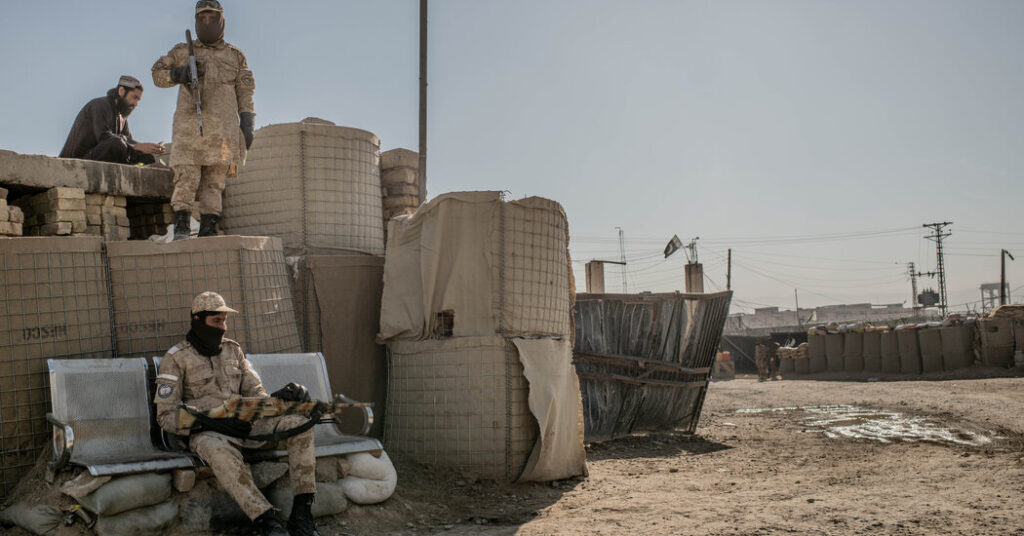
Taliban officials were issued visas to travel to Brussels, according to Belgium’s Ministry of Foreign Affairs, as they prepared for discussions with European Union officials about the deportation of Afghans from countries within the bloc.
Several nations, including Sweden, had urged that the meeting take place. It was coordinated by the European Commission, the executive arm of the European Union, but had been a point of diplomatic sensitivity and criticism.
Laurens Soenen, a spokesman for the Belgian foreign ministry, said that five visas had been issued for the Taliban delegation late on Monday afternoon. The visas are valid for a single day in Belgium, he said. Mr. Soenen would not confirm what date the delegation was expected to arrive, citing “reasons of security and public order.”
An Afghan government official said a delegation of five would travel to Brussels on Tuesday for a one-day trip aimed at discussing consular services for Afghan citizens in the European Union, including the return of some to Afghanistan. The official spoke on condition of anonymity to discuss the negotiations.
A diplomat based in Kabul who is not part of the Taliban government but who was briefed on the visit confirmed that it was scheduled for Tuesday.
The European Commission has repeatedly declined to specify when the meeting might happen. Its officials have called the visit a “technical” get-together, and have reiterated that European Union member states had asked for the meeting.
No E.U. member state recognizes the Taliban administration as Afghanistan’s legitimate authority, and E.U. officials have for weeks sought to downplay the significance of the Taliban visit.
“We’re not talking about a political visit,” Gilles Bertrand, the bloc’s special envoy for Afghanistan, said in an interview this month with Amu TV, an Afghan news outlet. “This is not changing the E.U.’s policy of not recognizing the de facto authorities.”
Some countries have already begun to expel Afghan nationals through bilateral coordination with the Afghan authorities. The Afghan official said that Germany had already expelled 120 Afghans this year.
Member states “are looking into ways to return persons who have committed serious crimes and who are possibly a security threat,” Markus Lammert, a spokesman for the European Commission, said at a news conference on Monday.
“What the commission can do is to help coordinate and facilitate contacts at a technical level,” Mr. Lammert added. “This is what we’re doing.”
Nearly five years after they swept back into power in Afghanistan, the Taliban have remained pariahs in international institutions, with no representation at the United Nations and other forums.
Only Russia recognizes the group as Afghanistan’s legitimate authority. China has maintained diplomatic ties with the Taliban administration but has grown increasingly frustrated with insecurity in the country, according to diplomats and security officials based in Afghanistan.
The European Union also has a delegation in Kabul, which it says is designed mostly to provide humanitarian aid and to advocate for the protection of human rights.
The European Commission has faced criticism over the meeting, including from Amnesty International. The decision to engage with the officials on deportations “overlooks the very real and well-documented risks that anyone returned to the country would face and their reasons for fleeing in the first place,” the group said in a recent statement.
It argued that the move “flies in the face” of the 27-nation bloc’s human rights standards.
Koba Ryckewaert contributed reporting.
The post Taliban Officials to Head to Brussels for Talks on Afghan Deportees appeared first on New York Times.