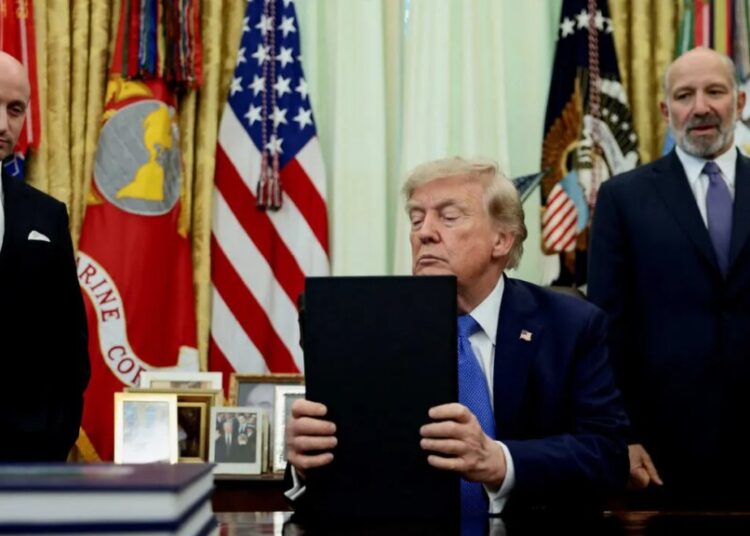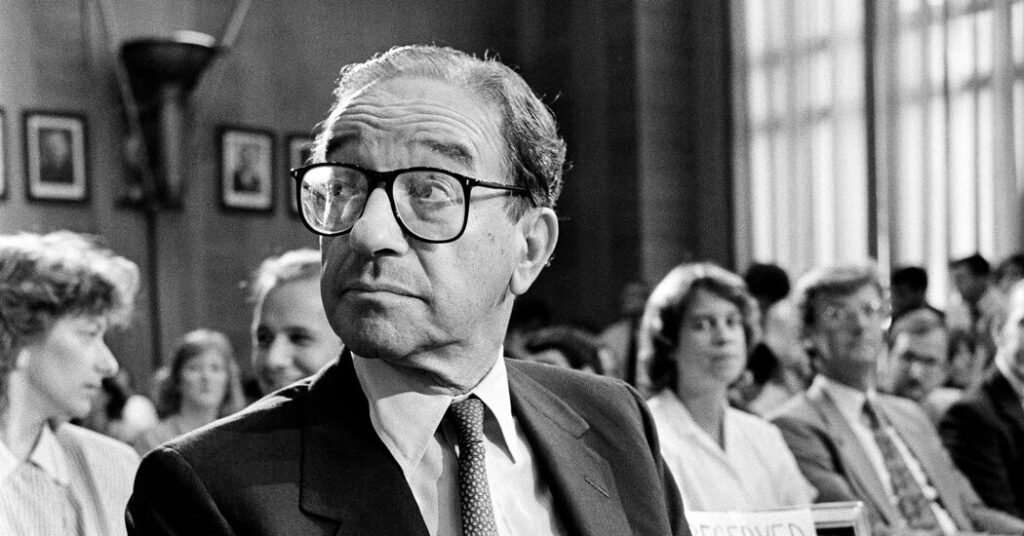
At his swearing-in ceremony as chairman of the Federal Reserve last month, Kevin M. Warsh singled out just one of his predecessors as a role model for running a central bank: Alan Greenspan, who led the Fed for nearly two decades before stepping down in 2006.
“Like Alan, I intend to fill the role of chairman with energy and purpose, just the way Chairman Greenspan did, faithful to the mission and the very best traditions of the Fed,” Mr. Warsh said in his first remarks in the top job.
Mr. Greenspan died on Monday at age 100. But Mr. Warsh, who has vowed to lead a “reform-oriented” Fed, is carrying on his legacy in a number of important ways. That spans how the Fed communicates about its plans for interest rates to the data it ascribes the most weight to make policy decisions.
Mr. Greenspan’s tenure earned him plaudits on Monday across Wall Street and Washington. In its own statement, the Fed celebrated him for guiding the central bank through “periods of significant economic expansion as well as periods of considerable stress” while helping to “establish the credibility that remains one of the Federal Reserve’s most important assets.”
Yet Mr. Greenspan’s tenure was not without its blemishes given the bubbles he allowed to form while overseeing the central bank, the most serious of which culminated in the 2008 global financial crisis.
Mr. Warsh, who inherits a uniquely complicated environment as Fed chairman, is already facing his own tests. Inflation is too high and has been above the central bank’s 2 percent target for far too long. There are potentially seismic changes being ushered in by the boom in artificial intelligence, which is fundamentally changing how policymakers think about productivity and the labor market. The Fed is also in the midst of scaling back many of the rules and regulations reining in Wall Street as financial risks are building in more opaque parts of the system, like private credit. And President Trump, who nominated Mr. Warsh for the job, has for over a year engaged in a relentless pressure campaign aimed at the central bank and its ability to set policy free of political meddling.
Seth Carpenter, who worked as an economist at the Fed under Mr. Greenspan and is now chief global economist at Morgan Stanley, said it would be a mistake to remember Mr. Greenspan, or any Fed chair, as having all the answers.
“I don’t think there’s any way you can read the Alan Greenspan record and say, ‘As long as I know what he did at every point in time, I will get everything right,’” Mr. Carpenter said. “That’s clearly not true. I think there was a lot of judgment. I think there was lot of healthy skepticism. But there was probably some luck in there as well.”
Careful Communciations
Today, Mr. Greenspan is often remembered for his cryptic pronouncements that left the public guessing about his views — an image he embraced.
“Since I’ve become a central banker, I’ve learned to mumble with great incoherence,” he told Congress in 1987. “If I seem unduly clear to you, you must have misunderstood what I said.”
But despite his oracular reputation, Mr. Greenspan moved the Fed toward greater transparency. When he took over as chairman in 1987, the central bank did not announce its policy decisions, leaving investors to parse financial market moves to determine whether or not officials had acted.
In 1994, however, Mr. Greenspan decided the Fed should begin disclosing its policy decisions publicly. In 1999, he directed the central bank to issue announcements after every meeting, even if rates were left unchanged.
“He didn’t want the markets confused about what we were doing,” said Donald Kohn, who worked alongside Mr. Greenspan and later served as a vice chair of the Fed. Mr. Greenspan was even inclined to provide so-called forward guidance, meaning signals about what the central bank might do with rates. “It was short-term,” Mr. Kohn said. “He was highly skeptical of long-term forward guidance.”
Mr. Greenspan’s successors expanded on this pivot and embraced significantly more transparency. By 2012, under Ben S. Bernanke, the Fed was releasing officials’ estimates for rates in the years ahead in what became known as the “dot plot.” And shortly after Jerome H. Powell took over as chair in 2018, he introduced news conferences after each of the Fed’s eight policy meetings. Previously, the news conferences had been held quarterly.
Mr. Warsh, who served as a Fed governor between 2006 and 2011, wants the central bank to reverse course on some of these changes so that officials send fewer signals about the outlook. He tested that approach last week at his first policy meeting to mixed reviews. At that meeting, the Fed opted to hold rates steady despite mounting support internally for higher borrowing costs this year to quell inflation.
The central bank’s condensed policy statement was cheered for its succinctness and simplicity. But Mr. Warsh’s decision to dodge any questions related to his thinking about the economic backdrop and how the Fed should respond if the circumstances were to change sowed some doubt about his handling of the job.
Mr. Warsh took over as chairman amid concerns about how independently he would operate from the president, who has long called for the Fed to lower rates. Mr. Warsh made clear that the central bank’s most important task would be getting inflation under control. But for Michael Feroli, chief U.S. economist at JPMorgan who worked as a Fed economist during Mr. Greenspan’s tenure, that independence would have been much more assured if Mr. Warsh explained his thought process.
“I could buy the independence a lot more if he told me, ‘These are the arguments, the pluses and the minuses,’” Mr. Feroli said.
‘Greatest Fine Tuner in History’
Mr. Greenspan, who ran a small economic consulting firm before his time at the Fed, was known for his faith in offbeat indicators that he believed could provide signals about the direction of the economy before better-known measures like the unemployment rate and gross domestic product. He tracked the price of scrap metal as an early signal of industrial production; sales of men’s underwear could provide a window into consumer sentiment. (During tough economic times, men would try to get a few more uses out of their old boxer shorts before replacing them, Mr. Greenspan theorized.)
“He was masterful in his inclinations to try to come up with better ways of measuring what was going on,” said Peter Hooper, who worked as an economist at the Fed under Mr. Greenspan and now leads research at Deutsche Bank. “He had just a knack for getting a sense of which way the economy was leaning at a time when some of the macro series were pointing in a different direction.”
Perhaps the most notable example of Mr. Greenspan trusting his instincts came in the late 1990s, when growth picked up and the unemployment rate fell. Such conditions would ordinarily lead the Fed to raise interest rates to try to prevent a burst of inflation.
Mr. Greenspan, however, argued that computing technology was causing a productivity boom, allowing the economy to grow more quickly without causing prices to rise. He resisted raising rates until near the end of the decade. Productivity data eventually bore out his instincts.
“Greenspan’s innovation wasn’t looking at more data; it was looking at the right data — finding inconsistencies in what he saw and working to resolve them,” Mary C. Daly, president of the Federal Reserve Bank of San Francisco, recalled in a February speech. His success, she added, resulted from his “willingness to listen to businesses, hear their ideas, use data and evidence to test them, and invite others to do the same.”
Alan Blinder, who served as Mr. Greenspan’s vice chair between 1994 and 1996, called him “the greatest fine tuner in history.”
“Greenspan will, justly, be remembered for his expert and successful steering of monetary policy for 18 years, especially in the late 1990s, when he saw the productivity gains before others,” Mr. Blinder said.
Lesson for the A.I. Boom
Mr. Warsh has argued that Mr. Greenspan’s approach to the ’90s carries lesson for policymaking in the present day. He has said that artificial intelligence, like the personal computer in Mr. Greenspan’s era, will allow for faster growth, and that, as a result, the Fed will be able to keep interest rates lower without allowing inflation to spin out of control.
Many economists, including some inside the Fed, question those parallels, however. They argue that the wave of A.I. investments could be driving up inflation in the short-run, even if the technology leads to faster productivity growth over time. And they point to differences between Mr. Greenspan’s era and today, noting that in the ’90s, globalization and other forces were pushing down inflation.
Some economists also worry that the A.I. boom could more closely resemble a different episode from Mr. Greenspan’s tenure: the dot-com bubble.
Mr. Greenspan famously warned of “irrational exuberance” in the stock market in a 1996 speech at the American Enterprise Institute. Investors continued to pour money into unprofitable internet companies for three more years before the bubble burst, sending stocks plummeting and helping to cause a recession.
The housing bubble of the following decade was even more damaging, setting off a global financial crisis and causing the worst recession since the Great Depression. That crisis struck after Mr. Greenspan left the Fed, but critics, and even some supporters, have long argued that his faith in markets and his skepticism of government regulation allowed risks in the financial system to grow unchecked for too long.
“His weak spot, sadly, was bank regulation and supervision, where his deep belief in laissez-faire led him to ignore problems that were building up in the financial system in the years prior to the 2007-2009 financial crisis,” Mr. Blinder said. “That left a big blot on an otherwise stellar record.”
Mr. Kohn, a former Fed vice chair, drew parallels to the shift underway across regulators, who have embraced much more lenient rules for Wall Street after years of trying to tighten the reins during the Biden administration.
“I’m concerned about how far it’s swinging back and whether the authorities doing the swinging back are taking account of the potential systemic risk,” Mr. Kohn said.
The post Warsh Looks to Greenspan in Designing Approach to Fed Chairmanship appeared first on New York Times.