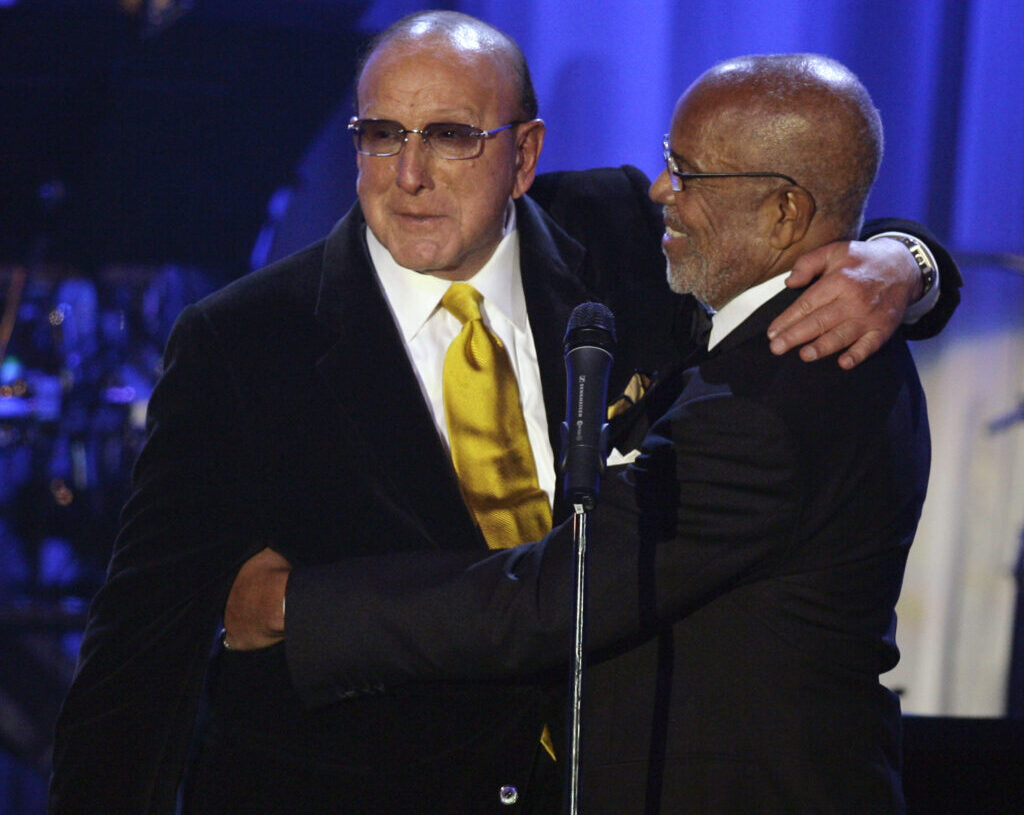
When Clive Davis showed up at the Monterey Pop Festival in 1967, he was a 35-year-old New York corporate lawyer and the newly appointed head of Columbia Records. Knowing “nothing about music,” he said, had not disqualified him from running the staid record company best known for classical recordings, Mitch Miller sing-along pop novelties and Broadway cast albums.
Grainy film footage from the festival shows him in the crowd, with his black glasses, receding hairline and a white V-neck tennis sweater. Amid the long-haired, tie-dyed “Summer of Love” hippies, “I was the one who looked weird,” Mr. Davis said in a 2017 Netflix documentary about his life. “I was blown away.”
The second act on the stage that day was Big Brother and the Holding Company, a San Francisco rock band fronted by Janis Joplin. “She was hypnotic,” Mr. Davis recalled of the then little-known singer. “I felt my spine tingle, my arms vibrate. I was overcome with emotion. This wasn’t just a social revolution, this was a musical revolution.”
Mr. Davis persuaded Joplin to sign a contract with Columbia, then politely declined her offer for a celebratory sexual encounter, he wrote in an autobiography. She became the first of a legion of artists he would launch or rejuvenate into superstardom over a five-decade career in entertainment. The roster included Barry Manilow, Simon & Garfunkel, Bob Dylan, Johnny Cash, Aretha Franklin, Bruce Springsteen, Billy Joel, Aerosmith, Barbra Streisand, Miles Davis, the Grateful Dead, Patti Smith, Whitney Houston, Alicia Keys and Carlos Santana.
Mr. Davis, 94, an unlikely tastemaker who stoked the star-making machinery longer and more successfully than most of his rivals and became one of the most powerful executives in the recording industry, died June 22, his family posted on social media.
“To the world, our father was the iconic music legend whose vision, instincts, and relentless pursuit of excellence shaped the soundtrack of countless lives,” Mr. Davis’s family wrote on Facebook. “He discovered, mentored, and championed the greatest artists in modern music history, leaving an indelible mark on culture that will endure for generations.”
A winner of multiple Grammy Awards and inductee of the Rock and Roll Hall of Fame, Mr. Davis ran Columbia Records and later Arista Records, the latter a small label he built into an industry powerhouse. During his 25 years at Arista, he guided 200 singles to No. 1 on the Billboard charts. In 2000, his final year at Arista before being pushed aside, the company had more than $1 billion in revenue.
Eye for musical talent
Mr. Davis had an uncanny knack for spotting and adopting musical trends and embracing emerging young talent. “He has the mind of a banker and the ears of a teenager,” Manilow once said.
Jann Wenner, founder of Rolling Stone magazine, said in an interview for this obituary that Mr. Davis “was instrumental in bringing modern white rock of my generation to the forefront” and developed a remarkable ear for music.
“Clive once told me that he would take all the records in the top 100 home every weekend, and he listened to every single one of them,” Wenner said. “I never heard of anybody doing that so methodically. He kept abreast of everything commercial that was going on. He just loved it.”
Music was decidedly not in his blood, Mr. Davis readily admitted in his 2013 autobiography, “The Soundtrack of My Life,” co-authored with Anthony DeCurtis. His taste in high school ran toward Bing Crosby and Frank Sinatra, and rock-and-roll had no appeal at all. He credited his visit to the Monterey Pop Festival as a turning point. Going there, he wrote, “I didn’t realize at all that I possessed skills that might ultimately distinguish me: the ability to recognize and nurture new artists; to help those artists create their best work; to bring that work to the marketplace and have it make a powerful impact.”
He was instrumental in turning 19-year-old Houston into an international star after signing her in 1983, and he shepherded her career until her accidental drowning in a hotel bathtub, in 2012, on the day of Mr. Davis’s annual pre-Grammy party in Los Angeles. She had been a close friend — and was his most successful protégé, even though drug addiction and the pressures of fame undermined her career — and her death affected Mr. Davis deeply.
Mr. Davis’s detractors criticized his obsession with hits and chart-topping singles, which they said he sometimes pursued at the cost of artistic considerations.
“His energy, his testosterone, all his hormones were ignited by having the biggest No. 1 records,” singer-songwriter Carly Simon, an Arista artist who generally lauded Mr. Davis’s talents, told the New York Times in 2017. “He is on the side of the winner at all costs, and the cost can be very high.”
At Columbia, Mr. Davis turned the company into a premier rock label and brought millions of dollars in revenue to CBS, the parent company. He was stunned when, in 1973, he was called into the office of Arthur R. Taylor, then CBS president, and fired for allegedly using $94,000 in corporate money to renovate his Central Park West apartment and for his son’s bar mitzvah.
Mr. Davis denied the allegations. He accused a personal assistant of forging signatures, falsifying invoices and committing other misdeeds involving his corporate account without his knowledge. His ouster coincided with housecleaning at CBS amid a larger grand-jury probe of payola and drugs — “drugola” — in the record business.
In 1976, Mr. Davis pleaded guilty in U.S. District Court in Manhattan to one count of tax evasion for having failed to report $8,800 that the record company had paid for non-business-related trips. Other charges were dismissed, and he received a suspended sentence and paid a $10,000 fine. He later called the experience “the most humiliating moment of my life.”
Mr. Davis staged a comeback by writing (with journalist James Willwerth) “Clive: Inside the Record Business” (1974), a best-selling account of his time in the music industry. That same year, he was lured to the failing Bell Records division of Columbia Pictures (no relation to Columbia Records).
He rechristened the company Arista, the name of his Brooklyn high school honor society, and set out to build a top-notch team of industry veterans to grow the label. He signed artists such as Gil Scott-Heron, Lou Rawls and Melanie, holding on to only two entertainers in Bell’s lineup — Melissa Manchester and the talented but still largely undiscovered Manilow.
Mr. Davis embarked on an ultimately successful effort to remake Manilow into a defining pop star of the 1970s. This undertaking involved persuading Manilow to record songs that he hadn’t written but that could be propelled into hit singles. Among them was “Brandy” — soon renamed “Mandy” — that charted in 1975.
In a key moment in their sometimes contentious relationship, Mr. Davis handed Manilow a number called “I Write the Songs.” Manilow, who considered it ludicrous to record a song with such a title when he had not written it, initially refused. His resentment festered and eventually led to an argument that ended with Mr. Davis declaring, “Well, if you were Irving Berlin, we would know it by now!”
Even Manilow conceded Mr. Davis’s inerrant judgment when it came to matching a voice to music. “Clive believed it would be a number one record for me, that it would be a signature song,” he told Newsday in 1990. “And he was right.”
Profound loss
Clive Jay Davis was born in Brooklyn on April 4, 1932. His father was an electrician and, later, a traveling tie salesman. His mother, with whom Mr. Davis was extremely close, died of a cerebral hemorrhage at 47 when Mr. Davis was 18 and a scholarship student at New York University.
“It was the most profound loss of my life,” he wrote in his memoir. Eleven months later, his father died at 56 after a heart attack. Mr. Davis later said that losing both parents at such a young age left him with the sense that anything he loved and embraced in life could be taken away in an instant. But those losses also served to propel Mr. Davis’s career, leaving him with a resilient survivor’s instinct to push forward.
After graduating from NYU in 1953, Mr. Davis received a scholarship that enabled him to attend Harvard Law School. He completed his law degree in 1956 and briefly worked at a New York law firm whose clients included CBS and its then-chairman, William S. Paley. Mr. Davis joined Columbia Records in 1960 as an in-house counsel.
.
In his autobiography, Mr. Davis revealed that he was bisexual and, later in life, had been in a long monogamous relationships with male partners.
In an industry replete with ego and massive financial rewards, Mr. Davis’s longevity was remarkable. At Arista, he reinvigorated R&B singer Franklin’s stalled career, branched into rap and hip-hop and launched Patti Smith when she was a young poet. He also survived the uproar that ensued when it was discovered that the German R&B duo Milli Vanilli hadn’t done the singing on its debut album and had lip-synched songs during TV and concert appearances.
“Clive just seems to be ever-growing,” said Franklin in a 1996 Los Angeles Times interview. “He loves the music and appreciates his artists. He’s not just kicking back somewhere counting his money. He is a consummate record man who is constantly involved.”
But in 2000, Mr. Davis was unexpectedly replaced by the head of BMG Music, Arista’s parent company, to make room for a younger leader. Mr. Davis refused to take a secondary role and threatened to leave. Startled at the thought of losing him, the head of BMG’s North American operations immediately offered to let Mr. Davis launch his own label with an initial investment from BMG of $150 million.
Mr. Davis would get 50 percent of the profits, and he could take five major Arista artists with him. He founded J Records (after his middle name). In 2008, Mr. Davis became chief creative officer for Sony Music Entertainment.
He liked to point out that he hadn’t dreamed of a career in music, especially one with such an extraordinary outcome. A 2001 Washington Post profile noted that he never stopped feeling “ravenous” for winning singles. “It’s always like the first day,” he said, “and it’s always like the first year. It’s not a chore, it’s just a particular mental attitude. I take none of this for granted.”
The post Clive Davis, recording executive and star-maker, dies at 94 appeared first on Washington Post.