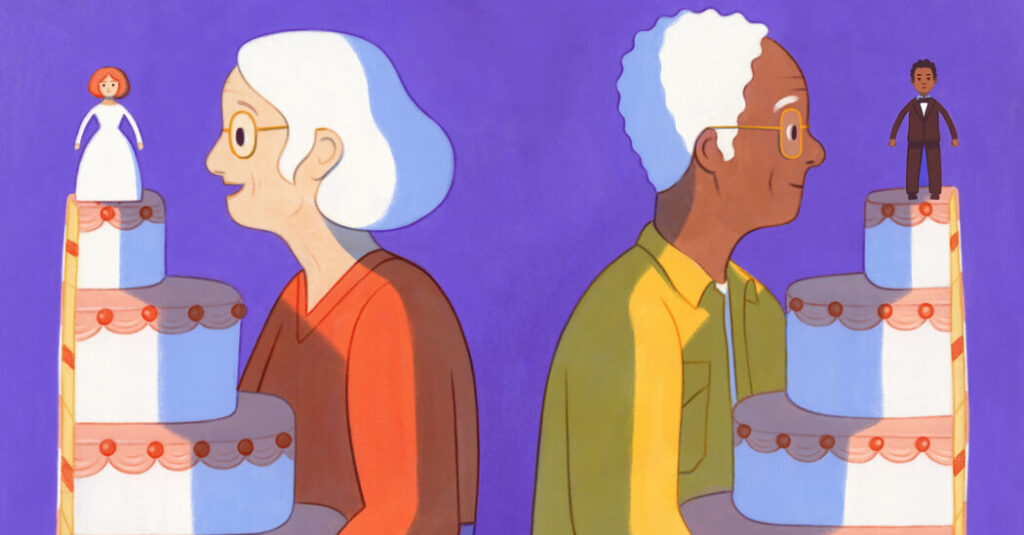
In 2021, after more than 30 years together, Alan Hickenbottom and his wife filed for divorce — but he still believes their marriage was a success.
Their early years together were fun and exciting. They bonded over a shared love of books and art, and a desire to do good things in the world. (Mr. Hickenbottom, 67, worked in renewable energy for decades; his ex was a teacher and a school librarian.)
Then they threw themselves enthusiastically into raising their two children, he said. But as often happens, when the kids left for college, Mr. Hickenbottom realized that he and his wife were more like colleagues and roommates than romantic partners.
Two years of marriage counseling didn’t fix things.
“I didn’t want to devalue the life that we built, but that was not how I wanted to live,” Mr. Hickenbottom said.
He might have another 40 years, he thought. “What do I want to do?” he recalled asking.
Mr. Hickenbottom is hardly the only 60-something who has decided to split up because of that line of existential questioning. Rates of “gray divorce” — splits among those 50 and older — have risen sharply in the United States, doubling between 1990 and 2010. Though those rates have stabilized since the pandemic, nearly 40 percent of divorces today occur between people 50 and older.
While divorce rates have been dropping across age groups in recent years, the exception to that trend is among Americans ages 65 and up. The reasons are complicated, but it’s becoming clear that some Gen Xers and baby boomers are increasingly unwilling to stay in what sociologists call “empty-shell marriages.”
These are relationships in which there is no real connection or vitality, where one or both partners are not happy, said Susan Brown, a professor of sociology at Bowling Green State University who co-directs the National Center for Family and Marriage Research. Traditionally, such couples often decided to stay together for the sake of their kids, in view of economic stability or out of fear of stigma.
Now, that may be a thing of the past.
“This generation is living longer than prior generations,” she said, “and that may be changing the calculus about whether you want to stay in a marriage that is not that meaningful anymore.”
Living longer with higher expectations
Longer life spans are driving older people’s decisions to divorce, said Justin Garcia, the executive director of the Kinsey Institute in Bloomington, Ind., and the author of “The Intimate Animal: The Science of Sex, Fidelity, and Why We Live and Die for Love.”
“We as a species are in longer relationships than our ancestors ever were,” he said. “Lifelong monogamy maybe meant a few decades.” Now, though, there are couples who have been together for 50, 60 or even 70-plus years.
“That is evolutionarily unprecedented for our species,” Dr. Garcia said.
At the same time, societal expectations for what marriage can or should be have changed. Baby boomers who got married relatively young — in part because that was simply the norm — are now living through a time when marriage is seen as a vehicle for love and self-actualization, said Claire Kamp Dush, a professor of sociology at the University of Minnesota.
“We’re not just partnering based on this idea that someone’s going to be the breadwinner and someone’s going to be the homemaker,” she said. It is possible, she added, that our collective tolerance for staying in just a so-so relationship “is going down.”
Ruchi, 58, hit that moment when her husband forgot her 50th birthday. She didn’t want a party or presents, but she expected she would maybe receive a card, or a home-cooked dinner. By 9:30 p.m., though, it became clear that her husband of 20 years had simply forgotten, said Ruchi, who asked to use only her first name because she is in the process of negotiating her divorce.
“You’ve put all these things aside because you’re a mom and you’re taking care of a family,” she said, noting that though both she and her husband have always worked — in research and science — she was the default parent to their two children, who are now teenagers. “Then you think: Is that all I am good for? When did I stop being a person?”
Menopause lent a kind of fury to Ruchi’s midlife turmoil. “I actually thought I was crazy, because I was irritated at everything,” she said.
Menopause “is not just about losing estrogen; it’s about losing tolerance,” said Rebecca Thurston, the associate dean for women’s health research at the University of Pittsburgh School of Medicine.
“You’re doing all the things,” she continued. “You’re taking care of the kids. You’re taking care of the parents. You’re taking care of the partner.” At the same time, many of her patients ask themselves: Is this really all there is?
Dr. Thurston has lost count of how many women have told her: “I want to get in the car and drive,” she said. “I just want to leave it all behind.”
A third act with more options
Of course, divorce is expensive, and older couples who are retired or nearing retirement age have a lot to lose financially. Some choose to end their shell marriages, but not to get divorced.
That’s the case for Gale Emigh, 73, who separated from her husband of 40 years six months ago. They have agreed to avoid a “messy and costly” divorce, she said, instead asking their financial adviser to pay them equally every month from their shared pot. She is staying in the house they bought together in Sequim, Wash.; he has moved into an apartment in California, where the pair spent most of their lives.
Their marriage, though not necessarily unhappy, had become “stagnant,” Ms. Emigh said. Sometimes, she could coast along, ignoring the emptiness she felt. Other times, it smacked her in the face, like at their son’s wedding. She had such a good time, Ms. Emigh said — laughing, dancing, practically overflowing with joy — only to realize she had spent almost no time with her husband the whole day. Back at home, she often felt lonely even when her husband was sitting next to her.
“I finally came to terms with: This is what it was going to be if we stayed together,” she said.
The period following a later-in-life separation, though, is not always easy to navigate. Dr. Brown noted that while younger adults tend to recover within a year or two of divorce, older adults tend to take more of a financial and psychological hit. Her research has also found that men are more likely to re-partner after a gray divorce, partly because women tend to outlive them, shrinking the pool of available partners. But there is also evidence that women are less interested in re-marrying after divorce than men.
Certainly, online dating has changed the equation for older adults coming out of long marriages, offering at least the perception of options. According to a 2023 Pew Research Center report, 14 percent of Americans in their 60s, and 12 percent of those 70 and older, say they have used a dating app.
Mr. Hickenbottom “dated like crazy” after he divorced, he said, before meeting his fiancée, whom he has been with for two years. (He and his ex-wife remain friendly, he said.)
Since her separation, Ms. Emigh said she hasn’t been remotely interested in remarrying — and takes joy in many types of relationships, particularly her female friendships — though she is open to finding a romantic connection. “Comfort, laughter, sharing” are what she still craves, she said.
Ruchi, on the other hand, said she didn’t know if she would ever date again. That may change with time — it’s still early days — but she said she didn’t need to find someone else in order to feel complete. She has been saying yes to the kinds of work trips she once passed up, and cooking spicier foods than her husband liked again — a small act “that feels huge,” she said.
“There was a time when I was like, ‘Oh my gosh. How are we going to do this? How is this going to work? What is my family going to say?’” she said.
But, she reminded herself, “I am a strong person. I am a capable person. My family is very, very, very important to me, but I am more than my kids and my husband. I think I kind of forgot that.”
The post Older Adults Are No Longer Staying in ‘Empty-Shell’ Marriages appeared first on New York Times.