LONDON — British Prime Minister Keir Starmer announced Monday that he will resign, succumbing to pressure from lawmakers within his own Labour Party, after crushing losses in nationwide local elections last month triggered a mutiny.
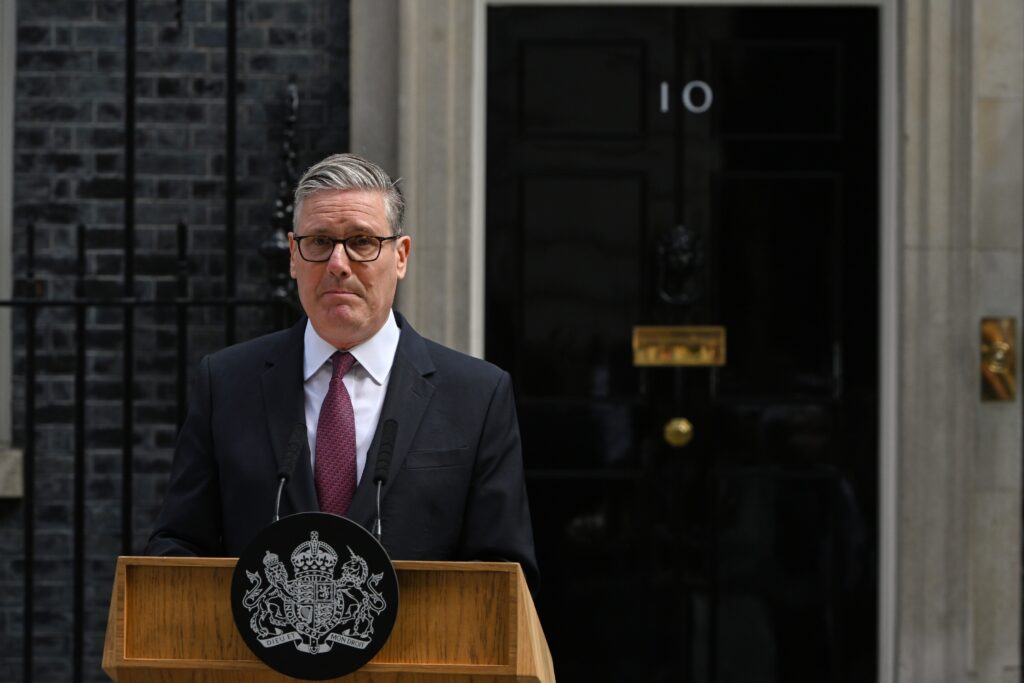
An emotional Starmer said he would leave office after a new Labour leader — and therefore a new prime minister — is selected in a leadership election that will begin in July. Standing outside 10 Downing Street, Starmer recounted his government’s achievements during its two years in office and then grew tearful after saying that he had informed King Charles III of his decision Monday morning and would soon devote himself to his own family.
“The question my party is asking now is whether I am best placed to lead us into the next general election,” Starmer said with his staff and some — but notably not all — of his cabinet looking on. “I have heard the answer of my parliamentary party to that question, and I accept that answer with good grace.”
Starmer, 63, had struggled to define his agenda while contending with economic stagnation, fallout from the Epstein scandal and turbulent relations with President Donald Trump.
The discord with Trump was punctuated by a final jab on Sunday when the U.S. president proclaimed that Starmer would resign — shoving the British leader to the door before Starmer had made any announcement of his own.
Starmer’s surrender came fast on the heels of a special parliamentary election in Makerfield on Thursday, in which Greater Manchester Mayor Andy Burnham won a decisive victory, returning him to the House of Commons and positioning him to mount a Labour Party leadership challenge that Starmer seemed all but certain to lose.
Burnham’s victory gave him momentum in a challenge to Starmer that has been brewing for months. And his status as a front-runner neared shoo-in levels on Monday when another likely candidate for a leadership race, former Health Secretary Wes Streeting, pulled out of contention and threw his support to Burnham.
To become the new Labour leader, any challenger must first secure the written backing of at least 81 of Labour’s 403 elected members of Parliament. Once that threshold is crossed, the contest goes to a broader vote of party members who rank candidates in order of preference until one of them clears 50 percent.
Starmer could have effectively anointed Burnham as his replacement, avoiding what could be a bruising intraparty battle for the top job. But some have argued that Labour, and the country, would be better served by a leadership contest that demanded candidates defend their vision for leadership.
Starmer opted for an open contest, saying he would instruct Labour’s executive committee to begin accepting nominations on July 9 with an eye to completing the election in time for a new prime minister to take office by the end of parliament’s summer recess in September.
It was unclear if that schedule would hold given the accelerating support for Burnham among lawmakers.
“He’s the next prime minister,” said Tim Bale, a professor of politics at Queen Mary University of London. “It’s going to be something like a coronation.”
Starmer’s resignation extends a remarkable era of political turmoil in Britain and will usher in the country’s seventh prime minister in the past 10 years.
Starmer spent less than two years at No. 10 Downing Street. His departure ends a troubled tenure marred by failures to deliver on campaign promises, ousters of senior advisers, criticism of his handling of the wars in Ukraine and Iran, and recriminations over his appointment as U.S. ambassador of former Labour power broker Peter Mandelson, whose entanglement with Jeffrey Epstein, the convicted sex offender, is now under investigation by the Metropolitan Police.
These and other missteps contributed to the undoing of a staid politician who led Labour to a landslide victory in 2024, promising competence and centrist polices that he said would reinvigorate the British economy and shield the country from the polarizing forces tearing other democracies apart.
After nearly 15 years of Conservative Party rule, Labour also benefited in that race from widespread unhappiness over the economic malaise that followed Brexit, the country’s Tory-led departure from the European Union.
And yet Starmer soon became caught in the same currents of voter discontent that he had exploited. Starmer, a former prosecutor who lacked the flair of Britain’s most famous prime ministers, faced persistently abysmal approval ratings and barely concealed scheming in the upper ranks of his party.
More broadly, Starmer’s resignation underscores the extent to which British politics is entering a turbulent new period in which insurgent parties — including Reform UK, whose anti-immigrant posture echoes the MAGA movement in the United States, and the populist Green Party — are gaining strength amid eroded support for the Conservative and Labour parties that have dominated U.K. politics for generations.
The bloodbath in local elections suffered by Labour on May 7 — a loss of more than 1,500 of the approximately 2,600 seats it held on local councils and other bodies — was widely expected. And with national parliamentary elections not due until mid-2029, Labour retains a strong majority in the House of Commons. But rank-and-file MPs quickly called for Starmer’s head, fearing a potential wipeout if they did not replace him in time for a dramatic turnabout.
On paper, at least, the looming leadership contest looked to be Burnham’s to lose even before Streeter pulled out Monday.
Burnham’s decisive win last week in Makerfield, a working-class constituency Labour strategists feared it might lose outright to Reform UK, handed him a fresh mandate as the figure best positioned to blunt the new right-wing party’s advance in the postindustrial seats Labour needs to hold onto power.
Burnham’s camp has said he has already secured the backing of more than 201 Labour MPs, half the 402-member parliamentary party. That tally, if it holds, would make him the prevailing favorite from the outset. Coming from local politics, he is seen as largely untainted by the compromises of Starmer’s government.
Streeting, 43 who served as health secretary under Starmer, resigned his Cabinet post last month to launch his own leadership bid. His quick endorsement suggested that Burnham was building perhaps insurmountable support.
Streeting, who hails from the more centrist Labour wing identified with former prime minister Tony Blair, would have challenged Burnham from the right, and had built a profile as a sharp-elbowed media figure willing to break publicly with Starmer’s government. That’s a contrast to Burnham’s more staid, institutional brand of working-class populism, built over three terms as mayor of Greater Manchester and 16 years before that in the House of Commons.
Streeting has stressed the need for Labour to win back swing voters defecting to Reform UK and had pointed to his record of NHS reform as proof of a pragmatic governing style. In withdrawing, he acknowledged that a divisive leadership contest could prove costly by stressing disagreements rather than unity.
“We could spend the summer exaggerating small differences, or we can roll up our sleeves and help him to deliver the change our Party and our country needs,” Streeting said in a statement.
Starmer’s struggles were compounded by strains in the “special relationship” between Britain and the United States.
Starmer’s early attempts to appease Trump upon his return to the White House — including a trip to Washington in which he carried an invitation from King Charles III for an “unprecedented” second state visit to England — did not shield Britain from steep tariffs imposed by Trump or from a steady stream of insults.
In recent weeks, Trump has lashed out at Starmer, saying he is “no Winston Churchill,” for his refusal to thrust Britain’s military more directly into the U.S.-Israeli war with Iran.
Seeking to avoid the fate of Blair, whose support for the 2003 U.S. invasion of Iraq is still seen as a stain on his legacy, Starmer initially refused to allow U.S. forces to stage attacks on Iran from British bases. He later softened that position to allow “defensive” strikes meant to blunt Iran’s ability to retaliate on British territories or allies. Starmer’s shifting positions added to perceptions of him as indecisive.
Still, it was another U.S. crisis — the Epstein scandal — that seemed most damaging. Starmer has no known direct ties to Epstein but was pilloried for the ambassadorial appointment of Mandelson, who maintained ties with the Epstein long after his 2008 conviction on solicitation of prostitution and shared with him sensitive U.K. government documents, according to U.S. Justice Department files.
In February, police arrested Mandelson on suspicion of misconduct in public office, raising the pressure on Starmer over his judgment in appointing him. Weeks earlier, a government review had found evidence in the Epstein files that sensitive information about the 2008 financial crash appeared to have been shared with the financier by a government official. Mandelson was a government minister at the time.
Starmer’s resignation is likely to add to a general sense that the political fallout related to Epstein has been far more severe in Britain and Europethan in the United States, where neither Trump nor other American politicians revealed to have had close ties with Epstein over the years have faced significant consequences.
In Britain, Starmer faced calls for his resignation. And Andrew Mountbatten Windsor, a brother of King Charles, was stripped of his royal titles and forced to leave his longtime royal residence following new revelations about his own Epstein connection.
Starmer weathered those initial calls to step down, but ultimately bowed to reality as the numbers among Labour’s rank-and-file turned against him. In his resignation speech on Monday, he claimed credit for bringing Labour back from the dead.
“Six years ago, I inherited a Labour Party that was politically, financially and morally bankrupt,” Starmer said. “I was told time and time again that my part was finished, that we were consigned to history, that a majority at the general election let alone a landslide majority was impossible. But we proved those people wrong.”
Leo Sands contributed to this report.
The post U.K. Prime Minister Starmer to resign as Labour Party seeks reboot appeared first on Washington Post.