Subscribe here: Apple Podcasts | Spotify | YouTube | Overcast | Pocket Casts
Who gets to be an American? It’s a simple question—one that was answered when Congress passed, and the states ratified, the Fourteenth Amendment to the Constitution in 1868. “All persons born or naturalized in the United States, and subject to the jurisdiction thereof, are citizens of the United States and of the State wherein they reside,” the amendment’s first sentence states. Thirty years later, in 1898, the Supreme Court cemented this principle in United States v. Wong Kim Ark.
But last January, on President Trump’s first day in office, he signed an executive order that would challenge the Court’s precedent—and, it has been argued, the purpose of the amendment. “The Fourteenth Amendment has never been interpreted to extend citizenship universally to everyone born within the United States,” the president’s order says. It would deny citizenship to babies born to parents who lack legal justification for being in the country—or born to those who are here only temporarily. The order was challenged in court within 24 hours.
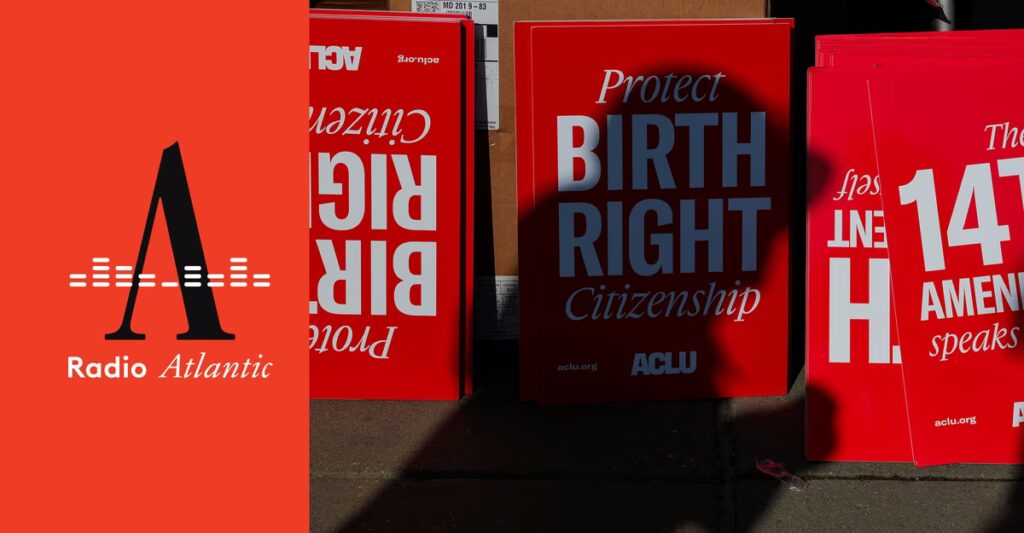
Now the Supreme Court will decide whether the Constitution means what it says; it will decide whether “all persons born or naturalized in the United States”—save for those who are here under unique circumstances, such as children of foreign dignitaries—are citizens of the union. This week on Radio Atlantic, I’m joined by Atlantic staff writer Adam Serwer to explore birthright citizenship and what it means to be an American.
The following is a transcript of the episode:
Adam Serwer: So you think about today’s discourse about birthright citizenship and these, you know, sometimes veiled, sometimes overt assertions that America is a white man’s country. You know, the people who wrote the Fourteenth Amendment did not believe that. They insisted that that was wrong, and they inscribed the equality of man into the Constitution in a much more sincere way than the original Founders.
Adam Harris: I’m Adam Harris. This is Radio Atlantic. And this is our first Monday episode of the show.
Today, we need to talk about birthright citizenship. The Supreme Court has before it a case that could redefine who gets to be an American. That’s not hyperbole.
Justice Neil Gorsuch: So you’re really at the end of the day, then this is a straight up constitutional ruling you want from this Court, win, lose, or draw.
Harris: The citizenship clause of the Fourteenth Amendment to the United States Constitution is brief—28 words: “All persons born or naturalized in the United States, and subject to the jurisdiction thereof, are citizens of the United States and [of the State] wherein they reside.”
For more than 150 years since the amendment was ratified and adopted in July 1868, the clause has animated a basic idea: If you were born in the United States, then barring very rare circumstances, you are a United States citizen. On President Trump’s first day in office in January 2025, he signed an executive order called “Protecting the Meaning and Value of American Citizenship.”
The order would deny citizenship to babies whose parents did not have legal status in the U.S. or whose parents are only in the country temporarily. States sued immediately. “The 14th Amendment says what it means, and it means what it says—if you are born on American soil, you are an American. Period. Full stop. There is no legitimate legal debate on this question,” Connecticut Attorney General William Tong said at the time.
The Supreme Court, which only takes up about 1 percent of the thousands of petitions it receives each year, decided to hear the case anyway. They listened to oral arguments this April, and soon they’ll decide whether the law is constitutional. Will the justices go against the precedent the Court set a century ago? And what does it say that the justices are even considering a challenge to birthright citizenship in the first place? With me to discuss all of this is my colleague Adam Serwer, who writes about the courts and politics at The Atlantic. Let’s get to questions.
Harris: Adam, thanks so much for joining me.
Adam Serwer: Thanks so much for having me.
Harris: Can you set the scene for us? Where did this idea of birthright citizenship in America come from?
Serwer: So birthright citizenship is a centuries-old principle in Anglo-American law, which is obviously from where the American system is designed. But the specific aim of the Fourteenth Amendment was to make real the promise of the Declaration of Independence “that all men are created equal.” And you know, obviously, prior to the Civil War, Roger Taney and the Taney Court decide Dred Scott v. Sandford, where they say that Black people can never be citizens of the United States, but this was a long-standing argument. You know, there were people like John Calhoun who said, obviously, in the Declaration of Independence “all men” did not refer to Black men.
When I was in middle school, I had a teacher who explained to me that the “all men” in the Declaration of Independence meant all white men with property. And, you know, that is a very narrow interpretation, but in effect that’s how it worked in the beginning.
You know, the author of the Fourteenth Amendment, or one of the authors of the Fourteenth Amendment, John Bingham, he said, you know, the purpose of this is to get rid of the horrid blasphemy that America is a white man’s country. So you think about today’s discourse about birthright citizenship and these, you know, sometimes veiled, sometimes overt assertions that America is a white man’s country. You know, the people who wrote the Fourteenth Amendment did not believe that. They insisted that that was wrong, and they inscribed the equality of man into the Constitution in a much more sincere way than the original Founders. But the purpose of birthright citizenship was to make America, as Frederick Douglass might have put it, right with itself. He used to say that all that is needed to fix America is for the country to get right with itself, to fulfill its own lofty ideals. And that was what the Fourteenth Amendment was meant to do.
Harris: So when you think about those lofty ideals, when you consider that we’ve sort of grown with this belief that America is a sort of melting pot, the idea of birthright citizenship is one of those things that really made it a melting pot, as opposed to just the ideal of a melting pot.
Serwer: Yeah, I think that’s right. I mean, there were a few Republicans who were angry about, you know, the possibility of like—they would say things like, You’re gonna let Chinese men become American citizens? And they were like, Yeah. Yeah, you know, it’s the only way to do this. It’s the only way to make this not a white man’s country, is to say, You know, it doesn’t matter where you’re from. It doesn’t matter what the color of your skin is. It doesn’t matter what your ethnic background is. If you were born in America, you are an American. Except in these very narrow instances, you know: the child of a foreign diplomat, Native American nations, which were considered, you know, obviously separate from the United States at the time. Those are the only two exceptions.
And that interpretation was so widely shared that the Court that decided Plessy v. Ferguson, you know, the decision that legalized Jim Crow in the United States, they decided in Wong Kim Ark that the fact that, you know, someone was Chinese did not prevent them from being a citizen if they were born in the United States.
Harris: President Trump is the first sitting President in US History to attend oral arguments at the Supreme Court. And he did so for this case. In Trump versus Barbara, so why is the administration challenging birthright citizenship?
Serwer: I think this administration, as an ideological principle, thinks that this is a white man’s country, and as long as the birthright-citizenship clause exists, that principle cannot be fulfilled. And the reason is, you know, obviously, if all you need to be an American is to be born here, then that applies to everybody regardless of race. And this administration has been, you know, involved in what is essentially a gigantic demographic-engineering project with its quote-unquote “mass deportation” in an attempt to make the country whiter.
So, you know, I really think to some extent this is a project—I mean, we’re talking about birthright citizenship, which is really important, but I really do think this is a larger project of essentially nullifying all of the Civil War amendments.
I think the [Chief Justice John] Roberts Court—and I should be clear: I don’t know that they’re going to side with Donald Trump on birthright citizenship. There were some indications on oral arguments that they did not take that argument very seriously. You know, John Roberts said something, the attorney arguing in favor of, you know, Trump’s interpretation of the birthright-citizenship clause, he said something about, like, Times have changed.
Solicitor General D. John Sauer: “We’re in a new world now, as Justice Alito pointed out to, where 8 billion people are one plane right away from having a child who’s a U.S. citizen.”
Serwer: And Robert said something along the lines of:
Roberts: “Well, it’s a new world. It’s the same Constitution.”
Serwer: So that may be an indication that the Court is at least not going to buy this one. I think ideologically, you know, the conservative majority on the Court favors a very narrow interpretation of the Civil War amendments, and that is convenient for the Trump administration, which wants to engage in overt racial discrimination—overt racial and religious discrimination, I would argue.
[Music]
Harris: After the break, we talk about the arguments for changing the birthright-citizenship law and how it would actually work.
[Break]
Harris: So, Adam, the arguments against the Fourteenth Amendment hinge on an interpretation of the phrase “and subject to the jurisdiction thereof” and the citizenship clause of the law. And opponents argue that this goes beyond mere physical presence and includes a required allegiance to the U.S. that would exclude children born to people who are here illegally, or who are here legally but temporarily, so people on temporary visas. So what do you make of that argument?
Serwer: It is an ahistoric argument that exists largely because of the Trump administration’s desire to nullify the birthright-citizenship clause. The birthright-citizenship clause has never been interpreted this way. Again, the Plessy Court did not interpret it this way. This is a long-standing principle of Anglo-American law. You know, if they were—during the debates over the Fourteenth Amendment, they were literally talking about, you know, Does this really mean anybody except for the very narrow exceptions?, “and the jurisdiction thereof” is, you know, when we’re talking about Native American nations or foreign diplomats or children of foreign diplomats, that’s what that narrow exception applies to. It would have made no sense to apply it to quote-unquote “undocumented” immigrants, because that concept did not exist at the time in the same way it does now.
You know, the concept of an illegal immigrant is a relatively recent one in American law, and it really starts, you know, in the 19th century with the Chinese Exclusion Act and, you know, these racist restrictions on immigration to the United States. And that’s not unconnected to the Trump administration, because one of Trump’s most prominent advisers and the architect of his immigration purge is Stephen Miller. And Miller is someone who believes that the 1965 act that repealed those racist restrictions on immigration was the thing that ruined the country.
So it’s really sort of extraordinarily, like, out in the open here as to, you know, what the purpose of what they’re trying to do is. You know, their view is that America is based on a very specific ethno-religious tradition, and so the diversity of the country is destroying the America that they understand to be real America. And you know, this is part of their plan to reverse that.
Harris: You know, I think a lot about one of The Atlantic contributors, early Atlantic contributors, Ralph Waldo Emerson, who says that the law stands to say, yesterday we agreed so and so. What say ye with this law today? And the Thirteenth, Fourteenth, and Fifteenth Amendments were examples of the American social contract being rewritten, of our laws sort of reflecting better the moral agreement that we had at the time. Is there an argument to be made that our nation has evolved so much since the Civil War era, since Reconstruction, that the makeup of our nation has evolved so much that that social contract once more needs updating?
Serwer: I mean, look, you can make that argument. I mean, obviously, you know, Eric Foner, the eminent Civil War historian, Reconstruction historian, refers to you know, the Reconstruction era as the second founding, and I think that’s an apt description for it. But we’re talking about constitutional amendments here.
The solution to fix the problems that you see with our collective social contract is to amend the Constitution. There’s a process for that. You can propose an amendment for whatever you think is wrong with the Constitution as it currently exists, and then if it gets ratified and added to the Constitution, then you’ve solved your problem. But instead, what the Trump administration is doing is demanding that the Supreme Court rewrite and nullify the Reconstruction amendments by fiat, you know, by arbitrary, one-sided decision, essentially amending the Constitution without having to actually amend it. And that, I think, is not defensible or justifiable.
Harris: One question that I’ve had, kind of growing out of the arguments—the oral arguments and even before—was something that had been written in The Atlantic. It was basically What would this even look like? Say that they try to modify the contract without a constitutional amendment—they have the executive order. What would it even look like to implement something like this?
Serwer: I think one of the things that people do not appreciate about this is how much absolute chaos this would be, because people think, Oh, this’ll just hurt undocumented immigrants. No. After this, every baby born in the United States has to prove that it’s a citizen of the United States. It’s total chaos. You have to show your papers. Your parents have to show your papers at birth. It would be a genuinely insane thing that would create all kinds of bureaucratic problems, headaches. You know, what happens if something goes wrong and someone’s citizenship isn’t proven and then, you know, they’re stateless, even though their parents are American citizens? It’s a bad idea from a policy-logistical point of view, in addition to being a thoroughly amoral thing.
And even though, you know, birthright citizenship is actually the rule in the Western Hemisphere, you know, I understand that Donald Trump is constantly insisting that we’re the only country who has it, but that’s not true.
Harris: You mentioned “stateless,” and I think people can hear that word and not sort of pin down exactly what it means to be stateless, like the position that a stateless person is actually put into. So can you just sort of explain a little bit what it would mean to be a stateless person?
Serwer: I mean, if you’re a stateless person, there’s absolutely—I mean you basically have no rights, right? You have no rights, except that which, you know, the people in whose custody you are see fit to give you, because there’s no government that gives you a guarantee of certain particular rights. So I mean, I think, you know, mass statelessness is something— you know, I don’t wanna be too categorical about this, but the immediate example I think of is Jews in displaced-person camps after World War II because no European country wants to take them. It creates a huge problem. It creates a class of people who can be abused and mistreated, you know, with no recourse, and that’s a monstrous thing.
Harris: If the Court decides to side with the president, what does that say about where we are as a multiracial democracy 250 years on from the Founding?
Serwer: Well, what I would say is that you could really argue that America has not been a multiracial democracy for very long. Not until 1965 did everybody in America have the right to vote regardless of race or gender. You know, obviously, in the early 20th century, women get the right to vote, but that vote is still prescribed by Jim Crow and by the wholesale denial of Black men and Black women of the right to vote in the South. So it’s really only 1965 when America becomes a true multiracial democracy, on paper at least. And since then, you know, in the past 20 years, we’ve seen those protections being dismantled.
And I think destroying birthright citizenship is, you know, a massive piece of that project of turning back the clock in America, so that you can define America in religious and ethnic terms rather than in the sort of universalist ideals that during the Cold War were espoused by both parties. I mean, if you go back and you look at Ronald Reagan’s speeches, he’s saying things like:
President Ronald Reagan: You can go to live in France, but you cannot become a Frenchman. You can go to live in Germany or Turkey or Japan, but you cannot become a German, a Turk, or Japanese. But anyone, from any corner of the Earth, can come to live in America and become an American.
Serwer: But once upon a time, that was just the established bipartisan consensus. And so the shattering of that consensus, I think, has tremendous implications, not just for the freedoms of people who are not considered fully American, but I think pretty much everybody, because you know, those kinds of rules force everybody else to prove their citizenship and therefore that they are entitled to the rights due to them under the Constitution as well.
Harris: Adam, thank you so much for joining me, and we’ll be watching in the days ahead.
Serwer: Thank you so much for having me.
Harris: That’s all for today’s show. Thank you again to our guest, Atlantic staff writer Adam Serwer. This episode of Radio Atlantic was produced by Mike Pesoli and engineered by Miguel Carrascal. Our music is by Rob Smierciak. Claudine Ebeid is the executive producer of Atlantic audio, and Andrea Valdez is our managing editor.
If you like what you saw here, new episodes of Radio Atlantic drop every Monday and Thursday. You can subscribe on The Atlantic’s YouTube page, on Apple or Spotify, or wherever it is you get your podcasts. And if you want to support this work and the work of my colleagues, you can subscribe to The Atlantic at TheAtlantic.com/Listener. Again, that’s TheAtlantic.com/Listener.
Until next time, I’m Adam Harris.
The post What Will Happen to Birthright Citizenship? appeared first on The Atlantic.