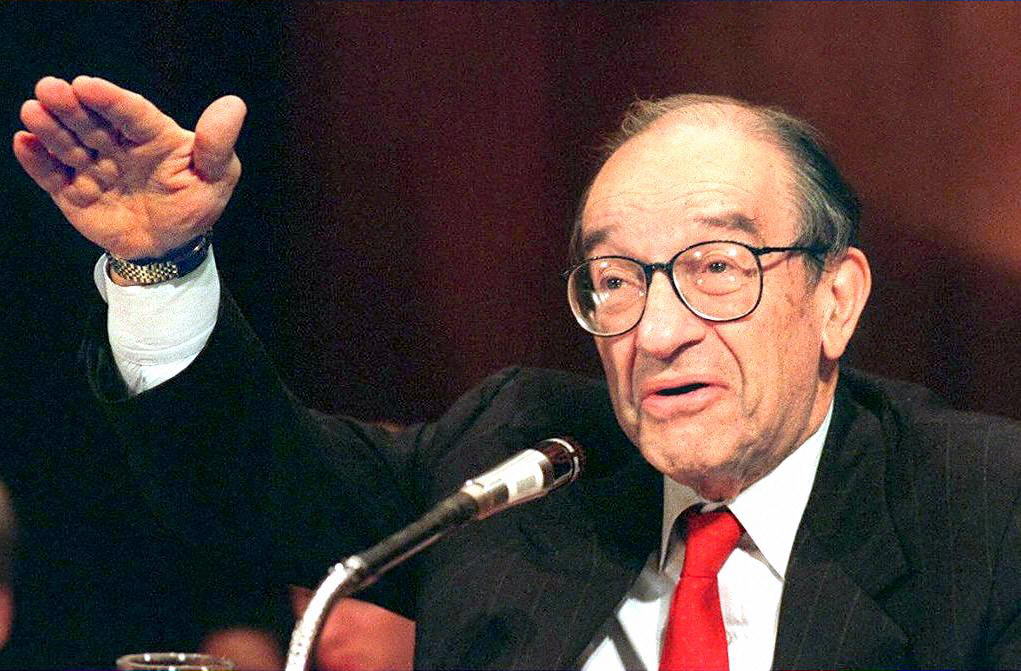
Sebastian Mallaby is the author of “The Man Who Knew: The Life and Times of Alan Greenspan.”
When he was in his heyday — when all of Washington seemed to hang on his advice — Alan Greenspan imagined Congress inventing a new game, called Zipswitch, and inviting him to preside. “What? I don’t know what the rules are,” Greenspan envisioned himself objecting; but Congress would insist, so convinced were lawmakers of his omniscience.
Greenspan, who died on Monday at age 100, shared this musing with colleagues in 1995, when he was still not halfway through his almost two decades as Federal Reserve chairman. Yet an element of his legacy was already clear: Even then, he had amassed extraordinary influence, inviting some commentators to suggest that he mattered more than the president. There were Alan Greenspan T-shirts and Alan Greenspan dolls; he was the ultimate celebrity expert in an era when technocratic wisdom was feted. America’s economic heroes of the time — from the cyber geeks of Silicon Valley to the wizards of Wall Street — embraced empiricism, pragmatism and unstuffy intelligence, virtues that Greenspan embodied. “Financial markets now view Chairman Greenspan’s infallibility more or less as the Chinese once viewed Chairman Mao’s,” observed two normally sober economists.
As the Zipswitch story shows, Greenspan loved to joke about his own celebrity. When a friend he encountered on an evening out asked how he was, he turned conspiratorially and held a finger to his lips: “I am not allowed to say,” he answered. Mocking his own reputation for oracular opacity, Greenspan once informed a member of Congress, “I know you believe you understand what you think I said, but I am not sure you realize that what you heard is not what I meant.” A cable news show came up with the gimmick of examining Greenspan’s briefcase for clues about his thinking — supposedly, a bulging case meant the Fed chairman was studying the economy especially deeply and might be about to move interest rates. Greenspan played along, instructing his driver to drop him off a block or so from the office so that he could walk the last yards with TV cameras trained upon his briefcase.
From his first stint in Washington, as chairman of President Gerald Ford’s Council of Economic Advisers, Greenspan worked to build influence. He courted journalists, both professionally and romantically; he never refused a lawmaker’s request for counsel; he golfed with chief executives and lobbyists. Although he was shy at parties — “an unprepossessing presence,” a cruel Newsweek profile sneered — he showed up at A-list gatherings with dogged consistency. Once, when Rep. Jack Kemp deliberately left him off the guest list for a grand Republican gathering, Greenspan begged the Fed’s vice chairman to call his buddy Kemp and extract an invitation.
Intimate meetings were Greenspan’s true forte. The power players who cycled through his office emerged feeling that Greenspan could read economic tea leaves with an almost magical brilliance, and they resolved to seek his advice when facing big decisions. It was a dependence that Greenspan slyly encouraged. “Extraordinary. That was his favorite word,” said a Ford administration rival. “He’d go in to see Ford and say, ‘Mr. President, this is an extraordinarily complex problem.’ And Ford’s eyes would get big and round and start to go around in circles.”
Greenspan’s wit and hypnotic cerebral power served more than his own vanity. By force of character and intellect, he essentially created the modern version of Fed independence. His predecessor, the redoubtable Paul A. Volcker, had been bullied by the Reagan administration; it was generally assumed that Greenspan, a loyal Republican, would do the bidding of the politicians to whom he owed his appointment. When Greenspan showed his mettle, sticking with high interest rates to quell inflation despite the political cost to President George H.W. Bush, the administration sought to punish him. Nicholas F. Brady, the treasury secretary, stopped inviting Greenspan to parties. Richard G. Darman, the budget director, put it about that there might be something creepy about this Fed chairman, an unmarried 65-year-old who telephoned his mother every day, like that mother-fixated figure in Alfred Hitchcock’s “Psycho.”
Greenspan shrugged off the pressure and then made his tormentors pay for it. He used his connections in Congress to block the administration’s financial reform plan, and Brady and Darman received unflattering coverage in important newspapers. (In the Ford years, when Henry Kissinger once wondered where a negative New York Times article had come from, his colleague explained that Greenspan had planted it.) Later attempts to cow Greenspan met with no greater success. When President Bill Clinton installed Alan Blinder, an eminent Democratic economist, as vice chairman of the Fed, Greenspan marginalized him so ruthlessly that Blinder resigned. When Clinton tried to replace Blinder with a banker who might stand up to the chairman, Greenspan’s Senate friends let it be known that they would block the president’s candidate.
And so, by the time of that Zipswitch musing, Greenspan ruled the roost: Not even the president could challenge him. The Fed had attained policy autonomy, though no law had granted it. It was a lesson in how Washington functions and how institutions grow. Greenspan assured the Fed’s independent stature not by ignoring politics or hiding in an ivory tower. He was a supremely political sage, who understood power and was not afraid to wield it.
The post Alan Greenspan understood power and was not afraid to wield it appeared first on Washington Post.