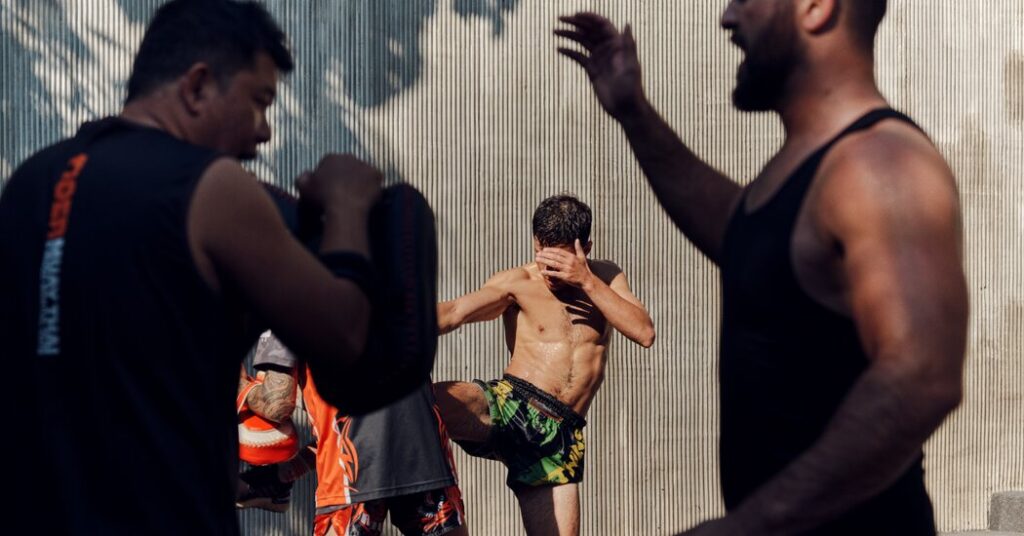
If you have about $1,300 and a way to get to Phuket, Thailand, you can live and train at Tiger Muay Thai & Mixed Martial Arts for a month and then fight another student, in a ring and in front of a crowd, for three rounds, or until one of you can no longer continue. I told my editors that if they sent me, I would write about the global combat-sports phenomenon that is Thai kickboxing and my own experience of Tiger’s notoriously grueling training regimen. Secretly my plan was to discover that I was a natural, with a paradoxically strong work ethic I would use to outcompete other men and comparably sized women, despite being, through no fault of my own, 48 years old.
This vision for the piece was not realized. Instead, Tiger reintroduced me to certain basic problems of embodiment. Like many biological nerds, I first became interested in martial arts as a way to prevent larger boys from dominating me physically. I joined the taekwondo boom of the late ’80s, went on to wrestle (poorly) at 98 pounds, dallied with point-based competitive striking, then trained in Brazilian jiu-jitsu before injuring out (broken hand, detached labrum, torn abdominal muscles) at age 31. In the process, I learned that domination comes in many forms.
I took up Muay Thai at this late stage for two reasons. The first is that bullies, drunks and street weirdos have always been drawn to me — either that or I’m paranoid. The second reason, which I prefer to focus on, is that I didn’t want the formative experiences of my life to be behind me; I wanted to keep changing as a person and, as a body, to get better instead of worse. In other words, I wanted to resist the domination of age. Someday I may be elderly, and when I think about the vulnerability inherent in that condition, it seems similar to childhood in ways that make me want to put it off as long as possible. At the risk of supporting the paranoia theory, my life got better when I became confident that other men could not simply reach out and hurt me.
Muay Thai is one way to prevent that, and there is substantial evidence that it works. The national sport of Thailand, it combines punches familiar from Western boxing with kicks, elbows and knees. Muay Thai can be distinguished from other forms of kickboxing by its emphasis on those knee and elbow strikes, as well as on kicks to the leg, for which the shinbone is the primary striking and blocking surface. This aspect of the sport, which shaped some of the earliest bouts between western kickboxers and Thai prizefighters, has given Muay Thai a reputation for brutality that has made Thailand a mecca for mixed martial arts enthusiasts from all over the world.
Tiger was the first Muay Thai gym on Phuket’s Soi Ta-iad. Known to foreigners who visit the island as Fitness Street, Soi Ta-iad looks like Maui if it were nuked and then invaded by a joint force of Britons and Russians. A narrow mile, with no sidewalks but many stretches of walkable concrete sewer coverings, it is home to (by my count) 10 fight gyms, six fitness gyms (one pirate-themed), 15 marijuana dispensaries, 12 shops selling Muay Thai equipment, nearly two dozen massage/cupping/acupuncture clinics, five tattoo parlors and various restaurants specializing in steamed chicken and brown rice. The traffic is 25 percent pickups hauling Burmese laborers and 130 percent scooters. I heard it called the safest street in Thailand because of the number of people who are there to train for fights. I also heard, in the first 24 hours I was there, three different scooter-accident stories involving brain matter on the surface of the road.
I arrived in Phuket on short sleep and steeled myself for 12 hours of wakeful reporting. That night, Viwat Sakulrat, the owner of Tiger, was hosting an event called the BBQ Beatdown. Held on the last Saturday of every month, the Beatdown combines exhibition fights between amateurs with professional Muay Thai bouts, all-you-can-eat barbecue, two free beers and, at the end, a dance party. I made plans to go with Cameron, a 27-year-old personal chef from England, and Gaillard, a 24-year-old military veteran from France, whom I met by the pool, where they were finishing a bottle from the night before. Their friend was fighting in the opening bout of the Beatdown after having taken his first Muay Thai class only two weeks earlier. I can admit that this behavior sounded cool.
The fight of the night was an M.M.A. bout between two Tiger trainees: Bogdan, a 27-year-old who was born in Ukraine and lived in England, and a heavily tattooed New Zealander named Quinton. The two set such an active pace that, after Bogdan finally won, Sakulrat impulsively took the mic and awarded one-year training scholarships to both. It seemed like a monkey’s-paw situation for Quinton, who was so exhausted that he had to be helped from the ring.
Perhaps you saw some Muay Thai in action at the recent U.F.C. White House event, which even I, a lifelong fan of combat sports, considered a bad sign. Might a society that gets more interested in M.M.A. become more open to violence generally? When I floated this possibility to Jonny Betts, a trainer at Tiger, he argued that however brutal prizefighting may seem, a world with it is preferable to one without it. “Fighting is a very natural part of humanity,” he said. “So I think martial arts — you know, combat sports — is the best way to get it out of our system. Because we do need to do it.”
Betts is right, insofar as a society with zero interpersonal violence is hard to imagine, and the one we have is chock-full of men who, as the U.F.C. lightweight Nate Diaz once put it, don’t know that they don’t know how to fight. The absence of street aggression on the Soi Ta-iad, which was so total as to feel uncanny, testifies to the power of combat sports to relocate fighting from the street to the arena. At the same time, it’s not as if fighting is a pro-social activity. At root, it is the practice of damaging other people’s bodies to override their will; and socially speaking, it competes with other means, such as persuasion and compromise, that we collectively prefer. If we accept that no fighting is impossible and constant fighting lies at the bottom of some slippery slope, then there is, in theory, an ideal level of hand-to-hand violence that can channel our impulses without totally denying or fully unleashing them. But this level has yet to be found.
It’s hard to look at the objective growth of the U.F.C., alongside the subjective growth of angry guys walking around in shirts with skulls on them, without considering the possibility that an antisocial subculture is corrupting the values of both public decency and martial discipline. At the U.F.C. White House event, for instance, the heavyweight Josh Hokit reached across the ring announcer to give the finger to his opponent and concluded his postfight remarks by saying Michelle Obama was a man; he is now 10-0, evidence against a strong correlation between prizefighting and the higher virtues. Could it be that training as a hobby is good for the individual, but prizefighting as a spectator sport is bad for the culture?
As a business, Tiger makes an end run around this question by rendering the barrier between hobby training and prizefighting unusually porous, as well as by creating a microculture in which everyone is too tired for interpersonal conflict. It’s a genius model in that it appeals to the maximum number of participants while also, if not exactly preying upon their belief that they could win in the ring, dangling the possibility that they might.
One recurring problem in martial arts is how to learn to fight without debilitating yourself in the process. You can’t just go down to the gym and hammer each other, because everyone will get hurt faster than they get better. At the same time, practice in a controlled environment introduces certain ambiguities regarding how good you are at fighting versus how good you are at your particular approach to training — ambiguities that become clear when you watch, for example, an aikido practitioner unfortunate enough to fight someone who has trained for competitive M.M.A.
Some martial arts are kind of fake, not because they don’t improve your reflexes and proprioception, but because they focus more on preserving specific cultural practices than on winning fights. The polite term for this distinction is “traditional versus dynamic.” The Ultimate Fighting Championship — which has grown significantly since its first event in 1993 and, along with various other promotions, popularized the sport of mixed martial arts worldwide — was originally marketed as a way to answer the question of which martial art works best. The modern sport has demonstrated that no one can succeed at the highest levels with just one discipline, but Muay Thai has emerged as a — if not the — preferred approach to striking.
Most people who train at Tiger never fight in a ring. For them, Tiger is functionally a resort, albeit one where you are more likely to get punched in the face. There are classes in Muay Thai, Western boxing, Brazilian jiu-jitsu and M.M.A., as well as in yoga, weight training and general fitness, supported by on- and off-site accommodations and a cafe. You can walk right off the mat and get a coconut, if you want to do that to your blood sugar.
But Tiger is also a resort with a professional fight team attached, and this team has trained multiple champions, including the U.F.C. featherweight Alexander Volkanovski and the flyweight Valentina Shevchenko. Thrillingly, there’s a pipeline: A person can start in the beginner class, fight in the Beatdown at the end of the month and win their way into a professional career, at least in theory. In practice, almost no one is trying to do that. On Monday morning, my Muay Thai class was mostly guys in their 20s with middle-class teeth, rounded out by pluralities of hyperfit women, veterans in their 30s and gray Russian men with age-inappropriate girlfriends. I wasn’t the oldest person there, but I was about two heart attacks away.
The two-hour session began with 10 minutes of running, followed by drills and shadowboxing, after which we divided into partners and worked long Thai combinations — e.g., jab-cross-slip-uppercut-duck-hook-cross-hook — that seemed designed to improve our concentration under conditions of exhaustion. Then we split into thirds, with one group working the heavy bags, one group hitting pads and one group sparring. As in Western gyms, this work was done in three-minute rounds with one-minute breaks in between; not as in Western gyms, we spent the minute doing push-ups.
It was not yet 9 a.m., but the temperature was pushing 90 degrees and the humidity had put a permanent wave in my notebook. After the second round, I switched to the next bag because I was slipping on a puddle of my own sweat. When it was my turn to hit pads, the Thai trainer kept saying, “Chirt, chirt!” I thought it was a boxing term I didn’t know, until I realized he was telling me to put on a shirt. I was projectile sweating. I’d had a fever for a week before I left and had not slept more than 90 minutes in any of the last four days. My ears were clogged up and my breath sounded like a dying whale heard from the inside. By the time I climbed into the ring to spar, I was performing every movement by sheer force of will.
My first two sparring mates were cool, and the third was a big Russian who knew every English word but “easy.” The second time I made the universal motion to chill out — step back, gloves down, pat the air — he threw an uppercut so hard he lost his balance. He spent three minutes trying to knock my head off, and finally I felt like I was doing something familiar: surviving. I got mobile and brushed my gloves up against his ribs as he winged hooks around me. He got me a couple of times, but he didn’t hurt me, and it felt great, right up until I climbed through the ropes and experienced a brief, systemwide brownout.
I was done, but class was not. The trainers had us line up facing each other and throw a hundred punches into our partners’ gloves, then link ankles for sit-ups. The man across from me was a kind and encouraging Norwegian in his 20s. “Come on, buddy,” he said as I failed to sit up. I hated him, but he was far away.
After class, dazed and increasingly viscous, I walked back to my room and tried to text my wife, but my hands cramped up and I dropped the phone. I was afraid to lie down, so I paced the room and thought about how I could not train like this anymore, even though I was the strongest I would ever be and would only deteriorate from here.
On Tuesday night, I went to Rawai Boxing Stadium — which is more of a boxing warehouse, with plywood bleachers, a capacity of roughly 300 and hard liquor available for purchase. I was initially confused by the ring girl, a white teenager in Air Force 1s who looked embarrassed as she held a belt over her head, until I realized she had been deputized from the crowd. The sheer number of fight nights in Phuket, where four venues present a combined 16 cards each week, means that Thai trainers and promoters are constantly flogging tickets, mostly to tourists. The crowd at Rawai was overwhelmingly white, and while many looked like fight fans — you can tell by the shirts — many did not.
The first two bouts were between children. A heavyset 8-year-old named Super Mean lost by decision to a smaller but better-conditioned boy. A Canadian child who appeared no older than 10 won his match, then took the mic to advise us to “believe in God if you want to be strong like me.” Many Thai fighters have their first professional bouts around age 7. A child that age competing at a venue the size of Rawai can make the equivalent of $60 for a win — a significant amount in Thailand.
Compared with American prizefighters, who rarely take more than three bouts a year, early-career fighters in Thailand maintain extraordinary schedules. While athletic commissions enforce limits on fighter activity at the larger stadiums, venues the size of Rawai go mostly unsupervised. In 2018, a 13-year-old named Anucha Tasako died after being knocked out in a Muay Thai bout; he had fought professionally 174 times since age 8. At Tiger, I met trainers in their 30s who claimed to have fought more than 300 times.
This difference between the Thai and Western approach to prizefighting as a profession translates to different styles within the ring. Westerners tend to favor a pressure style, seeking to overwhelm their opponents with high output in the early rounds. The Thai fighters prefer punctuated aggression. This approach is partly because of the influence of gambling — the first two rounds of a five-round Muay Thai fight are customarily treated as an opportunity for gamblers to get their bets in, and fighters often don’t try to knock each other out until Rounds 3 and 4 — and partly because their active schedules make it unwise to leave it all in the ring during any single bout. They fight like gunslingers, affecting expressions of bored contempt, conserving their energy and looking for ways to end things suddenly. Unlike the Westerners at Rawai, who fought like it was their chance to win in Thailand, the Thais fought like it was their chance to make $60 on a Tuesday night.
The two groups seem mostly but not completely segregated; of the roughly 40 bouts I saw advertised when I was in Phuket, only two matched Thais against white opponents. There were no Thai students in the classes I took at Tiger, where farang training — meaning the version of Muay Thai taught to foreigners — seemed something of a dirty word. Sakulrat, who himself started fighting at age 7, told me that for foreigners, training in Thailand is about learning the culture, conditioning and having fun. “We cannot push them like we push the Thai kids,” he said, “because those kids go up in the ring and try to kill someone. Someone try to kill them.”
No one was killed at Rawai on Tuesday night, but a young man was knocked out and lay on the canvas for several minutes. In that time, fighting was not cool or fun at all, as first his cornermen and then a nurse entered the ring and tried to wake him up. The bleachers across from me became a mass of stricken white faces, and a matronly woman took the hand of the boy next to her, who was about 10. He looked like he had learned more about Thailand than he wanted to know.
The next morning, I caught up with Bogdan, the 27-year-old from England whom Sakulrat had offered a year’s free training after he won his bout in the BBQ Beatdown. He had taken the deal, and now he was trying to figure out how he could make money in Thailand. At home he had worked in security, a strictly in-person field. Maybe he could do remote marketing or make money from sponsorships? He didn’t know, but his plan was to move forward.
“It’s a very drastic, final kind of change,” he said, dripping after a private session with one of the Thai trainers. “But this is life. We have to just adapt and move. That’s it.” He had come to Thailand two months earlier. When I asked him if earning a scholarship at Tiger had been part of his original plan, he said he never had one. This is the dream of training: That you will discover a knack you didn’t know you had, and it will reorganize your whole life. It is, perhaps, the bedrock of Tiger’s business.
Unlike Bogdan, most Tiger trainees come from the office class and tend to experience Phuket as a respite from life. I met several addicts in recovery, outnumbered only by people whose goal was to lose weight. Others were hardcore fitness enthusiasts, like Paulius and Jago, two 26-year-old Englishmen who had made the intensely 26 decision to train for three sessions each day. The experience reorganized their priorities in ways they found instructive. “Here you don’t have vices, because you’re just filled up day to day,” Paulius said. Jago cited thrifting. “You realize that’s actually not that important,” he said, “and it’s the happiest I’ve ever been in my life.”
I was making a different exit from life as I previously understood it. The night before my trip, I took an over-the-counter sleep medicine, shut my eyes and spent the next 10 hours more awake than I had ever been, watching the window turn from black to blue. My seatmate on the 14-hour flight from Seattle to Doha was a registered nurse who told me that some people — especially redheads — experienced this amphetaminelike “paradoxical reaction” to certain sleep aids. “You do kind of have red undertones,” she said. I identify as a brunette; it was like being told I had a food allergy and my eyes were too close together.
I had lain awake all night after Rawai and was now operating on less than six hours of sleep in the past five days. I knew that I was acting weird, but I wasn’t sure how. Bruised and knotted from Monday’s training, I suspected I was blowing the piece and compensated by conducting way too many interviews — talking, for example, to the prizefighter Suren Jaf, known as Jango, for several minutes about how jiu-jitsu side control had largely vanished from modern M.M.A.
Jaf, who is Muslim, was training four hours a day without drinking water because it was Ramadan. He sat in an ice bath and described his childhood desire to be recognized in a neighborhood where only criminals were famous, something he had no idea how to do until he found fighting. “I was just lazy, bro,” he said, submerging himself and popping up again.
The sun was low, and I left to eat an early dinner of steamed chicken, brown rice and salad. Then I went up and sat by the pool, where Gaillard was smoking and listening to Dire Straits. He had broken a bone in his foot. It looked bad, but he didn’t want to get a cast, because then he would have to stop training. We were joined by Cameron, who had been pulled over for riding his scooter without a helmet and assessed a fine in the amount of all the cash he had on him.
After the Beatdown on Saturday night, Cameron and Gaillard had gone to a nearby town called Patong, where a drunk accosted them outside a bar. In Bangkok, the bouncers break it up; in Patong, they clear a space. The drunk wouldn’t go away, so Gaillard fought him. “There was no choice,” he said quietly. He came out on top, although his shirt got torn and he realized, the next morning, that something was wrong with his thumb.
I barely knew him, but I wanted him to go to the hospital. He had a serious quality that, in combination with his youth, made me worry about him, as though he were a little brother being lured into something that would chew him up — or worse, turn him into a guy who wins fights outside of bars. What I want is for fighting to make me stronger, and for everyone else to give it up and find love. The sun was down now, and the cicadas had struck up. I watched bats take insects off the surface of the pool for a few minutes and then went inside, where I lay down and slept for 10 hours.
I woke in a different Phuket. Rising with the cicadas, I consumed one banana from a bunch I had purchased from a smoothie vendor in an off-menu deal — smaller than an American store banana and really sweet and good, possibly a turning point in my whole relationship with bananas — then walked down to Tiger singing like an old or crazy person. For the first time in 10 days, I could not feel the interface between the air and my skin.
Training was light work. I took it easy in drills and on the bag, focusing on whipping my punches. Because of a childhood dislocation, my right round kick has always been weaker than my switch left, but instead of trying to fix it, I just threw it into the bag over and over, forgetting about doing it right and concentrating on doing it again.
One remarkable thing about the Thai trainers, to a person with a background in karate or taekwondo, is the enormous variation in their kicks; they heave their legs up through all kinds of arcs and angles, with their feet in so many different positions as to look downright careless. This phenomenon is partly attributable to accumulated injuries, but it is also a consequence of Muay Thai’s relentless focus on results; you think they kick sloppily, but when they make contact, you realize they are generating more power than Western kickboxers 30 pounds heavier.
None of the trainers uses a last name. Even Sakulrat was identified as “Mr. Viwat” on the Tiger organizational chart. Except for members of the nobility, most Thais did not have surnames until the 1910s, when the government assigned them as part of a broader project of national organization. When I rotated over to hitting pads, I paired up with a Thai trainer, who appeared to be hung over but managing it, and asked his name. “Cartoon,” he said grimly, pronouncing it like the name of a place where people were sent to be executed.
Cartoon had two comedic bits in which he took great pleasure. Whenever sweat flew off me — a frequent and frankly gross occurrence for which I apologized repeatedly — he would recoil and sputter as though he had been struck by a wave. When I threw a particularly clean high kick, he would stumble backward as though overcome by the force. These were basically the same bit, but we both loved them. Over the next few days of training, Cartoon became my guy, and we would seek each other out for pad work. Occasionally, during sparring, I would look over and see him and another trainer — who was roughly his age and size but (please don’t say this part out loud if you are reading to Cartoon) looked less like he had been punched in the face 10,000 times — evaluating me, which, given the near-total lack of interest the trainers generally took in any non-Asian male, I found extremely flattering.
The reintroduction of sleep to my routine made training a joy instead of a will-shattering ordeal. I fell into a serene pattern of training in the morning, having a smoothie and a salmon bowl in the cafe, showering, getting a massage and then showering again before dinner. When the cicadas started up, I would sit by the pool and watch the sun set, then drink a soporific mushroom cocoa while I watched the Running of the Bats. Once, I tried crouching in the water with my eyes at surface level while they barreled in around me, but it was too exciting. I was in bed by 8 o’clock every night. I don’t want to overstate it, but I basically achieved total harmony with myself and my surroundings. Even the lizards or possibly monkeys trying to kill each other inside my ceiling sounded right.
Then on Saturday I sparred with a maniac. He was American, with a haircut I considered Californian, but I didn’t ask. He sparred like no one I had ever seen, almost never punching but repeatedly trying to knock down my guard with both hands. Pulling your opponent’s glove down with one hand and hitting him with the other is an effective albeit comical strategy; doing it with both hands doesn’t work, because they can get their guard up again faster than you can get your hands back up and punch. He did throw a few haymakers that, had they landed, would have hurt me. I said, “Let’s go lighter,” and he said something about doing tai chi on a rooftop, which is when I realized he wasn’t even there. Some people get to sparring and lose their minds.
I reached out and put my glove in front of his face, letting him walk into it as he stepped forward. When I pulled back my hand and saw his outraged expression, I realized I was sparring and he was fighting. The difference is whether you want to hurt somebody, which I have also heard is the difference between the skilled practitioners and the high-level pros: Good fighters see that their training partner is hurt and instinctively stop, while great fighters see him hurt and want to hurt him more. I was never great. I have been mean from time to time, but not with my hands.
The Californian waded forward and knocked my hands down again, now trying to clinch. This strategy was better, in that he was strong and could control my body if he got his arms around my head and shoulders, guard or no guard. I didn’t let him at first, but as he kept trying, I became so curious what his plan was that eventually I let him grab me. At the last moment I realized he was looking for a head butt. He missed, but Cartoon’s friend saw it and sent him off to hit the heavy bag instead.
“You fight good,” the trainer said to me. Immediately I recognized it as one of the most important moments of my life; I could feel it making up for years of childhood. He asked how long I was in Phuket, and when I told him I was leaving on Monday, he lost interest in me forever. I wondered, though, if he and Cartoon had been scheming to put me in a fight.
Obviously I would never do that. I was in Thailand for work, having organized my whole life around what I could get out of the particular arrangement of my brains, and I was six months shy of 49. Best-case scenario: I would win one and then fight until I found someone who would permanently stop me. I had a wife and a son and a good dog waiting at home. But it occurred to me that I could just not get on the plane. Some people don’t.
The post Could I Become a Kickboxer at 48? I Went to Thailand to Find Out. appeared first on New York Times.