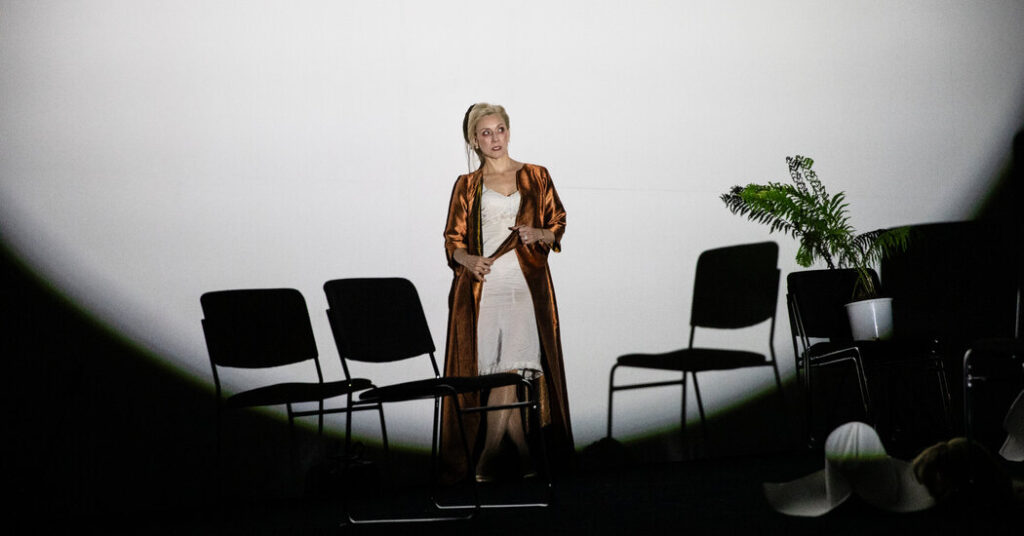
When the Fisher Center at Bard approached representatives of the Tennessee Williams estate in 2023 about getting the rights to adapt the play “Suddenly Last Summer,” they were met with two main conditions.
“We could edit, we could cut, but we couldn’t add text,” Gideon Lester, the Fisher Center’s artistic director, said in an interview. “And it couldn’t be a musical, but it could be somewhere on the spectrum of opera and music theater.”
What Lester and his collaborators — the composer Courtney Bryan and the director Daniel Fish — came up with is an opera. Their “Suddenly Last Summer,” which opens Thursday as part of Bard SummerScape, in Annandale-on-Hudson, N.Y., is a co-production with Opera Philadelphia, which will present it Oct. 22-25. (It is also one of Bard’s inaugural Civis Hope commissions.)
This was a big step for Bryan, the winner of a MacArthur “genius” grant, who had never written an opera before. But she and Lester, who wrote the libretto with Fish, had met when she was attending Columbia University, and he remembered that she had expressed interest in the art form. That she is from New Orleans, where “Suddenly Last Summer” is set, also felt right.
The word “operatic” is often used to describe the fervid intensity, tragic flamboyance and hothouse atmosphere of Williams’s work, to which “Suddenly Last Summer” also adds a gothic menace. In his Williams biography, John Lahr wrote that the play, which premiered in New York in 1958, “made a stylistic departure into the realm of the grotesque.”
It is a tricky work, full of potent symbolism and allusions to horrifying events, and Bryan had complicated feelings about it. “It is a challenging story,” she said after a rehearsal at the Brooklyn Academy of Music a few weeks ago. “I was like, ‘How do I feel about these themes? What does it mean to recreate a piece in a different way from an earlier time — what is it saying now?’”
But the story kept drawing her back, she said, “and musically, I was really interested in trying to find a way to match Tennessee Williams, the energy in the play.”
“Suddenly Last Summer” is not often produced these days, partly because, like a Greek tragedy, it largely tells without showing. The central conflict revolves around three characters with conflicting agendas embroiled in a battle of wills: Catherine Holly (the soprano Mikaela Bennett), a young woman holding on to a terrible secret; her aunt, Mrs. Venable (Tina Benko), who fiercely protects the reputation of her dead son, and Dr. Cukrowicz (Branden Lindsay), stuck between placating Mrs. Venable and helping her niece.
“There’s something that’s happening where Courtney’s music and the emotional and psychological world of the play are somehow conversant with each other,” Fish (the director of the Tony Award-winning revival of “Oklahoma!”) said. It is not mere illustration, he said, or something akin to putting a soundtrack to Williams. Rather, it feels like yet another collaboration. “The music really does feel intuitively, kind of wonderfully, in dialogue with the play,” he said.
Fish and Bryan had Bennett in mind from the start. She had starred in Fish’s staging of the Michael Gordon and Deborah Artman opera “Acquanetta” (2018) and in Fish’s “Most Happy in Concert” (2021) at Bard, a liberal take on the Frank Loesser musical “The Most Happy Fella.”
Bennett proved to be a central element to Bryan’s score, and not just because she handles some vocal heavy lifting, including a 23-minute scene in which she sings almost continuously. She was also a kind of collaborator for Bryan, who would give her chord progressions and suggest she improvise vocal lines over some of Williams’s text. That way Bryan could hear, for example, where Bennett set her voice.
“As an opera singer, even with premiering new opera, the norm is that you show up to a workshop or a rehearsal with a notated score and a general idea of where a piece is headed,” Bennett said in an email. “I’ve been given the ultimate gift of being a part of this process from the very beginning, and it being shaped around me.”
Bryan also researched Williams, watching interviews online, catching productions of his plays and exploring his connection with New Orleans. A major source of inspiration was Williams’s text itself, which has numerous references to birds. Some are described in the abundant, evocative stage directions as singing “clearly and purely”; others are “flesh-eating” emblems of death with “wild, ravenous, harsh cries.” If that sounds creepy, consider that the play touches on cannibalism and lobotomy.
“I collected bird sounds in New Orleans, on the Gulf of Mexico and the Mediterranean Sea — some sweet-singing like red cardinals, yellow warblers and Mississippi kites, as well as crows and vultures,” Bryan said. She then incorporated them into the score: “The bird sounds are notated with additional guidelines on improvising within the sounds of the birds. At some point in the opera, every instrumentalist and vocalist musically transforms into a bird.”
More consequential in terms of structure was the decision that Bennett’s character would sing, while Mrs. Venable and the doctor would speak their lines. (The cast also includes 12 members of the Young People’s Chorus of New York City.)
“The biggest question I’ve had for Daniel is, ‘Why am I the only actor onstage who is singing? What is the significance?’” Bennett said. “His answer has been ‘Why not? Let’s discover the why together.’”
Bryan had no perfect answer about how to find the balance between the sung and the spoken either. “A lot of it was a question mark,” she said. She sounded inspired by the challenge.
The post Cannibals, Lobotomies, Lethal Birds: A Tennessee Williams Opera appeared first on New York Times.