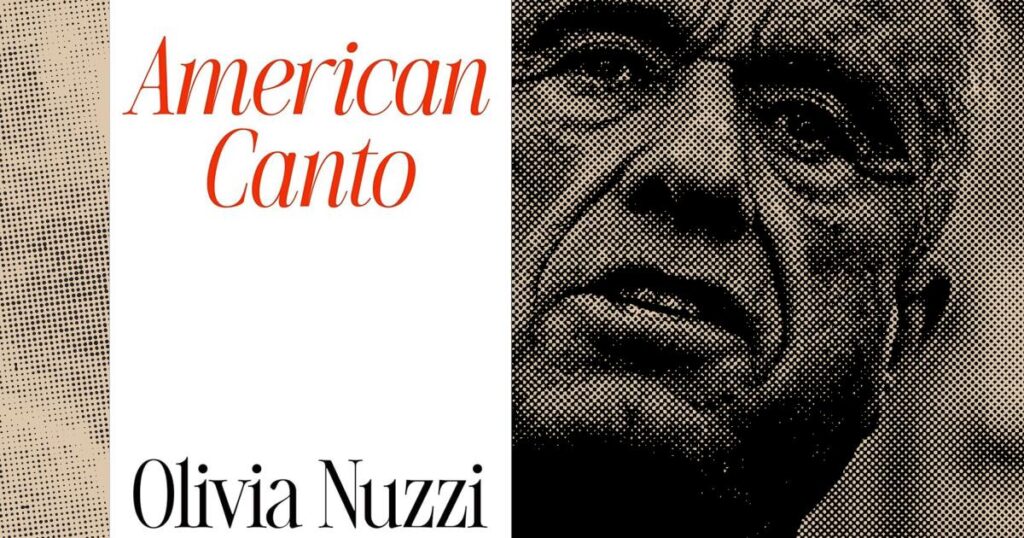
“You cannot outrun your life on fire,” writes political journalist — and recent tabloid darling — Olivia Nuzzi in the opening pages of her much-anticipated memoir, “American Canto.”
The release of “American Canto” will no doubt stoke that fire — not extinguish it — if the latter was Nuzzi’s wish when her reputation went up in flames about a year ago. As the result of revelations of an alleged affair with her interview subject, Robert F. Kennedy Jr. (who has denied it) during his run for president, Nuzzi was notoriously fired from her job as Washington correspondent for New York Magazine. Her fiancé — political reporter Ryan Lizza — broke off their engagement. A frenzied media storm has since ensued, in which Nuzzi is either victim or perpetrator, depending on your point of view. With “the debris of her life” littering the planet, Nuzzi fled the East Coast for a secluded bungalow in the Southern California hills, where she vowed to no longer “see myself, the character of myself imagined by others, viral allegory of hubris, female avatar of Icarus, stripped and left for dead in a pool of wax.” She recounts pledging “a vow of silence,” and “to fall silent in myself, too.” Further, she writes that “I do not wish to be understood, which no one seems to understand.”
In writing “American Canto,” while Nuzzi has broken her vow of silence — smashing it into smithereens and setting off a wave of public retribution by Lizza — she has succeeded brilliantly in her wish not to be understood. Nuzzi emerges less as someone who, in the words of her publisher, “walked through hell and she took notes,” but as a woman whose version of the events that laid her low remain stubbornly unprocessed — as blurry and borderless as the book itself.
Nuzzi has been a keen political observer, praised, for example, by legendary longtime editor Tina Brown for her “unabashed bravura” and “vivid, irreverent coverage” — which is no doubt among the talents that led Vanity Fair to risk hiring her, post-scandal, as their West Coast editor earlier this year. And those skills helped establish Nuzzi as an emerging media star in the first place, with ready access to the biggest names in politics. But in the pages of “American Canto,” those storytelling skills falter, as the author loses the narrative thread — avoiding confrontation even as she plunges into it. Where exactly is she going with all of this?, one can’t help but wonder. “It is inconceivable,” Nuzzi writes of the paparazzi who stalk her, “that someone would choose to allow a crisis to go to waste, would not want to make of their attention more attention, would not want to reap some kind of short-term profit from the mess of their life.” But isn’t “American Canto” an attempt to enter the belly of that beast?
Nuzzi’s aim in offering this account remains cloudy, but readers looking for a mea culpa won’t find it here. The author’s few attempts at regret or self-reflection don’t land, nor do her efforts to contrive a kind of contemporary, Didion-inspired journalistic style that mixes meticulous observation with first-person intimacy. Court transcripts, transcripts of conversations Nuzzi’s had with other reporters and snapshots of a D.C. politico’s high life collide with one another in disjointed chapters that eschew timelines and zigzag among subjects. There are lengthy digressions involving, say, the puzzling practices of an American flag warehouse, or the time the FBI apparently investigated the author of the children’s book “Harold and the Purple Crayon.” Nuzzi intends these as part of a larger mosaic, and while they are occasionally intriguing, they exist as fragments, precluding any possibility of narrative momentum.
Yes, Nuzzi does provide some sharply insightful perspectives on Trump she gained through her “method reporting style” and talent for “talking to people who are abhorrent,” though she largely withholds judgement of the man she likens to a king who has been run out of his castle, after Biden’s election. Trump now “must resurrect himself,” she writes, “project the self that he wishes the world to see, and he must see it so clear that through his insistent clarity he conjures the vision for others until is it not a vision at all but the truth of his existence and the truth of yours.” She’s a witness to his powers of destruction. “His lawlessness inspired lawlessness. His rejection of norms called norms into question,” she notes. But when her alleged lover, Kennedy, comes to her for advice on whether he should align with Trump, all she can muster is to approach “his dilemma Socratically.” In those moments, Nuzzi writes, she asked Kennedy, “How do you feel when you visualize standing onstage and endorsing the Democrat?” He responds, “Nauseous.” Then she asks, “How do you feel when you visualize standing onstage and endorsing the Republican?” “Nauseous,” he responds. It’s important to Nuzzi that she maintain neutrality, apparently blind to her own bias. While Kennedy had acute misgivings about either choice, Nuzzi reports that the Trump option “seemed the surest way of maximizing his influence.” However, she adds that Kennedy was “clear-eyed about the president himself.” He always thought of Trump “as a novel: hundreds of lies that amounted to one big truth.” What that truth is, we’re left to guess.
In Lizza’s widely-circulated revenge series of Substacks meant to counter any negativity Nuzzi aims at him in “American Canto” — and in fairness, his presence barely registers, except that he may have set off the entire hullabaloo — he suggests his ex’s most egregious transgression was journalistic. Yes, Nuzzi cheated on him with a famous married man, but she was also aiding and abetting that man politically through her writing. Lizza also alleges that Nuzzi may have helped quash negative coverage of Kennedy, and that her coverage of Biden was potentially tainted by her desire to protect the man she was in love with. While she skirts this fundamental issue in the book, Nuzzi does affirm her inexplicably passionate feelings for Kennedy. She writes that she “loved that he was insatiable in all ways,” and when he threw himself down onto the bed of their hotel room, “his pink shirt unbuttoned, revealing my favorite parts of his chest.” She shares in her pages that Kennedy “told me he loved me,” after which she realizes that “the sound of him made me smile, that the sight of him made me smile, that just the thought of him made me smile.” Even in his “darkness,” she saw “softness.” He tells Nuzzi that what he felt for her was as powerful as “waves knocking me down.” What drew them together? Nuzzi writes that “we were both of us, vain, and our shared reverence for physical beauty, was in part, what bonded us.” That bond wouldn’t hold: when their alleged relationship threatened Kennedy’s position, he denied it had ever transpired.
Nuzzi describes the grief she feels over this betrayal, but from a distance, shrouded in verbosity. What she’d experienced, she writes, “was a kind of death … one that called for a period of griefless mourning. It was the death of an idea. An idea of self. Not of self itself. Not of myself. But of an iteration of myself.” I get it, but … ?
“American Canto” contains no footnotes or sourcing, and its main players are referred to not by name, but using designations such as “the Politician” (for Kennedy), “the Personality” or “the South African tech billionaire” — presumably for Elon Musk. Nuzzi claims to have a near-photographic memory for recalling conversations, which she relies on here to recount some of the book’s central events. There’s a maddening quality to these editorial choices that make it difficult to view Nuzzi as a character worthy of sympathy — which after all, may not be what she was trying for.
And yet that’s what we crave. We want to be able to root for this woman, whose misguided love led her to egregious personal and professional compromises she hasn’t reckoned with here. In real life, Nuzzi may have risked it all, but as an author, she hasn’t been as fearless, using words as armor, not conduit. It’s an understandably protective posture, but not one that has produced a memoir of consequence.
Haber is a writer, editor and publishing strategist. She was director of Oprah’s Book Club and books editor for O, the Oprah Magazine.
The post Yes, we give you permission to hate-read ‘American Canto’ appeared first on Los Angeles Times.