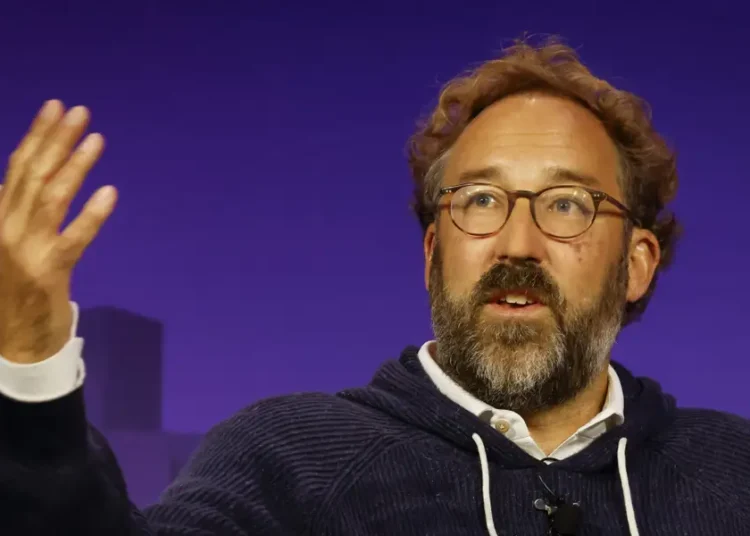
Abelardo De La Espriella, a criminal defense lawyer with no previous political experience, appeared headed for a razor-thin victory on Sunday in Colombia’s presidential election, in a potential win for his fervent supporters, the global right and President Trump, who had endorsed him.
Mr. De La Espriella — who transformed himself from sharply dressed Miami lawyer to populist in a soccer jersey and a straw hat — won 49.7 percent of the vote with more than 99 percent of the votes counted, according to preliminary official results. Iván Cepeda, a leftist senator and a longtime human rights advocate received 48.7 percent.
His victory would return Colombia to conservative rule after four years under Gustavo Petro, the country’s first leftist president. It would also advance Latin America’s broader shift to the right in Mr. Trump’s second term.
As word of the results spread, Bogotá, the capital, exploded with the din of shouts, car horns and vuvuzelas. People rushed into the streets, whether to celebrate or to march in opposition. President Petro said online that there would be “no president” until the votes had been scrutinized, which is the usual process — but cries of “Out with Petro” filled the air.
In Barranquilla, on Colombia’s Caribbean Coast, fireworks erupted and supporters of Mr. De La Espriella waved flares. When Mr. De La Espriella appeared, he shouted, “Colombia, here’s your president!”, and said, “I’m proud of you.”
Mr. Cepeda told supporters in Bogotá that he would await the full vote review but accepted the preliminary results. Remarking on the millions who voted for his leftist government, Mr. Cepeda said, “We stand before the Colombian people to tell you that we are an undeniable force.”
On Sunday night, Secretary of State Marco Rubio said on social media that he had called Mr. De La Espriella to congratulate him. “The Trump Administration looks forward to working closely with your incoming administration” he wrote.
Mr. De La Espriella, 47, ran a high-voltage campaign complete with machine-generated flames; A.I. videos of tigers, his mascot; and pounding anti-Petro chants that made him somewhat of a celebrity.
He also vowed to “disembowel” Colombia’s left and asked the Trump administration to target his political opponents, leading critics to call him an autocrat in the making.
The results, which were announced by the agency overseeing the election, revealed the highest voter turnout since Colombia installed a two-round voting system more than three decades ago, as well as the closest margin between two candidates.
Mr. De La Espriella ran on a platform now popular among right-wing leaders across the region: He vowed to restore security amid crime concerns, rescue the country from what he portrayed as economic ruin created by the left, and crack down on corruption.
His campaign was stridently nationalistic, claiming the flag, the Colombian national soccer jersey and the patriotic slogan “Firme por la patria!” — “Standing firm for the homeland!”
It nevertheless borrowed ideas, and a deft social media strategy, from the iron-fisted leader of El Salvador, Nayib Bukele, and from Argentina’s president, Javier Milei, two hugely popular figures in Latin America.
Like those leaders, Mr. De La Espriella adopted an aggressive tone. He promised to build megaprisons and to claw back the country from progressive politics and “gender ideology,” putting God and family first.
His vow to hunt down criminals and crush Colombia’s “narcoterrorists”— Mr. Trump’s favored term — resonated with supporters while alarming those who opposed him, raising the specter of more bloodshed and authoritarianism.
“It sounds like a military regime,” said Andro Giovanny Camelo, a 44-year-old taxi driver in Bogotá.
Many of Mr. De La Espriella’s supporters come from cities, not from the rural areas where armed groups are fighting over cocaine-trafficking routes and illegal gold mines. But the candidate seized on fears of a return to the acute violence of decades past, when rebels laid bombs and kidnapped people even on the busy streets of Bogotá.
He also focused on widespread extortion by criminal groups, which has crippled small businesses.
Karlos Morales, a 28-year-old waiter who voted in Barranquilla on Sunday, said that greater security would lead to more jobs and foreign investment, which suffered under President Petro.
“The left asked for an opportunity,” said Mr. Morales. “We haven’t seen very good results.”
Underscoring his security message, Mr. De La Espriella campaigned in a bulletproof vest, gave rally speeches from behind bulletproof glass, and denounced the violence of the campaign — including the killings of another conservative presidential hopeful and two of his own campaign workers. .
If he takes office, Mr. De La Espriella will face formidable challenges that could test his popularity, from subduing armed groups that have drones and other sophisticated arms to tackling a major budget deficit after Mr. Petro’s runaway spending. He also faces a state takeover of the health system that many Colombians say has made it harder for them to get medical care.
He has projected confidence by pointing to his vice president.
While Mr. De La Espriella portrayed himself as an anti-establishment, iron-fisted outsider, he nevertheless chose a respected former commerce minister, José Manuel Restrepo, as his running mate, a move that many voters said had calmed their nerves about voting for the outsider.
“That gives him credibility,” said Brayan Emanuel Ariza, a 32-year-old business student in Bogotá. “Otherwise he wouldn’t have gotten so many votes.”
He said that Mr. De La Espriella, who grew up near the Caribbean Coast, represented the energy and playful humor of “El Caribe,” while Mr. Restrepo from Bogotá was “more serious.”
Mr. De La Espriella has argued that he will bring prosperity to Colombia by working more fluidly with the United States, following a contentious relationship between Mr. Petro and Mr. Trump.
Playing up his patriotism, Mr. De La Espriella did not speak at rallies about his close ties to the United States, where he lived for more than a decade in Florida and was naturalized as a U.S. citizen in 2023. There were no American flags or MAGA hats.
But he traveled to Florida to drum up support for his run with Republican lawmakers and the Colombian diaspora. And to meet his ambitious security goals, he has said he would enlist Colombia in a new U.S. military coalition to combat drug trafficking cartels.
After he was heartily endorsed by Mr. Trump this month, and received the vocal backing of Senator Bernie Moreno of Ohio and others, Mr. De La Espriella began to emphasize that the United States had his back.
He ratcheted up his threats on opponents, promising that the U.S. government would come after anyone who obstructed the election by, for example, buying votes to benefit his rival.
Colombians began to take that rhetoric seriously this past week, when U.S. authorities detained a Colombian activist in Arizona who had spoken out against Mr. De La Espriella. On the same day, Mr. Rubio issued a memo claiming that the activist, Beto Coral, was deportable because his advocacy interfered with U.S. foreign policy goals.
As Sunday’s election approached, Mr. De La Espriella’s threats turned feverish.
He said in an interview that he was “savoring” the prospect of protests if Mr. Petro called for supporters to contest election results — and promised to bury anyone who challenged his win in prisons “15 meters underground without light and without water.”
Mr. De La Espriella’s career has been characterized by audacity.
In Miami, he became known for representing high-profile clients back in Colombia, including many charged with drug trafficking and corruption or embroiled in scandals linked to right-wing paramilitaries. He has said he took only cases that gave him “vertigo.”
His client list included Alex Saab, who was later charged by the U.S. authorities with helping Nicolás Maduro, Venezuela’s former leader, to launder hundreds of millions of dollars meant to help the poor. Mr. De La Espriella has downplayed his relationship with Mr. Saab, who is now in U.S. custody.
Before his run, Mr. De La Espriella was also known as a flamboyant bon vivant. He sang opera, wore tailored suits and self-produced an album of covers of hits by artists like Andrea Bocelli and Frank Sinatra. In the video for his Spanish cover of “My Way,” he appears eating sushi on a private jet.
He also formed businesses, from a piano bar to a luxury goods line called De La Espriella Style, and went in on a rum company. His campaign sold pricey, limited-edition watches to donors.
Many in Colombia recognized a familiar figure in the candidate.
“I have never seen two leaders more aligned than Donald Trump and Abelardo De La Espriella,” said Manuel José Cepeda, a prominent political scientist and former president of Colombia’s Constitutional Court, who is not related to the left-wing candidate.
Mr. De La Espriella created a groundswell by sidestepping the usual power brokers and going straight to the people — starting with their cellphones.
His online messages alternated between shouting attacks on the left, videos of sweaty workouts and A.I. videos that portrayed his rivals facing him in a soccer match.
He also showed off his wife and four children and talked about his daily routine, which he said started with prayer — a key plank of his campaign, which targeted the religious right.
Mr. De La Espriella, if elected, would take over an extremely polarized population.
On Sunday night, thousands converged on a convention center in Bogotá, where Mr. Petro told supporters to go fight for the presidency. Some cried and hugged. A man shouted, “we all came to support Cepeda,” and called for protests to stay peaceful.
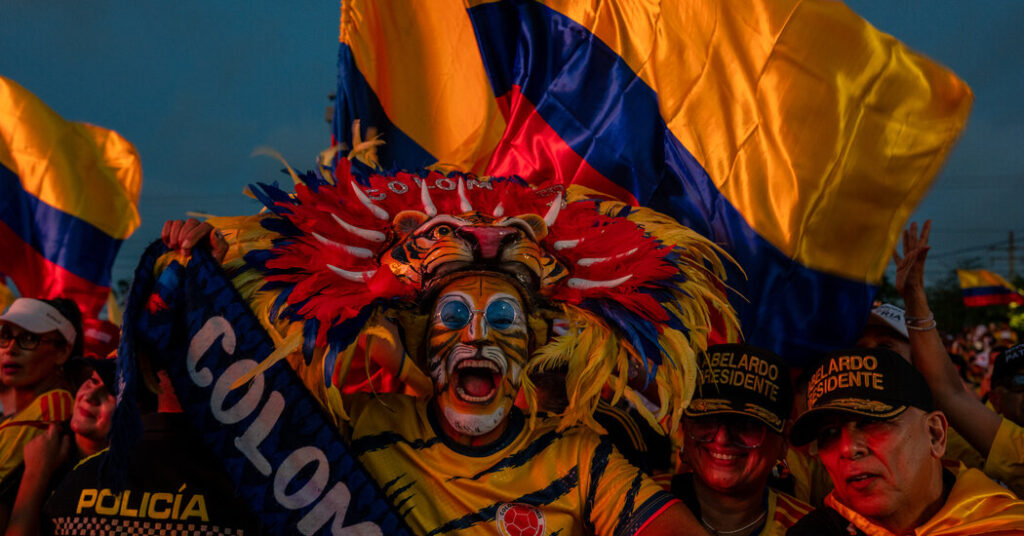
But in much of Colombia, people seemed to have dressed up in yellow jerseys and tiger costumes to support Mr. De La Espriella. A sense of passionate optimism prevailed, along with simple curiosity.
“The left didn’t work,” said Juan Manuel Viarte, a 32-year-old engineering student in Bogotá. “I want to try something new.”
Genevieve Glatsky and Federico Rios contributed reporting from Barranquilla, Colombia, Lucía Cholakian Herrera contributed reporting from Bogotá and Jorge Valencia contributed reporting from Cartagena, Colombia.
The post Trump-Backed Outsider Appears to Win Colombian Presidential Race appeared first on New York Times.