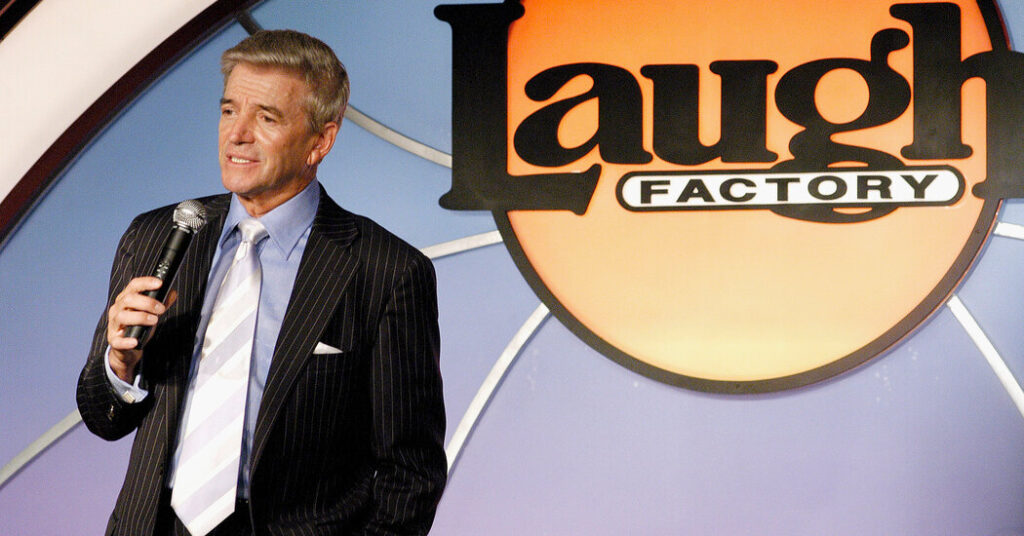
Tom Dreesen, a comic whose nearly 60-year career began as the white half of a rare interracial stand-up duo with Tim Reid and who later became a reliably funny staple of late-night television and Frank Sinatra’s longtime opening act, died on Wednesday at his home in Sherman Oaks, Calif. He was 86.
His daughters, Amy Barbuscia and Jennifer Garber, announced the death but did not provide a cause. He had been successfully treated for appendiceal cancer in 2019.
Mr. Dreesen was a smooth, clean performer whose self-effacing routines revolved around subjects like family (he was one of eight children who grew up in poverty), religion (he was Roman Catholic), sports (he was a Chicago Cubs and Bears fan) and Irish and Italian culture (he was a mixture of both).
“He was a total craftsman and professional, which is undervalued in comedy,” Robert Wuhl, a comedian and actor, said in an interview.
David Letterman, a close friend, said that Mr. Dreesen’s comedy grew out of his upbringing in Harvey, Ill., a struggling, low-income suburb of Chicago.
“He once talked about how poor he was, and how five siblings slept in one bed,” Mr. Letterman said in a phone interview. “Four of the five wet the bed and the fifth became a great swimmer. If you put a microscope on the joke, it’s unpleasant — a puddle of urine in the bed — but it’s sweet. That was Tom.”
Mr. Dreesen appeared dozens of times on Mr. Letterman’s shows and on “The Tonight Show,” with Johnny Carson and then Jay Leno. In 1975, after being bumped three times before his first “Tonight Show” appearance, he delivered a routine that ended with Mr. Carson giving him his signature “OK” hand gesture of approval that comedians dreamed of getting.
He did so well that night, Mr. Dreesen said, that the next day, CBS signed him to a development deal; sent him a check for $10,000; and guaranteed him $1,850 a month for a year, which eased his family’s financial burden. No programming came of the CBS deal but he soon became one of the busiest comedians in the country, working in clubs, arenas and on television.
In 1983, while he was opening for Smokey Robinson, Mr. Dreesen met Sinatra’s lawyer, Mickey Rudin, and impressed him with his glibness. Soon after, Mr. Dreesen got an offer to open for Sinatra in Atlantic City, N.J.
“I thought, ‘Wow, this is great. I’ll work with him for a week, and I’ll get a picture taken with him, which I can hang inside every tavern in Harvey and that’ll be that,’” he recalled in “Still Standing … My Journey From Streets and Saloons to the Stage, and Sinatra” (2020), written with Darren Grubb and Johnny Russo.
That week turned into 13 years with Sinatra, performing in 45 to 50 cities annually. “This was truly the life I wanted,” he wrote, reflecting on idolizing Sinatra since he was a boy. “From my vantage point, every night, there was no TV series, no radio show, no movie deal that compared to what I was experiencing.”
After Sinatra’s death in 1998, Mr. Dreesen was a pallbearer and the M.C. at his funeral.
Sinatra is one of many subjects that Mr. Dreesen discusses in a podcast — “Who’s Tom Dreesen?” — that he started earlier this year with Joe Goal, a friend and actor. “He wanted to get his life out there,” Mr. Goal said in an interview.
Mr. Dreesen was also renowned for his philanthropic work, often as the host of fund-raising events for charities, including those supported by pro-am golf tournaments; he was an ardent golfer.
In 1997, Jim Murray, the Pulitzer Prize-winning sports columnist of The Los Angeles Times, wrote that Mr. Dreesen was as “necessary to the well-being of the game’s essential pro-ams as the ropes, the marshals, the scorekeepers, the army of other volunteers.”
In 1982, he began organizing A Day for Darlene, an annual event in the Chicago area that raised money for multiple sclerosis research. It was named for Mr. Dreesen’s sister Darlene Bethman, who had been diagnosed with the disease and died in 1989.
Thomas Eugene Dreesen was born on Sept. 11, 1939, in Harvey. His father, Walter, played trumpet in a band before taking factory jobs, and his mother, Glenore (Algoe) Dreesen, was a bartender. Life was difficult for the family of 10, as Tom’s father sank into alcoholism.
“I often joked that Daddy would rather hear that he had six months to live than to hear we were out of Schlitz,” Tom wrote in his memoir.
In the book, Mr. Dreesen recalled a nagging feeling that he looked less like his siblings than two of his male cousins. When he was a teenager, he confronted their father, who admitted that he was his biological father.
“I was grateful my uncle had shared the truth, painful as it was,” Mr. Dreesen wrote.
Growing up, he shined shoes in a tavern, sold newspapers and caddied. After dropping out of high school, he served in the Navy for four years, worked in construction and sold life insurance.
In 1968, while volunteering with the United States Junior Chamber of Commerce, a civic group, he met Mr. Reid. Together they worked on a drug prevention program, making students laugh while encouraging them to think about their life choices. An eighth grader thought they were funny enough to be a comedy team, so Mr. Dreesen and Mr. Reid decided to give it a try as Tim and Tom.
Billing themselves as the nation’s only Black and white comedy team, they performed on the chitlin’ circuit of Black-owned venues, Playboy Clubs, prisons and schools for about five years until Mr. Reid left to be a solo comic and actor.In 1978, he was cast as the hip disc jockey Venus Flytrap on the CBS sitcom “WKRP in Cincinnati.”
Mr. Dreesen moved to Los Angeles, where he gradually built his stand-up reputation at the Comedy Store, a club that also nurtured the rise of Mr. Letterman, Mr. Leno, Robin Williams, Elayne Boosler and others.
But they were performing for nothing.
“Tom and George Miller” — another comedian — “started doing the math on how much money the Comedy Store was generating for itself and how much money was not being paid to the comics,” Mr. Letterman said. “They decided, ‘Wait a minute, the reason people are coming to the Comedy Store is the comics, not the watered-down drinks.’”
Mr. Dreesen led a two-month strike of about 100 comics against the comedy club in 1979. It ended with an agreement that included the club paying the comics $25 for each 20-minute set performed at its locations in West Hollywood and Westwood, according to The Los Angeles Times.
“Tom was the spearhead,” Mr. Letterman said, adding, “Now, by God, if you work at the Comedy Store, you’re not working for free, you can make a living working there.”
In addition to his daughters, Mr. Dreesen is survived by four grandchildren, three great-grandchildren; his sisters Margie Brooke, Judi Austell and Alice Dreesen; and his brothers Glenn, Wally and Dennis Dreesen. His marriage to Maryellen Sebock ended in divorce. His son, Tom, died in 2022.
Mr. Letterman, who was enamored of Mr. Dreesen’s Sinatra stories, asked him to repeat one in particular..
“Tell me the story about the time Frank Sinatra saved Shecky Greene’s life,” Mr. Letterman said on “Late Show.” He set up Mr. Dreesen’s account by extolling Mr. Greene as a much-loved, hysterically funny man who lacked enemies.
“Well,” Mr. Dreesen said, “one night, three guys were beating him up.”
“Frank walked by and he said to the guy” — here, Mr. Dreesen pointed his left index finger, as Sinatra might have — “‘He’s had enough.’”
The post Tom Dreesen, Comic Who Kept Sinatra’s Crowds Laughing, Dies at 86 appeared first on New York Times.