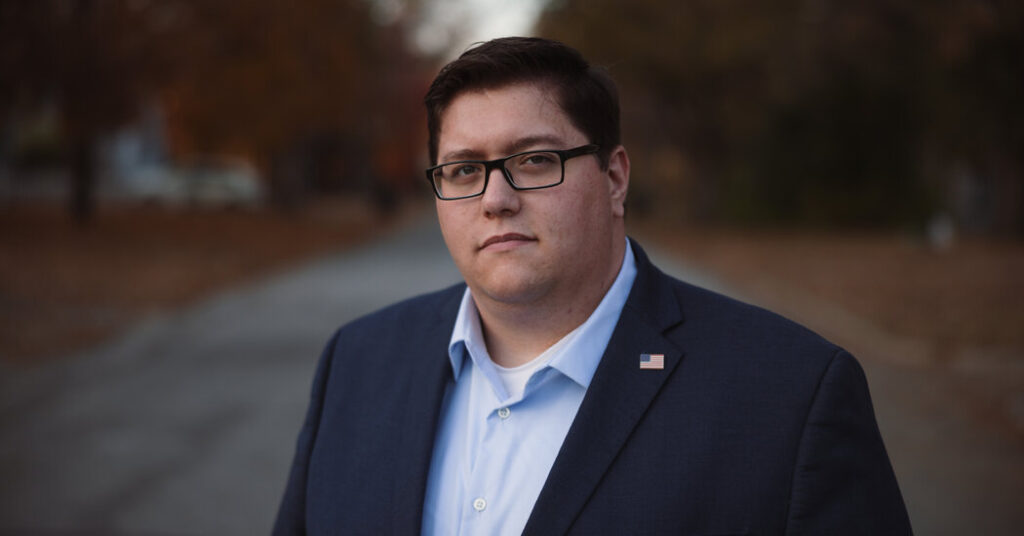
In 2023, the Kansas Republican Party was in turmoil.
A new state party chair was throwing his weight behind a proposal that had gone off like a bomb: Strip certain groups, including ones for Black, Hispanic and female Republicans, of their representation on the state G.O.P.’s executive committee.
William Hendrix and Alex Dwyer, ambitious members of the Young Republicans, a club for aspiring political leaders, wanted to support the new chair.
So Mr. Dwyer wrote a statement saying exactly that. But when his local chapter refused to issue it, Mr. Hendrix, younger and new to politics, decided to do it himself.
The reaction from some senior party officials and other Young Republican members was immediate, Mr. Hendrix said.
“It was a very explosive, dramatic kind of response,” Mr. Hendrix, who is now 24, said in an interview. He said he was accused of being a racist and a toadie for the party chair.
He added, “It put a really bad taste in me and Alex’s mouth.”
In the end, the proposal did not go forward. But that experience, Mr. Hendrix said, cemented his friendship with Mr. Dwyer, who is now 29, and inspired the two to take control of the Young Republicans for the state.
“We were not fans of the way the Young Republicans were being run,” Mr. Hendrix said. “Why not just take over?”
It was a fateful pairing. In October, texts were leaked from their group chat with 10 other Young Republican leaders in New York, Vermont and Arizona, revealing racist, misogynistic and antisemitic language — including “I love Hitler” — that rocked many in the party.
The Kansas Republican Party immediately denounced the messages and declared its Young Republicans group “inactive.” Republican parties in the other states followed suit. In all, seven people, including Mr. Hendrix, lost their jobs.
The quick response of the state Republicans stood in contrast to the party’s national leaders. Vice President JD Vance, who has made a point of reaching out to young men, posted that he refused “to join the pearl clutching” about what was essentially “edgy offensive jokes” made by “kids.”
Mr. Hendrix, who has not spoken publicly about the group chat until now, said in a series of interviews that he was stunned by the intensity of the uproar and the fallout on his life. He echoed Mr. Vance’s defense, describing the chat members as friends who understood that they were all joking. And he defended Mr. Dwyer, who did not respond to requests for comment on this article.
But the full picture is more troubling. In interviews with almost two dozen people — Republican activists and officials, and people who knew Mr. Dwyer or Mr. Hendrix — a picture emerged of a younger, more rebellious generation of activists who grew up online, and are bringing the language and ideas they find there into Republican activism.
It is true, say many experts of online culture, that the loose invective of anonymous chat rooms is now an edgier part of Gen-Z language. It is meant to be transgressive — a way to signal tribal allegiances and to poke fun at what they see as the rigid sensibilities of liberal adversaries.
But if the language is repeated often enough, that builds a numbness to the ideas behind it, and can even help radicalize.
“It’s easy to keep moving down that line where you are not shocked anymore because you are used to it,” said Dashka Slater, author of “Accountable,” a 2023 book about a social media blowup at a California high school. “The danger is that it normalizes the unthinkable.”
And the danger becomes exponentially more alarming when that online language enters into politics. These were not high school gamers, people in Kansas pointed out, but future leaders of the Republican Party.
It does not help that President Trump has blurred boundaries. In 2022, he dined with Nick Fuentes, the avowed racist and antisemite. And Mr. Trump recently defended the media host Tucker Carlson for his sympathetic interview with Mr. Fuentes.
Some local Young Republican chapters in Kansas had already been battling the problem well before the group chat messages were revealed — conducting investigations and asking several members to leave. Mr. Dwyer himself had previously resigned from a local chapter, after an investigation into his social media posts turned up content associated with white nationalism.
It was not limited to one group. Austin Gilpin, 28, wrestled with the problem of white nationalist language in 2017 when he was the chair of another group meant for young adults, the Kansas Federation of College Republicans.
“It’s hard because some of these people mean it, and some of them don’t,” he said. And when chats become public, prompting furious reactions, the bonds among participants can become stronger. “The people who mean it use the public’s outrage to recruit the guys who don’t.”
In High School, Dazzled by Politics
Mr. Hendrix dates his political awakening to Mr. Trump’s 2016 election, when he was a sophomore at Topeka High School. He had never been interested in politics, or much noticed the views of his liberal father, a registered Democrat. And when students walked out, protesting Mr. Trump’s win, he followed along — happy to get out of class.
Then he started looking into what students were saying. “It was very much just, ‘He’s a racist, his policies are racist,’” he said. “It all seemed like an overstatement.”
Mr. Hendrix did not like school. Tall and heavy set, he said he was bullied for his weight.
Life at home was also precarious. His parents divorced when he was a child, and his mother, a disabled veteran, moved to Louisiana. His father supported Mr. Hendrix and his older brother with odd jobs like laying tiles and cleaning gutters. At times, they turned to the local food bank.
He spent a lot of time playing video games in the public library, which he now sees as an escape from his life.
Things began to change when, at 15, Mr. Hendrix took a journalism class. The teacher, Heather Hooper, noticed a spark and encouraged him to join the student newspaper.
“The newspaper became his thing,” she said.
He was one of the few conservative students on the staff, but Ms. Hooper said the students accepted one another. Mr. Hendrix eventually became editor in chief.
When Mr. Trump came to Topeka in 2018 for a midterm election rally, Mr. Hendrix, a senior, applied for and received a White House press credential. During the event, Mr. Trump pointed at the press section and said “fake news.”
Mr. Hendrix loved it.
“You’re just like, ‘how the hell did I wind up here?’” he said. “I’m a member of the press pool, the president of the United States is up there calling me fake news. That’s something I’ve only ever seen him do on TV, and now he’s doing it for me.”
Being at the center of it all was exciting, and he longed for a career in politics. But after high school, he worked at a Cracker Barrel restaurant and then a Dollar Store, and eventually went to trade school.
In 2021, he saw a possibility: challenging an incumbent on the Topeka City Council in his hometown district. He campaigned for a new grocery store and better streets. He came in last in the primary but was impressive enough to win the attention of some local Republicans, who got in contact. He asked why there wasn’t a local group for young conservatives.
“This guy was like, ‘man, have I got news for you,’” Mr. Hendrix said.
He joined the Topeka chapter of Young Republicans and quickly became its treasurer. Eventually, he was hired by two state legislators as a part-time office assistant. He quit his job at a Hy-Vee grocery store, he said, and wore a suit and nice leather shoes on his first day of work in January 2023. He was 21.
“I was kind of in awe,” he said. “I’m working in the Capitol.”
He first met Mr. Dwyer a month later at the state Republican convention.
“We got on like a house on fire,” Mr. Hendrix said.
Mr. Dwyer was older and more experienced, but Mr. Hendrix said he saw a similar motivation: to stand up for working-class people.
Mr. Hendrix, who lived with his father in a small one-story house, was struggling to pay off debt from trade school. And hearing older Republicans talk about personal responsibility infuriated him. “This mantra of pull yourself up by the bootstraps, that’s not cutting it,” he said.
Mr. Hendrix kept in touch with Mr. Dwyer, and together they weathered the criticism over their statement supporting the controversial move by the new G.O.P. chairman.
Eventually they thought about taking over the Kansas Young Republicans, which would mean, Mr. Hendrix said, that they could demand more for young people.
“As I think back on it,” Mr. Hendrix added, “I really just put on the rocket boots and went for the top.”
The College Activist
In 2017, college campuses were ground zero for progressive power. The #MeToo and the Black Lives Matter movements were ascendant.
“It was prime time for woke overreaction and campus witch hunts,” said Mr. Gilpin, the former head of Kansas College Republicans who describes himself as a moderate.
Mr. Dwyer, who grew up in an upper-middle-class conservative family, pushed back on that liberal culture. In 2017, as a sophomore at the University of Kansas, he met with the political activist Charlie Kirk, and set up a Turning Point USA chapter.
Mr. Gilpin, who corresponded with Mr. Dwyer in those years, said he seemed like a moderate conservative. Mr. Dwyer even invited him to a conservative environmental group, Mr. Gilpin said.
After graduating from college, Mr. Dwyer found his way to the Young Republicans, where members were introduced to party leaders and served as volunteers on political campaigns.
But Mr. Dwyer and other young activists in his circle seemed to have different ambitions, according to five former members of the group, who asked to remain anonymous because their jobs prohibit them from speaking publicly on the matter. The younger members were more irreverent, focused more on expressing their views on social media and less on the methodical work of attending meetings and door knocking.
Around the same time, several young men with extreme views had started to surface in Republican groups. Mr. Gilpin, of the College Republicans, said that he had to force out a member who had made an antisemitic reference to Adolf Hitler. The man later surfaced as a worker on Kris Kobach’s unsuccessful campaign for governor. Eventually, his views leaked, along with those of two other workers, and the campaign fired him.
By 2022, Mr. Dwyer and several young men in the Johnson County chapter of Young Republicans were also accused of expressing white nationalist views, according to two former Young Republican leaders who asked for anonymity because they did not want to be associated with offensive language of some members.
The chapter’s leadership combed through their social media feeds, and found some worrying content, the former leaders said. They said they expelled one young man for posting favorably about Mr. Fuentes, the white nationalist.
And Mr. Dwyer’s feed turned up a 2019 post of him holding a coffee mug that said “A.F.,” which seemed to refer to “America First,” the name of Mr. Fuentes’s podcast. Mr. Dwyer was asked to resign, and he complied.
John Altevogt, a longtime Republican Party activist who saw the young men’s social media postings, said in an email, “What struck me was their hostility to traditional conservative ideals.”
Taking Over Young Republicans
Despite these warning signs, Mr. Dwyer managed to resurface in Young Republicans. In March 2024, he was elected to a big role: leading the state organization.
His victory was not a testament to any newfound popularity. Fund-raising, which is central to the position, had become much harder, and slightly older members, many with families and full-time jobs, decided against competing. In the end, Mr. Dwyer and his slate ran unopposed.
Mr. Hendrix, who by then was working for the state attorney general’s office, became vice chair.
Trouble started almost immediately. The new treasurer, Aidan Thompson, was accused of posting a video with Mr. Fuentes. Mr. Hendrix said that Mr. Thompson resigned after a request from Mr. Dwyer.
Mr. Thompson, who declined to comment for this article, has continued to post, writing on X recently that “Jews are always overrepresented among high intellectual fields” and that the reason Germans embraced Hitler mirrors the situation in the United States today: “The same story of elites betraying us.”
That December, the Kansas Young Republicans held a Christmas gala. One of the guests was Peter Giunta, a Young Republican from New York, Mr. Hendrix said. Mr. Giunta wanted to discuss taking over the national leadership. (Mr. Giunta did not respond to a request for comment.)
“What we had in mind for Young Republicans in Kansas, he wanted to do it for the nation,” Mr. Hendrix said. “And so that made it an easy decision to support him from early on.”
A private group chat on Telegram, “RESTOREYR WAR ROOM,” was set up to talk about it.
The Implosion
Over the next seven months, 12 Young Republicans from Kansas, New York, Arizona and Vermont sent 2,900 pages’ worth of messages, according to Politico, which first reported on the texts in October.
Racist, sexist and antisemitic language was laced throughout. Mr. Giunta, chief of staff to Mike Reilly, a New York assemblyman, posted, “If your pilot is a she and she looks ten shades darker than someone from Sicily, just end it there. Scream the no no word.”
At another point, according to Politico, Mr. Giunta was asked if he was watching an N.B.A. game, and he responded, “I’d go to the zoo if I wanted to watch monkey play ball.”
Mr. Giunta apologized, but lost his job.
The chat contained multiple Hitler references. Mr. Dwyer weighed in with smiley emojis on several, including one in which Mr. Giunta talked about sending their opponents to the gas chambers.
Mr. Hendrix also used racial slurs. “Bro is at a chicken restaurant ordering his food,” he said of another member of the chat. “Would he like some watermelon and kool aid with that?”
And he used the N-word.
Many Kansas Republicans said they were stunned.
“Most of us were surprised to hear that kind of language in any capacity, let alone from people we thought were — for lack of a better term — normal,” said John Whitmer, a radio show host in Wichita, Kan., who has been active in Republican politics for decades.
He said that his next thought was, “Wow, what else do we not know?”
The state party’s chairman, Danedri Herbert, acted swiftly. She sharply condemned the language and pointed out it was not representative of Republicans in Kansas as they had just elected her, a Black woman, to be their leader.
Because she worked for the state attorney general’s office, she also fired Mr. Hendrix from his job there.
Looking back, Mr. Hendrix sees how his texts could be offensive. But he said he did not intend them that way. The group, he said, was firing off zingers at each other, like towel snaps in a locker room.
“We were making fun of each other,” he said. “Who can out-ridiculous who?”
This was his generation’s breaking of taboos, he said. He would never use this language with someone he did not know or did not like, he said, but saying it to a close friend feels transgressive and fun. He pointed out that the person he was insulting with the racist language was white and a friend.
Mr. Hendrix said the N-word was used all the time in his majority Black and Hispanic high school and middle school, and among video game players. A hard “er” at the end was a racist term, he argued, and his spelling — with a soft “uh” or “a” at the end — was a term of endearment.
Ryan McPartlan, who directs political organizing for left-wing online communities, said the language is much more common than people think.
“Every high schooler on the planet is in a group chat like this,” he said. “There’s nothing in here I don’t say to my more edgy friends.”
And the language can help eager-to-please members of the tribe fit in, a kind of right-wing virtue signaling.
“You’re demonstrating you’re not one of the libs, that you don’t take all the identity stuff seriously, that you’re in on the in-joke,” said Erik Balsbaugh, a left-leaning political organizer who works with gamers.
But words have meaning, and Mr. Hendrix was leaning into something that was also quite dangerous.
Mr. Dwyer had said something in the chat that suggested more than a towel snap.
According to Politico, he referred to the number 1488, a white supremacist, neo-Nazi code: 14 for the number of words in a slogan by David Eden Lane, who in 1984 shot the Jewish radio host Alan Berg, “We must secure the existence of our people and a future for white children.” And 88 is code for “Heil Hitler,” because H is the eighth letter of the alphabet.
Mr. Hendrix said he could not speak to Mr. Dwyer’s involvement with those ideas.
“That’s not the Alex I know,” he said. “I heard people say that kind of stuff about him, but you know, he and I, we just had a different idea about doing things for young Republicans. And through that we kind of became friends.”
‘In It Together’
Today, Mr. Hendrix is still trying to process what happened.
He lost a job he had loved. Prominent state Republicans denounced him. He was deluged with messages calling him a racist. His picture, one that he hated, was everywhere, including on “The Late Show With Steven Colbert.”
“It felt like my entire life caved in,” he said.
For now, he is focused on practical things, like paying his bills. He just found a job this week, this time far from politics.
“Maybe I’ll go back to trade school,” he said, “and disappear into the blue-collar world and no one will ever hear from me again.”
He said he has no regrets. And he continues to talk with people from the chat, including Mr. Dwyer.
“While the whole world has something to say about us,” Mr. Hendrix said, “there’s at least 11 other people that I know for certain know who I am — and I know who they are.”
“And,” he added, “we’ve shared in it together.”
Sabrina Tavernise is a writer-at-large for The Times, focused on political life in America and how Americans see the changes in Washington.
The post How a Kansas Republican Became Part of a Racist, Antisemitic Group Chat appeared first on New York Times.