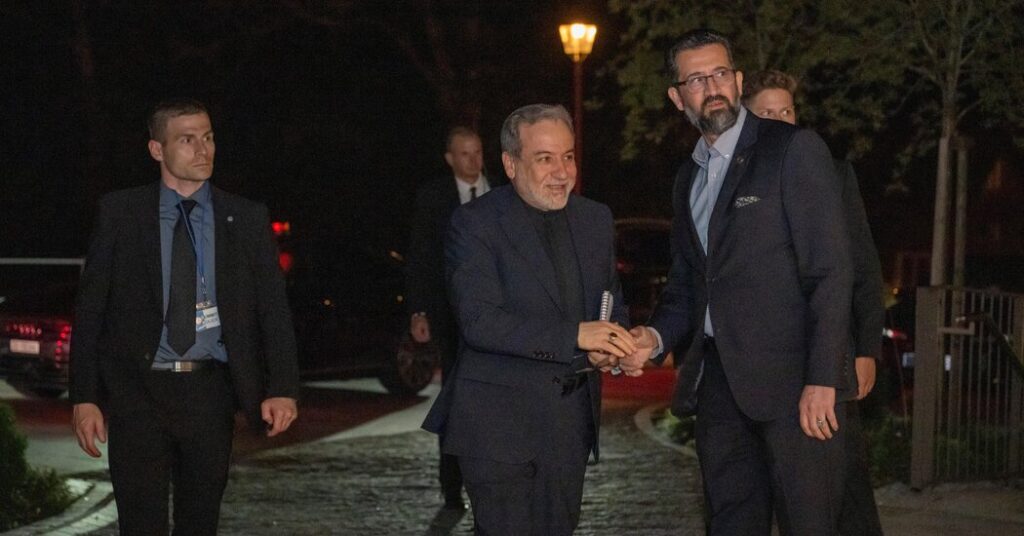
U.S.-Iran talks were set to begin in Switzerland on Sunday after the two countries signed an initial agreement last week to pause their war for 60 days and discuss terms for a longer-lasting peace.
The agreement provides Iran with major economic benefits in return for opening the Strait of Hormuz, a crucial waterway for oil and gas shipping, among other provisions. And talks are later expected to turn to how Iran will restrict its nuclear program and what kind of sanctions relief it will receive in turn.
Here are some of the key Iranian figures in the negotiations.
Mojtaba Khamenei
Iran’s most powerful man, Ayatollah Mojtaba Khamenei, 56, is largely an enigma. Most Iranians have never heard him speak or seen him in public since he took over as supreme leader in March.
He assumed the position after his father, Ali Khamenei, was killed in a strike at the outset of the U.S.-Israeli war against Iran and has since communicated only through a few written statements. He is believed to have been injured in the U.S.-Israeli attacks that began in February, though the circumstances and extent of his injuries are unclear.
Despite his physical absence, Mr. Khamenei would have to assent to whatever his negotiators hammer out with the United States. On Thursday, he released a statement claiming that while he disagreed with signing the interim deal, he had given his permission based on assurances from Iran’s president, Masoud Pezeshkian.
In another message issued in April, he wrote that Iran would retain its nuclear capabilities, that Iran planned to manage the Strait of Hormuz and that the United States had no place in the Persian Gulf region. Those positions are likely be tested in the coming negotiations.
Abbas Araghchi
Mr. Araghchi, 63, Iran’s foreign minister, served for nearly a decade with the powerful Iranian Revolutionary Guards Corps during the Iran-Iraq war. When that conflict ended, he joined the Ministry of Foreign Affairs, rising to ambassador in Helsinki and Tokyo, where a U.S. Embassy official found him to be polished and skilled.
Mr. Araghchi played a significant role in negotiating the 2015 nuclear deal that Iran struck with former President Barack Obama and other world leaders. Wendy Sherman, who led the American negotiating team during those talks, has described him as “a very tough negotiator.”
Mr. Araghchi, who comes from a family of carpet dealers, wrote in his 2025 memoir about the principles of bargaining as he saw them — repetition, “combined with steadfastness and persistence.” He added, “Insisting on positions and repeating demands is a necessity that must be done each time with different rhetoric and reasoning.”
The Iranian negotiating style, he wrote, “means continuous and tireless bargaining. It requires a lot of time and energy, and he who gets tired and bored quickly will lose.”
Mohammad Bagher Ghalibaf
Mr. Ghalibaf, 64, Iran’s speaker of Parliament, is leading the negotiating team. He is a brigadier general, having also served in the Revolutionary Guards, and was a key figure overseeing the Iranian side of the war with the United States and Israel.
Mr. Ghalibaf said in an interview with state television on Wednesday that Iran had not allowed Israel and the United States “to achieve the kinds of objectives that they themselves had announced when they began the war.”
“They reached none of those goals,” he said.
Mr. Ghalibaf ran for president several times unsuccessfully, and he served as mayor of Tehran, Iran’s capital, a tenure marked by accusations of financial corruption, which he has denied. He is a conservative, but not known as a strong, hard-line ideologue on social issues.
At the same time, Mr. Ghalibaf has shown that his red line is the Islamic Republic’s survival and that he will repress dissent harshly to ensure it. He labeled the most recent wave of protests, which the government brutally put down in January, as “sedition.”
He was one of two dozen Revolutionary Guard commanders who wrote a letter to President Mohammad Khatami in 1999, effectively telling him that they would crack down on student protests if he did not act first.
In an audio recording obtained and released by news organizations and a human rights group, Mr. Ghalibaf bragged about beating and threatening anti-regime protesters and managing the repressive response to the 2009 Green Movement protests in Tehran.
The post Three Men Are Key to Iran’s Approach to U.S. Talks appeared first on New York Times.