As the war in Iran appears to come to a fragile close, Americans are left to wonder why it has accomplished so little. How could a middle power like Iran — geopolitically isolated, economically on the ropes after years of sanctions and beset by widespread protests — face down a global superpower that spent $29 billion and counting to end up in a weaker position than it started?
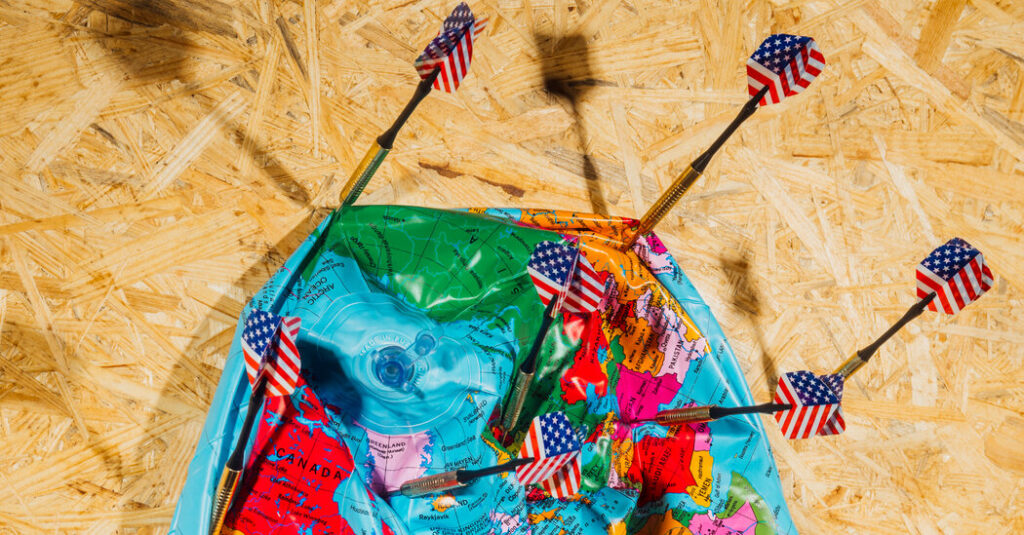
Put simply: Because the United States attempted to essentially go it alone. Acting only with Israel, President Trump believed he could use the unparalleled might of the U.S. military to overwhelm Iran and force it into submission. The president did not seek approval from the U.N. Security Council, as required by the United Nations Charter, making the war illegal from the start and thus radioactive for many of America’s traditional allies. He did not consult with partners in the region before starting a conflict that put them at direct risk. He was confident that if he dropped enough bombs, he would get what he wanted.
He was wrong. President Trump failed to understand that two can play at that game: Iran illegally closed the Strait of Hormuz by threatening to attack ships that entered. It launched drones and missiles against its neighbors. By the time President Trump decided to seek wider support to stop Tehran, it was too late to build a coalition. Even our NATO allies were unwilling to join his illegal war of choice, even though they, too, suffered from the crippling economic effects of Iran’s response.
Indeed, nations long allied with the United States did not just refuse calls to assist in the war; they wanted nothing to do with it. Several states, including stalwart allies, closed their airspace and bases to U.S. forces participating in the war effort. Spain denied both airspace access and the use of joint U.S.-Spanish bases for operations tied to the Iran conflict. France refused overflight for planes carrying U.S. military supplies to Israel. Italy and Switzerland restricted access, too. Britain, which has long celebrated its “special relationship” with America, engaged in an agonized debate about whether to allow its bases to be used, finally deciding to let U.S. forces rely on them only for “defensive” operations. “We are not getting involved in offensive action that the United States and Israel are taking,” Prime Minister Keir Starmer said.
The war in Iran has made one thing clear: Even the most powerful state in the world is not all that powerful when it decides to act alone. This is a lesson with implications that extend far beyond the war in Iran. It cuts to the heart of the problem with the president’s global strategy: Mr. Trump wants to make America great again, but he fails to understand that what made America great was not its power to achieve its ends unilaterally but its singular ability to build international institutions that embodied its values and interests and that others wanted to join.
The United Nations is a case in point. The first draft of the U.N. Charter was written in the State Department. Under Secretary of State Sumner Welles spearheaded a working group that envisioned an international body that would help keep the peace after World War II so that the United States would not again have to send its soldiers to stop “savage and brutal forces seeking to subjugate the world.” The United Nations embodied the values for which the United States fought — including the prohibition of territorial aggrandizement and the abandonment of the use of force. Today, however, the Trump administration has repeatedly waged war in violation of the charter the United States drafted, not just in Iran, but in Venezuela and with lethal boat strikes in the Caribbean.
The president’s unilateral economic policies have also undermined the postwar Bretton Woods institutions and agreements that fueled U.S. global economic dominance in the postwar era. These bodies not only reflected America’s commitment to global free trade and economic liberalism, but also helped ensure the dollar’s role as the world’s reserve currency, which in turn has allowed the United States to borrow cheaply and leverage the dollar as a sanctions tool that no other country can match.
As the United States is stepping away from its historic role leading global institutions, China is stepping in. On his first day back in office, Mr. Trump ordered the U.S. withdrawal from the World Health Organization, to which the United States had been the largest donor. China answered by pledging $500 million to the W.H.O. over five years, positioning itself to replace the U.S. as the organization’s top state donor. While the United States relinquishes its seats on several U.N. leadership bodies, China is eagerly seeking more. It is now the second-largest funder of the U.N., behind the United States, and could soon seize the lead — and the influence that comes with it.
The deal Mr. Trump just signed with Iran again demonstrates his preferences both to sideline allies and rely on force. Whereas the Joint Comprehensive Plan of Action that the Obama administration negotiated to prevent Iran from obtaining a nuclear weapon — which Mr. Trump scrapped during his first term in office — was a joint agreement between Iran and the five permanent members of the U.N. Security Council plus Germany, the new deal is just between the United States and Iran. And it is backed by Mr. Trump’s threat to return to bombing. If Iran doesn’t follow through, he pledged, “We’ll go right back to dropping bombs right smack in the middle of their head.”
The profound damage done by President Trump’s go-it-alone strategy is only beginning to be felt. Our allies, having learned that we cannot be trusted to abide by the core values of the international system we helped create, are now busy hedging against a mercurial United States. Nations are making trade agreements that do not include us. They are building up their militaries so they no longer need us. They are forming coalitions that do not include us.
It will take time for the full bill to come due. Many of our longtime allies are still highly dependent on us and still fearful of what President Trump might do if they stand up to him. But that will not always be true. The more states learn we no longer stand for the values we once championed, the more we will be left to go it alone, even when it is no longer our choice to do so. President Trump may think our power over other nations comes just from our might. What the war in Iran should teach him, and all of us, is that our power also comes from other nations believing our might is right.
Oona A. Hathaway is a professor of law and political science at Yale and is a nonresident scholar at the Carnegie Endowment for International Peace and the president of the American Society of International Law.
The Times is committed to publishing a diversity of letters to the editor. We’d like to hear what you think about this or any of our articles. Here are some tips. And here’s our email: [email protected].
Follow the New York Times Opinion section on Facebook, Instagram, TikTok, Bluesky, WhatsApp and Threads.
The post You Can’t Be a Superpower Without Allies appeared first on New York Times.