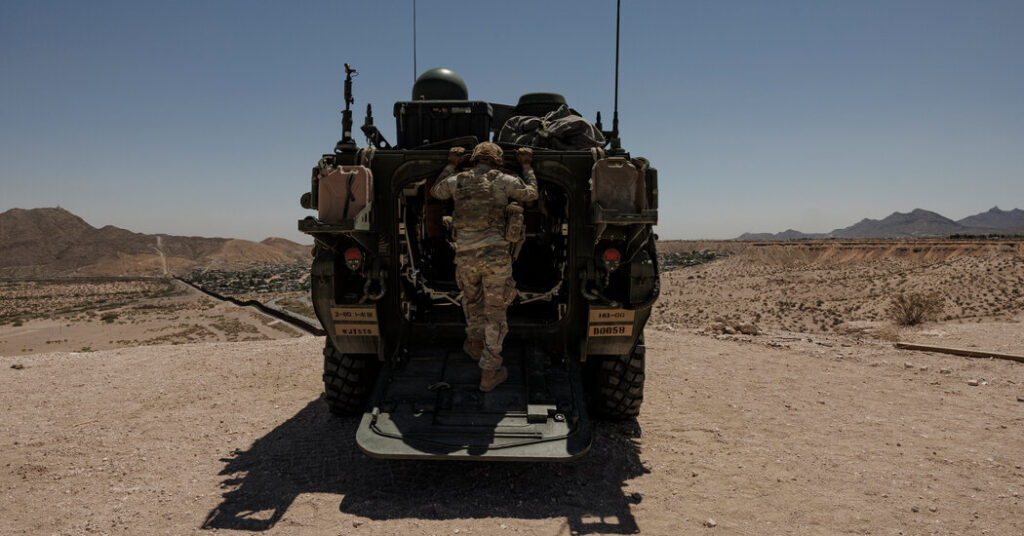
For more than a year, the Pentagon has deployed about 9,000 active-duty troops along nearly 2,000 miles of the southwest border to confront illegal migrants, smugglers and drug cartels.
The troops are still there — at a cost of tens of millions of dollars each week — even though the Trump administration months ago largely achieved its goal of slashing illegal crossings.
The military patrols, working closely with Customs and Border Protection as well as the Mexican military, have pushed Mexican cartels and smugglers into more remote mountainous areas to evade detection.
But threats to American troops are on the rise, U.S. officials say.
Some members of Congress have questioned whether the patrols are the best use of active-duty troops who would otherwise be training for deployments to Eastern Europe, the Middle East or the Indo-Pacific region. Lawmakers and independent analysts have voiced concerns that the border missions will distract from training, drain resources and undermine readiness.
The mission marked a milestone late last month when its third commander, Maj. Gen. Curtis D. Taylor of the Army’s First Armored Division, took control of one of the centerpieces of the Trump administration’s Western Hemisphere security policy.
Challenges abound for the troops involved in the mission, which the military calls Ardent Vanguard.
Cartel activity increased along the border in February after Mexican forces, aided by the C.I.A., killed a notorious Mexican cartel leader known as El Mencho. Soon after, U.S. service members discovered that their phones had been hacked, and they began receiving threatening messages, congressional officials said.
“I’m very concerned about this operation and the safety of our Marines,” Representative Sara Jacobs, a California Democrat on the Armed Services Committee, said at a hearing in March. “Our service members did not sign up for immigration enforcement, and this political stunt is putting their lives at risk.”
While U.S. forces deployed to the southern border use several counter-drone systems, the general in charge of helping defend U.S. territory said that many troops lacked adequate technology for patrols.
“It presents us a different challenge,” Gen. Gregory M. Guillot, the head of the military’s Northern Command, said at a security conference in Tampa last month. He noted the overall increase in anti-drone technology.
Unlike the drone wars on the battlefields of Ukraine or Iran, there have been no drone attacks on either side of this border conflict and no American casualties, military officials say.
The mission to detect and interdict illegal activity across hundreds of miles of desert and mountainous frontier has also become a high-stakes proving ground for emerging technology, including counter-drone devices, remotely guided sea vessels and advanced sensors.
General Guillot said at a change of command ceremony in Arizona last month that the military had for the first time conducted joint patrols with Mexican soldiers using encrypted radios and high-energy lasers to knock down potentially hostile cartel-operated drones.
“My mission is to control the border,” Maj. Gen. David W. Gardner, the commander of the 101st Airborne Division, said in a phone interview from Fort Huachuca, Ariz., before handing off the operation to General Taylor. “We remain focused on the mission of sealing the border.”
Asked about confronting the drones and other security threats posed by the Mexican cartels, General Gardner said that U.S. forces had disabled or knocked down drones that the cartels use to find new smuggling routes around the American patrols.
“The illicit actors are finding it more and more difficult to accomplish their objectives,” General Gardner said.
Indeed, the military has flown more than 800 surveillance and reconnaissance flights since the mission started in early 2025, up from about 160 a year earlier, according to Northern Command. Flying in support of the operation are Air Force U-2 Dragon Lady, RC-135 Rivet Joint, and RQ-4 Global Hawk surveillance aircraft, the command said.
The troops have been supporting law enforcement agencies, fanning out on foot patrols, in helicopters and in combat vehicles to serve as a deterrent, and to give the authorities more eyes and ears on the ground.
These efforts have provided evidence to both sides of the debate over the usefulness of sending frontline combat forces to the border: They appear to be deterring cartels, making life somewhat harder for human smugglers, and giving soldiers and Marines a chance to hone some skills. But the financial costs and the consequences for long-term combat readiness are still unclear.
Senator Jack Reed of Rhode Island, the top Democrat on the Armed Services Committee, expressed concern at a hearing last month that the border mission was siphoning money from important training missions. He said the Army faced a nearly $2 billion budget shortfall largely because the Department of Homeland Security had not reimbursed it for border-support missions.
“I have received concerning reports about the potential for canceling training rotations, grounded flight hours, and reduced Guard and Reserve training resources,” Mr. Reed said, referring to the National Guard and Army Reserve. “These are real costs for real units.”
But several commanders and some troops stationed along the border said in interviews — some of them recent — that serving in one of Mr. Trump’s highest-priority missions gave them purpose. They are using many of their skills — route planning, mission rehearsals, patrols and surveillance flights — in the real world against criminal smuggling gangs and Mexican drug cartels, instead of just practicing at their home bases or in exercises, they said.
There is no end in sight for the military mission on the border. The Pentagon said last May that the first four months of the operation cost $525 million. But the department declined to say what the total cost was now.
The military has also expanded its territorial authorities to help interdict migrants. The Pentagon has created five narrow strips of land along the border with Mexico — one in California, one in Arizona, one in New Mexico and two in Texas — effectively turning them into parts of nearby U.S. military bases.
Migrants entering the strips are considered trespassers and can be temporarily detained by U.S. troops until Border Patrol agents arrive.
So far, the military says it has temporarily detained 116 individuals in these five sectors before Border Patrol agents took them into custody.
The post No End in Sight for U.S. Military Mission Along Border With Mexico appeared first on New York Times.