The antifederalist opponents of the Constitution worried that the office of the presidency was too powerful.
“To be the fountain of all honors in the United States,” An Old Whig wrote in December 1787, “is in reality to be a king.”
The antifederalists were certain that at some point a man of low character would take office and twist the government to his own narrow ends. “He will spare no artifice, no address, and no exertions, to increase the powers and importance of it,” argued the Federal Farmer. “The servile supporters of his wishes will be placed in all offices, and tools constantly employed to aid his views and sound his praise.”
The antifederalists especially feared that the president would use his pardon power to corrupt the nation. “The unrestrained power of granting pardons,” Cato wrote in November 1787, “may be used to screen from punishment those whom he had secretly instigated to commit the crime, and thereby prevent a discovery of his own guilt.” A president possessed of enough ambition, Cato went on, “has power and time sufficient to ruin his country.”
The antifederalists, like their Federalist counterparts, drew their examples from both distant history and recent experience. The tyrant, as they imagined him, was both a figure of antiquity — a man, as Aristotle wrote, with “no regard to the common good, except for his own advantage” — and their former king, “A Prince, whose Character is thus marked by every act which may define a Tyrant, is unfit to be the Ruler of a free People.”
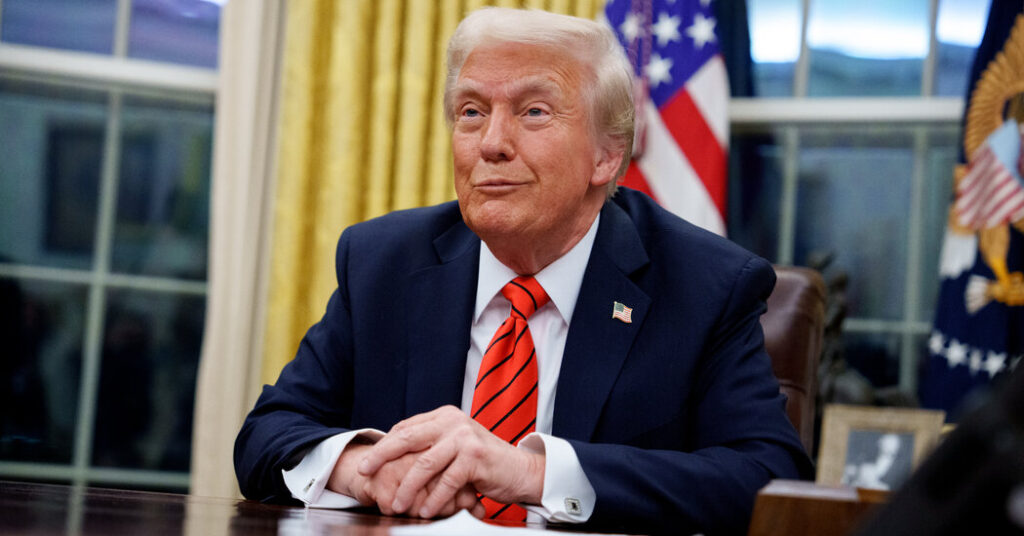
From the vantage point of 2025, the antifederalists might as well be describing not a king, but Donald Trump, who seems to embody their every nightmare: the man who ascends to high executive office “without the virtue, moderation and love of liberty” needed to preserve republican government and who would rather “die a thousand deaths rather than sink from the heights of splendor and power, into obscurity and wretchedness.”
And Trump, just as they feared, is busy abusing one of the great powers of the presidency — the pardon.
Last month, I wrote about the president’s corruption — the simple fact that Trump is the uncontested leader in presidential graft and influence trading. He and his family have made billions of dollars off the presidency, from crypto deals seemingly shaped by the promise of government intervention on behalf of the industry to more penny-ante fare that amounts to selling access to the president by way of his clubs and resorts around the world.
The president’s corruption does not end there. It extends beyond payola to include flagrant abuse of his constitutional authority. Specifically, Trump has weaponized the pardon as a tool of executive lawbreaking and misconduct.
To be clear, Trump is not the first president to issue problematic pardons — far from it. George H.W. Bush pardoned Elliott Abrams, Caspar Weinberger and several others for their roles in the Iran-contra scandal under Ronald Reagan. Bill Clinton pardoned his brother, Roger Clinton, for a 1985 conviction for drug-trafficking and cocaine possession, as well as Marc Rich, a prominent financier with connections to the Democratic Party who had fled the United States while being prosecuted for tax evasion. George W. Bush commuted the sentence of his assistant I. Lewis “Scooter” Libby, who had been convicted of perjury in connection with the public identification of Valerie Plame as a covert C.I.A. agent, and Joe Biden broke a promise of impartiality to issue a pardon to his son Hunter — who had been convicted on charges related to illegal gun possession — which included clemency for any “offenses against the United States which he has committed or may have committed or taken part in during the period from Jan. 1, 2014 through Dec. 1, 2024.”
These were objectionable pardons. And yet they pale in comparison to the growing number of outrageous pardons issued by President Trump, beginning with his blanket pardon of those rioters involved in the Jan. 6, 2021 attack on the United States Capitol, along with a pardon for the former Proud Boys leader Enrique Tarrio and a commutation for Stewart Rhodes, founder of the Oath Keepers.
This is the exact kind of pardon the antifederalists feared would happen under a tyrannical executive. The rioters, working on behalf of Trump, tried to overthrow constitutional government in the United States. And Trump, with gratitude, has freed them to try again.
In addition to his co-conspirators in the effort to “Stop the Steal,” Trump has also pardoned a number of white-collar criminals. In March, he pardoned the founders of a crypto exchange after they had pleaded guilty to money laundering. In April, Trump pardoned a nursing home chief executive, Paul Walczak, whose mother is a major Republican donor, and in October he pardoned Changpeng Zhao, a billionaire with connections to the Trump family’s crypto investments.
There is yet another set of Trump pardons meant for people convicted of fraud and political corruption. In May, Trump commuted the sentence of Lawrence Duran, who had been convicted of Medicare fraud and money laundering. That same month, he also commuted the sentence of Marian Morgan, who had been sentenced to a 35-year prison term for stealing millions of dollars from investors in a Ponzi scheme. Trump also pardoned Rod Blagojevich, the disgraced former governor of Illinois, as well as the former Republican congressman George Santos, who was serving a seven-year prison sentence for fraud and identity theft. Santos, Trump said, “had the Courage, Conviction, and Intelligence to ALWAYS VOTE REPUBLICAN!”
At its best, the presidential pardon has been used to show mercy — leniency for Americans who might be unjustly imprisoned or received sentences that were not commensurate with their offense. Not so the Trump pardons, which seem to be connected to his interests — personal, political and pecuniary — in one way or another.
As venal and scandalous as the president’s pardons have been, they aren’t yet as bad as they could be. Take the Supreme Court’s grant of presidential criminal immunity for “official acts” in Trump v. United States. Under the conservative majority’s theory of the Constitution, which treats the pardon as a “core power” shielded from judicial scrutiny, the president could order the assassination of a political rival and then pardon those involved without any violence done to the constitutional order.
At this moment, the president is issuing, through the secretary of defense, Pete Hegseth, orders to destroy civilian boats in the Caribbean. There is evidence, in the form of a Washington Post report that is disputed by the administration, that on Sept. 2 Hegseth told subordinates to kill everyone on board a vessel suspected of trafficking drugs. The boat was then attacked twice, even though two survivors were clinging to the wreckage caused by the first strike. In a formal conflict, this is a war crime. In the absence of a formal conflict — and the United States is not currently at war with Venezuela — it would be murder. If a congressional investigation were to lead to criminal charges for Hegseth, would Trump pardon him? Would he pardon others who might break the law on his behalf?
Unfortunately, there is nothing to be done right now about the president’s abuse of the pardon power. But if there’s an issue that demands constitutional amendment, it’s this one. Americans should give serious consideration to whether they want to amend the Constitution to restructure the president’s pardon power — to limit its scope and make it more subject to the checks and balances that are supposed to structure the American system.
Even without an amendment on the table, a future Congress could use its power and authority to speak about the Constitution to condemn the Trump pardons as an unconstitutional abuse of power. That Congress could say, through legislation, that the pardons are invalid. It could investigate the pardons and force the White House to explain itself. And in the almost certain event that this would then reach the Supreme Court, congressional action could push the court to state its view, so that the American people know where they stand if they decide to rein in the president’s authority.
Even so, there is only so much one can do with parchment barriers and institutional arrangements. No matter how well you design a political system, responsible government is not possible in the absence of civic virtue among either the people or their leaders. The best defense against abuse of the pardon — the best defense against the kind of system-threatening corruption that we’ve seen under Trump — is just not to put men like Trump into office.
Given the perennial problem of demagoguery in a democracy, this is much easier said than done.
The Times is committed to publishing a diversity of letters to the editor. We’d like to hear what you think about this or any of our articles. Here are some tips. And here’s our email: [email protected].
Follow the New York Times Opinion section on Facebook, Instagram, TikTok, Bluesky, WhatsApp and Threads.
The post Guess Which Presidential Power Trump Likes the Most appeared first on New York Times.