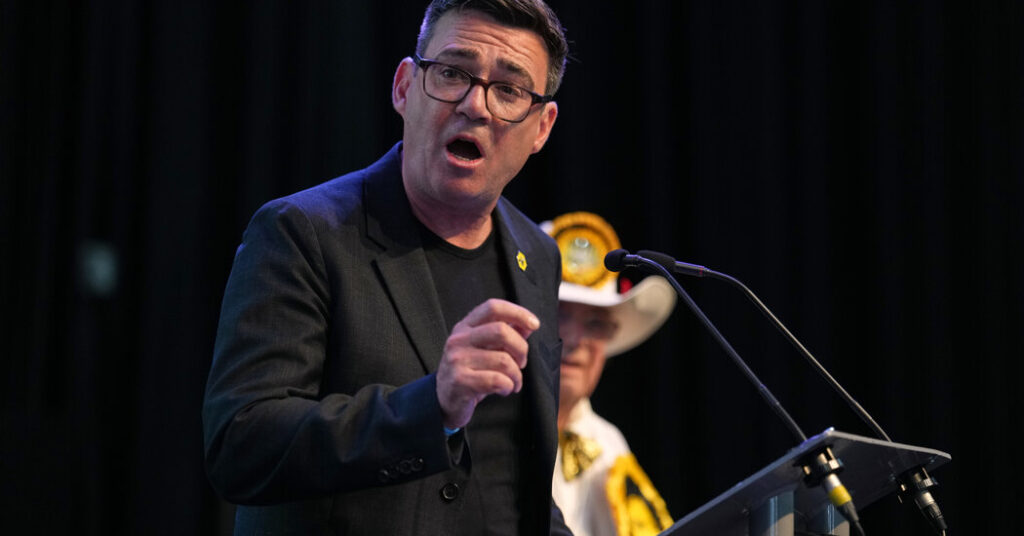
If Andy Burnham’s election to Parliament on Thursday results in him becoming Britain’s 59th prime minister in the weeks ahead, it will test the power of personality over policy.
Mr. Burnham, the 56-year-old former mayor of Greater Manchester, is a Labour Party politician, just like Prime Minister Keir Starmer. They both speak often of the importance of adhering to “Labour Party values.” They disagree in some areas about what that means, but so far there’s little to suggest that a Burnham government would differ drastically in policy terms from Mr. Starmer’s.
But many Labour Party lawmakers — spooked by how deeply unpopular Mr. Starmer has become among voters — appear convinced that Mr. Burnham, who is seven years younger, more charismatic and offers a more authentic personal style, will be able to shake the party, and the country, out of its doldrums.
“If the sausage isn’t going to change, when it comes down to it, all he’s really offering is some sizzle,” said Tim Bale, a professor of politics at Queen Mary University of London.
“But things have looked so bleak for so long for the government,” he said, “most Labour people would take that, hoping by sheer force of personality Burnham can persuade people to give the party a second look, a second chance.”
All of the challenges that have bedeviled Mr. Starmer will still be there if Mr. Burnham manages to make his way to Downing Street. The economic stagnation. The government debt. The underfunded defense and health care systems, each competing for scarce resources. The complaints of a growing tax burden. And the reality of an ascendant, anti-immigrant populism that has captured the support of up to a third of Britons.
During a special election campaign that lasted barely a month, Mr. Burnham offered a few clues as to how he might tackle those challenges. He talked about giving more power to local regions outside London, bringing utilities like water back under public control, cutting property taxes for small businesses and building more low-income housing.
But he also spoke to voters in sweeping generalities about the hope and change he thinks is needed in the country’s leadership.
“Everyone knows that politics isn’t working,” he told supporters in the wee hours of Friday morning after being declared the newest member of Parliament for Makerfield, a collection of coal villages and market towns in northwest England. “Everyone can feel that the country isn’t where it should be. Tonight could, just could, be the turning point.”
Mr. Burnham’s allies argue that, as someone born and raised in the northwest, he understands the frustrations of people who live outside of London, where economic struggles have deepened since the 2008 financial crisis, and since Britain left the European Union. They say he is an effective storyteller who can counter the inflammatory rhetoric of populist rivals and make people feel heard in a way that Mr. Starmer never seemed able to.
As mayor, Mr. Burnham won praise for bringing Manchester’s bus system back under public control, introducing free travel on bright yellow “bee buses” in the city center and capping fares at 2 pounds (about $2.65.) His efforts to create a clean air zone failed, but he was credited with helping to bring a wave of private investment into his city.
“The intention is to make politics work for those in the more deprived areas of the U.K.,” Ben Wellings, a professor specializing in British nationalism and politics at Monash University, Australia, wrote on Saturday. He said Mr. Burnham could “start to make voters in that part of Britain feel heard.”
“Many of us are impatient to deliver for our constituents, and we see the best path for that is with Andy Burnham leading,” Rachael Maskell, a Labour member of Parliament from York, told BBC Radio on Friday. Patrick Hurley, an MP from Southport, told the program that “right now we need a transition to something new.”
There are plenty of precedents in politics for charisma and personality prevailing over detailed policy plans. When Boris Johnson, the larger-than-life Conservative Party politician, won an internal leadership contest to succeed Theresa May as prime minister and then triumphed in the 2019 general election, it was his jovial, pugnacious style that drove his success.
And in the United States, President Trump has campaigned and governed by creating a cult of his own personality to power the Make America Great Again movement, complete with banners of his face hanging on government buildings and his name emblazoned on everything he can find.
Mr. Burnham is not a commanding presence like Mr. Trump or a soaring orator like former President Barack Obama. But after an earlier stint in Parliament and government, he has spent nine years as a regional mayor distancing himself from the inside-Westminster politics that so many voters despise.
During Covid, his defiant performances in which he stood up to the national government on behalf of Manchester earned him the nickname “King of the North.”
In the end, the most powerful incentive for Mr. Burnham’s Labour colleagues in Parliament to support him may be their desire to win, and to prevent Reform U.K., the populist, right-wing party led by Nigel Farage, from forming the next government.
With Mr. Starmer at the helm, Labour has been struggling in the polls and at the ballot box. They lost a special election in February to the Green Party. Reform has consistently outperformed them in public opinion surveys for more than a year.
On Thursday, Mr. Burnham not only won his race, but he also did so in decisive fashion. Running against 13 other candidates, he received almost 55 percent of the vote, more than all of the other candidates combined. He easily bested the candidate from Reform U.K.
That is the kind of result that Labour lawmakers want.
”Starmer is clinging to his job as U.K. prime minister by his fingertips after Burnham’s spectacular victory,” Mujtaba Rahman of the Eurasia Group wrote on Friday in an analysis of the outcome. He said Mr. Burnham’s supporters “will put maximum pressure on Starmer — initially in private and if necessary in public — to opt for a ‘dignified exit.’”
So far, the prime minister has resisted that pressure. In interviews on Friday, he dutifully congratulated Mr. Burnham for keeping the Makerfield area in the Labour family. But he also vowed to fight to keep his job for the three years left in his five-year term.
“The one thing we’ve got to avoid doing is plunging our party and our country into chaos by turning on each other and tearing apart our party and our movement,” Mr. Starmer said.
The decision to resign may become more appealing to Mr. Starmer if his cabinet colleagues turn on him. The prime minister could decide to step aside in an orderly transition to avoid the kind of messy, intraparty pain that he says he doesn’t want, and to protect what remains of his legacy.
Either way, Mr. Burnham might eventually discover what Mr. Starmer did after the Labour Party won a parliamentary majority in 2024 — albeit on just 34 percent of the vote, a historically low share.
Voters can be very fickle, and it may take more than just a winning personality to find a long-term solution to Britain’s woes.
The post Britain Is Set to Test How Far Charisma Can Shift Electoral Dynamics appeared first on New York Times.