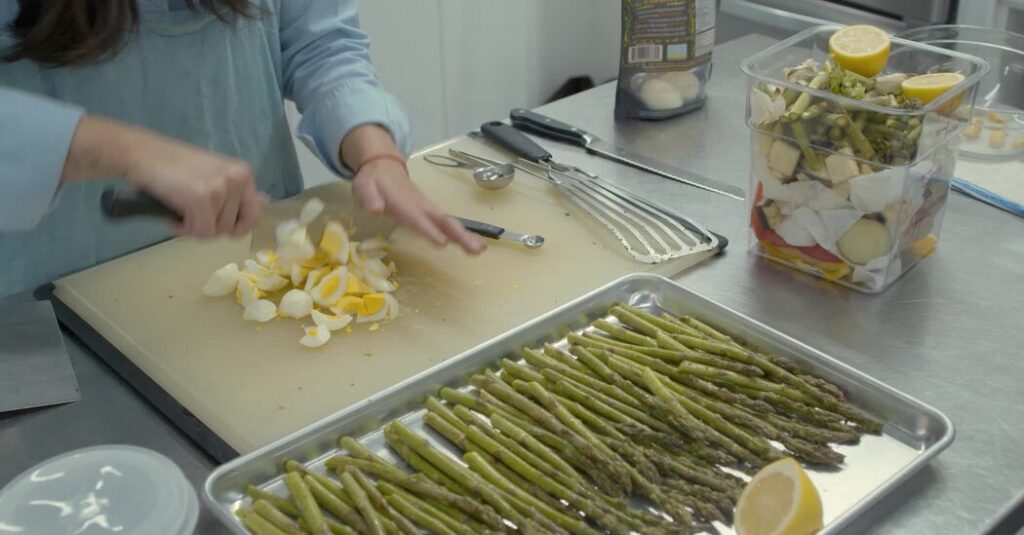
As the smell of sizzling bacon wafted through the air, dozens of recipe developers, food stylists and photographers bustled about, misting bottles of wine with Evian to portray the perfect drops of condensation and dusting chocolate shavings over a fluffy peanut butter pie.
This is what Neil Vogel likes to think of as his “secret weapon” in the new era of artificial intelligence: a 40,000-square-foot test kitchen just outside Birmingham, Ala.
Mr. Vogel, the chief executive of People Inc., one of the country’s biggest digital and print publishers and the home of brands like Food & Wine, People, Entertainment Weekly, Allrecipes and Southern Living, has already seen chatbots upend search traffic and A.I.-generated slop flood the internet. And he is betting that readers would rather make a recipe created by someone who knows how to handle a chef’s knife than one generated by a robot.
People Inc., which already creates more food-related content than anyone else, is ramping up the production of social media videos out of the 28-kitchen complex and leaning into the human element behind its recipes: Each one is developed, tested and retested by people. A.I., after all, famously recommended using glue on a pizza.
“What has happened in this world of A.I., particularly around food, is nobody knows what’s real and what’s good,” Mr. Vogel said in an interview. “Everybody who cooks has at this point used an A.I. recipe that doesn’t work, because you can’t take four recipes and synthesize them together.”
The kitchen hub was opened in 2016 by what was then Time Inc. Through a series of mergers reflecting the consolidation of the magazine industry, Time Inc. eventually became part of People Inc., which up until 2025 was known as Dotdash Meredith.
Honoring that spirit of name-changing, People Inc.’s parent company, IAC, announced in April that it would now be known as “People Incorporated” to reflect a focus on its publishing business. That decision was deliberate in the age of A.I., said Barry Diller, the chairman of People Incorporated.
“Until we get to the final simulation, people are the only really valid, honorable and positive endeavor that People Inc. can take,” he said in an interview.
The Birmingham facility develops some 1,800 new recipes a year and tests an additional 5,300. Downstairs is a prop storage room, bursting with a rainbow of crockery, glassware and table linens in every fabric imaginable. The facility also has a “lab” that has evaluated more than 3,000 products to date, mostly kitchen appliances.
For years, the hub was almost entirely focused on creating content for the company’s print magazines. By late 2022, Mr. Vogel saw a need to change. He and other executives at the company had just met with Sam Altman, the chief executive of OpenAI, who was showing them the abilities of ChatGPT before it was released publicly that November.
“We walked out of that room, and we just looked at each other: ‘This is a new world,’” Mr. Vogel recalled.
Traffic to People Inc. websites from Google has plummeted to 25 percent of visits, from 75 percent, over the last four years because of the search platform’s use of A.I. summaries. So the company quickly pushed to build new audiences on platforms like Instagram, Apple News and YouTube and to find other ways to make money, through events, sponsorships and licensing deals.
To encourage readers to keep returning to its websites, People Inc. started MyRecipes, a free product that allows them to save recipes from the publications; it now has more than three million users, Mr. Vogel said. On Tuesday, People Inc. announced that it had acquired Hot Luck, an annual food and music festival in Austin, Texas.
And the test kitchen facility was reoriented to make more social media videos for People Inc.’s food brands. With 13 photo studios and three video studios, it now produces about 175 videos a month.
“The fundamentals of what we’ve been doing here haven’t changed, but the way we’re doing it keeps changing so fast,” said Allison Lowery, the vice president of content studios.
On the day The New York Times visited the test kitchens, one recipe developer was working on a Pub Sub Dip for Southern Living — a homage to a famous sub sandwich from the Publix grocery chain that had been trending on social media. In another area, a food stylist was being filmed demonstrating how to fold onigirazu, a kind of sushi sandwich.
In another kitchen, some members of the staff were testing a creamy tomato aspic, a retro, cantaloupe-hued gelatinous mold studded with olives and sweating under the studio lights. It was part of a new project by Southern Living, which has been in publication since 1966, to test and digitize its vast archive of recipes, which include more than 20,000 that have never been published online.
“A.I. can’t smell what something smells like,” said Sid Evans, the editor in chief of Southern Living. “It can’t taste. It doesn’t understand nostalgia. And I think we are able to communicate all of that, and the expertise that we have.”
Mr. Vogel is quick to acknowledge he is not an A.I. denialist. People Inc. has a licensing agreement with OpenAI, and uses it both for research and to make operations more efficient by monitoring social media or pricing out ingredients. A.I. is not used for writing, editing, visuals or other creative work at any of the brands, he said.
Not all of People Inc.’s decisions are as people-focused. It has shed nearly 1,000 workers since 2021, mostly reductions from halving the number of magazine titles it prints to seven from 14. Mr. Vogel said in the interview that People Inc. was profitable and growing; the company has reported 10 straight quarters of digital revenue growth.
For now, the leaders of People Inc.’s food brands say they are seeing evidence that their strategy is resonating with readers, who hold the company’s recipes and videos to a high standard.
In January, Food & Wine posted an Instagram photo of a freshly made bowl of nikujaga, a Japanese meat-and-potato stew. Several commenters quickly decried it as the work of artificial intelligence.
It “got my hackles raised,” said Hunter Lewis, the editor in chief of Food & Wine. He defended the post in his magazine column, listing by name the nine humans who had worked to assign, develop, test, taste, style and shoot the recipe.
But he soon realized the commenters’ outrage wasn’t an insult.
“It’s really encouraging to me, actually,” Mr. Lewis said. “People are paying for our products because of that level of trust and that expectation of quality, and it’s not made by a machine.”
The post The Giant Test Kitchen Where Cooks Battle A.I. Slop appeared first on New York Times.