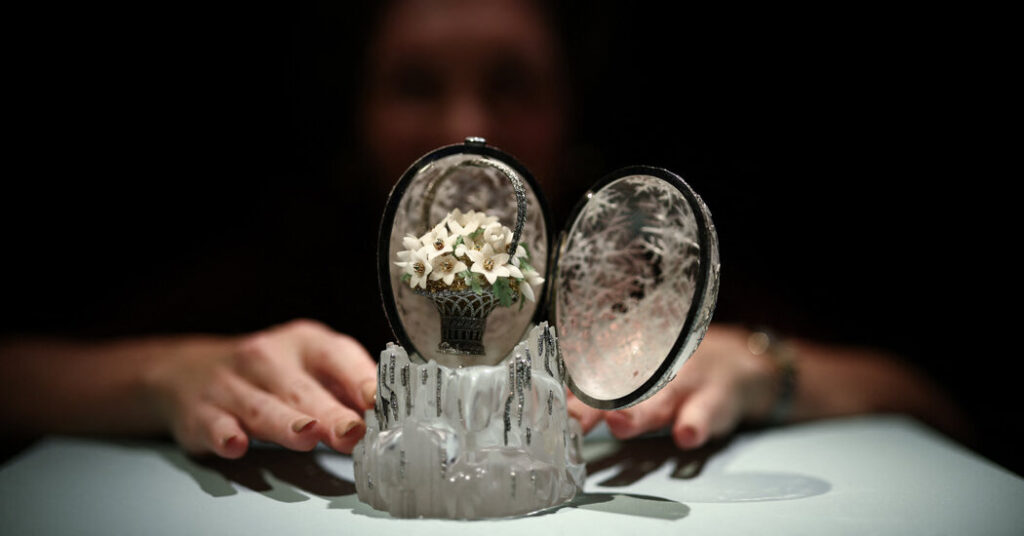
A crystal Fabergé egg laced with platinum snowflakes and encrusted with thousands of tiny rose diamonds sold in London on Tuesday for more than $30 million, an auction record for a creation by the famed Russian jeweler.
The Winter Egg was created in 1913 for Czar Nicholas II of Russia, four years before the Romanov empire collapsed in the Russian Revolution. It was one of 50 Easter eggs that Fabergé is known to have created for the Russian imperial family between 1885 and 1917.
The eggs, with their intricate motifs, enameling and fine jewelry work, came to symbolize the wealth and the extravagance of the Romanovs. And more than a century after their fall, the extraordinary workmanship and scarcity of these eggs still inspire collectors to shell out millions of dollars for a single piece.
Here’s what to know about Fabergé eggs, starting with the one that went under the hammer this week:
The Winter Egg is considered one of Fabergé’s best.
The House of Fabergé made the Winter Egg for Nicholas II to present to his mother, Dowager Empress Maria Feodorovna, on Easter in 1913, the 300th year of the Romanov dynasty.
It was designed by Alma Pihl, one of the most celebrated designers at Fabergé. The Winter Egg sits on a pearly base made of crystal rock that looks like a block of melting ice, and holds inside it a small platinum flower basket filled with miniature wood anemones. It was the third most expensive egg Fabergé produced for the Russian royal family, according to Christie’s.
A few years later, after Nicholas II abdicated, the egg was among the Romanov valuables that came into the possession of Russia’s new communist rulers. The Soviet government sold many of the items to raise funds. The Winter Egg ended up with the Wartski Gallery in London in the late 1920s, according to Christie’s.
The egg was considered lost since the 1970s, but was rediscovered in the 1990s. It was auctioned twice after that, first in 1994 and then in 2002, each time breaking the auction record for a Fabergé item. It broke that record again on Tuesday with the $30.2 million sale to an unnamed buyer, according to Christie’s.
Fabergé Eggs were an Easter tradition for the Czars.
Czar Alexander III, Nicholas II’s father, commissioned the first egg from Peter Carl Fabergé in St. Petersburg, Russia, as an Easter present for his wife. Known as the Hen Egg, its exterior is white with a band of gold around the center. The egg twists open to reveal a gold yolk in which lies a gold hen. It was the first of 50 eggs the jewelry house is believed to have finished for the Romanovs, and were known as imperial eggs.
Alexander III gave a Fabergé egg to Maria Feodorovna every Easter after that until his death. Nicholas II continued the tradition, but commissioned two per year: one for his mother and another for his wife, Alexandra.
Fabergé spent a year working on each egg and did not reveal details during their production because the czar liked to be surprised, according to Christie’s. Some of the notable pieces include the Mosaic Egg, another Alma Pihl design and the most expensive one produced by the house. This egg is studded with tiny pearls, diamonds, sapphires and other precious gems and contains a plaque with the portraits of five Romanov children.
There is also the Coronation Egg, which Nicholas II gave to Empress Alexandra in 1897 to mark his ascension to the throne. This egg includes a compartment with a replica of a coach Alexandra used.
Only a handful of Fabergé imperial eggs are in private hands.
The whereabouts of only 43 imperial eggs are known. They are spread across museums and trusts around the world. According to Christie’s, fewer than 10 are privately owned.
The Fabergé Museum in St. Petersburg has nine imperial eggs, and another three are held by the Royal Collection Trust in London. In the United States, there are five at the Virginia Museum of Fine Arts in Richmond and one at the Cleveland Museum of Art.
An unnamed buyer purchased the Third Imperial Egg, which contains a watch, for $33 million in 2014, according to Fabergé.
Jin Yu Young is a reporter and researcher for The Times, based in Seoul, covering South Korea and international breaking news.
The post A Prized Fabergé Egg Is Sold at Auction for More Than $30 Million appeared first on New York Times.