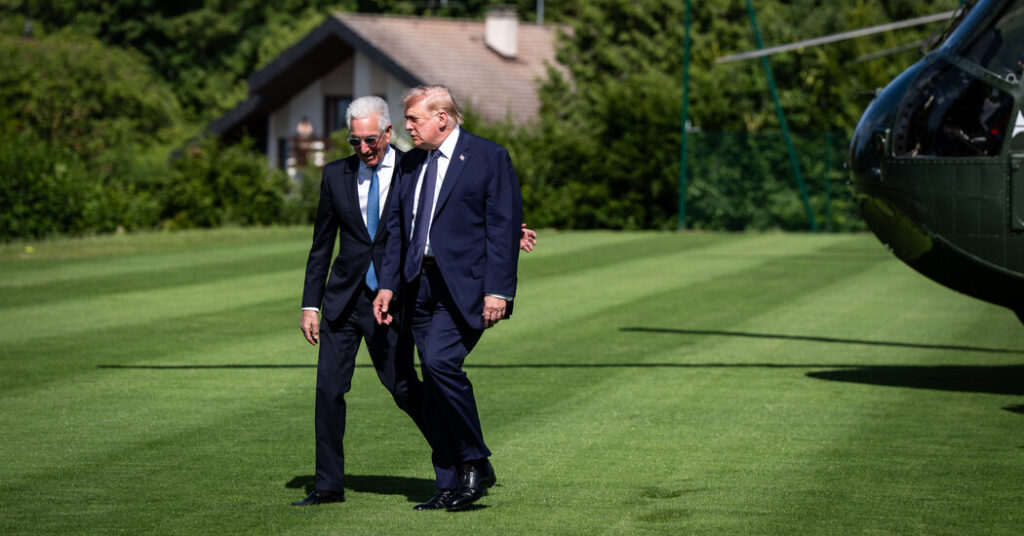
Four days before marking the 82nd anniversary of the D-Day landings in Normandy, Charles Kushner, President Trump’s ambassador to France, made a quieter pilgrimage to a military cemetery in eastern France. There, he recited the Kaddish prayer over the graves of five Jewish American soldiers killed in World War I.
It was a solemn act of commemoration for Mr. Kushner, an Orthodox Jew who puts his faith at the heart of his diplomacy. But it is his full-throated advocacy on behalf of Jews living in today’s France that has drawn more attention, and reproach, in Paris, where he has cut a Trumpian swath through its decorous salons.
Mr. Kushner, whose son Jared is married to Mr. Trump’s daughter Ivanka, clashed with his French hosts weeks after arriving last July when he accused them of not doing enough to combat antisemitism. Nearly a year later, he contends the problem has gotten worse — so much so that he has suggested the Trump administration grant refugee status to French Jews, even as it otherwise scales back asylum provision.
“It would be an objective of mine to have, for the Jewish population here, more options to go to America rather than the option of only going to Israel,” Mr. Kushner said in an interview last week in his baronial residence in Paris. “They live in fear and they feel abandoned by this government.”
Statements like that, which he first put in an open letter to President Emmanuel Macron last August, have burned his bridges with the French Foreign Ministry. Mr. Kushner, 72, has been summoned twice to be rebuked for interfering in France’s internal affairs — snubbing both requests — after which the foreign minister, Jean-Noël Barrot, threatened to forbid him from meeting with French officials.
In February, he was called in after the U.S. Embassy reposted State Department comments that raised concerns about the beating death of a young far-right activist by far-left gangs. Mr. Barrot rejected what he called efforts to politicize a tragedy, saying, “We have no lessons to learn from the reactionary international movement.”
Such clashes, which once would have raised doubts about Mr. Kushner’s suitability for a diplomatic post, mark him as a fitting emissary for the age of Trump. He is not merely an in-law given a plum job but also a faithful messenger of Mr. Trump’s hostility toward Europe, whether that means pushing the fight against antisemitism or meeting with far-right political leaders. Mr. Kushner is among the best connected of a corps of ambassadors who have cast aside diplomatic niceties to channel a disdainful president.
“You know, America and France disagree on a lot of issues,” Mr. Kushner said in our interview. “This is not Charlie Kushner versus Barrot or Macron. America has a lot of issues in the world now that they have a very different opinion on than Europe and France, in particular.”
Mr. Kushner — joined in the interview by his wife, Seryl, and his influential chief of staff, Gabriel Scheinmann — was unrepentant about refusing to report to the French Foreign Ministry. Being summoned, he said, was “disrespectful to me personally” and “disrespectful to the United States government.”
A billionaire real estate developer from New Jersey, Mr. Kushner served more than a year in prison after he pleaded guilty to tax evasion and witness tampering, having hired a prostitute to seduce his brother-in-law, who was cooperating with investigators against him, and then sending a videotape of the encounter to his sister. He was later pardoned by Mr. Trump.
Regarding his post in Paris, Mr. Kushner conceded that he did not have the “natural ingredients for diplomacy.” But he said, “We’re very results-oriented, so if that shakes things up sometimes, maybe we shake them up.”
Mr. Kushner and Mr. Barrot have since talked by phone, and Mr. Kushner’s access to French officialdom appears intact. He met for breakfast recently with Mr. Macron, accompanying Tom Barrack, who is Mr. Trump’s special envoy to Iraq. Mr. Kushner said he had a constructive relationship with the economics minister, Roland Lescure, for whom he organized a round table with executives from American technology companies.
Mr. Lescure said in an interview that he appreciated that Mr. Kushner did not impose the White House’s views at that session. But he said he shared his colleagues’ dismay at some of Mr. Kushner’s public statements.
“I don’t know any real estate guy who has become an ambassador,” Mr. Lescure said. “I’m not sure he’s fully learned to behave like one.”
Mr. Macron’s top advisers still steer clear of one-on-one meetings with Mr. Kushner, current and former French diplomats said, because they viewed his letter to the president as a personal attack on their boss. The French officials spoke on the condition of anonymity to discuss private conversations.
The tensions with Mr. Barrot, according to a senior American official, began after he did not warn Mr. Kushner at their first meeting in July 2025 that Mr. Macron planned to announce that evening that France would recognize the state of Palestine. The official spoke on the condition of anonymity to discuss sensitive diplomacy.
A spokesman for the French Foreign Ministry said that there was no intention to conceal and that France’s movement toward recognition was well known. The ministry declined to comment more broadly on its relations with Mr. Kushner; Mr. Macron’s office did not answer requests for comment.
The Trump administration has voiced no misgivings about Mr. Kushner’s conduct. A spokesman for the State Department, Tommy Pigott, said, “From his leadership in commercial diplomacy to his strong advocacy against antisemitism, Ambassador Kushner is committed to advancing the ‘America First’ foreign policy vision.”
Few French officials dispute that Mr. Kushner has a point in warning about antisemitism in France. According to the French Interior Ministry, the number of violent acts against Jews rose sharply after Hamas’s attack on Israel in October 2023 and Israel’s retaliatory invasion of Gaza, even if the rate dropped slightly last year.
Antisemitism is on the rise across Europe and in the United States. In France, which has large Jewish and Muslim populations, the debate is especially layered in history. In World War II, the Nazi-backed regime that controlled southern France helped to deport French Jews to concentration camps. More recently, France’s recognition of Palestine — which Mr. Kushner called “a gift to Hamas” — stirred questions about whether the move would fuel anti-Jewish feeling in the country.
Yet experts contend that Mr. Kushner is wrong to say that the French government is not doing anything to counter antisemitism. France, they say, possesses a stronger legal arsenal to combat antisemitism than almost any other country, and it has significantly reinforced security at Jewish institutions.
“The ambassador, who is right to take an interest in this issue and who hopes that France could improve its measures, should use more diplomatic language if he wants to be heard,” said Marc Knobel, a historian and expert on antisemitism in France. Mr. Kushner, he added, would be well advised “to also concern himself with the antisemitism taking place in his own country.”
Mr. Kushner granted that. “If you told me 10 years ago that we would have the antisemitism here today, I would have said, ‘You’re crazy.’” He said the difference was that Mr. Trump had taken robust action against it. The administration has sued institutions like Harvard and the University of Pennsylvania on the contested claim that they tolerated antisemitism on their campuses — while, Mr. Kushner noted, France had not taken comparable steps against French universities.
Mr. Kushner’s strong words have made him a hero among some Jews on both sides of the Atlantic. Before the ceremony at the military cemetery, American Jews lined up to thank him for his advocacy.
“He didn’t say it like the French would have liked, and it wasn’t very diplomatic,” said Simone Rodan-Benzaquen, a former director of the Europe branch of the American Jewish Committee, an advocacy group. “But to have a U.S. ambassador who says he clearly cares about it, and this is a No. 1 priority — that is very reassuring,” she added.
As a child of Holocaust survivors, Mr. Kushner said that he deplored acts of hatred against any people of any religion. He said he had met with Catholic priests and Muslim clerics to discuss interfaith tensions. Hassen Chalghoumi, an imam in Paris known for his outreach to Jews, said that Mr. Kushner’s family ties to Mr. Trump gave his efforts greater impact.
“The ambassador is not just an ambassador,” Mr. Chalghoumi said. “He is directly linked to the president’s family.”
During Mr. Trump’s first term, Jared Kushner helped engineer the Abraham Accords, agreements under which several Arab countries normalized diplomatic relations with Israel. Unabashedly proud of his son’s achievement, the ambassador gives visitors signed copies of his son’s memoir, “Breaking History.” Mr. Kushner is cultivating Middle East ambassadors in Paris, he said, in the hope of persuading more countries to join the accords.
One of those envoys, Rabih El Chaer of Lebanon, said that Mr. Kushner had floated a meeting in the United States between Lebanon’s president, Joseph Aoun, and Prime Minister Benjamin Netanyahu of Israel, an old friend of Mr. Kushner’s. When Mr. El Chaer hesitated, he recalled Mr. Kushner telling him, “I am a man of deals.” Mr. El Chaer said he replied, “I come from the Middle East, where we don’t simply skip over history.”
For Mr. Kushner, too, history hangs over this assignment. Next month, he will celebrate the 250th anniversary of American independence with a party at his residence, at which guests will be serenaded by the Italian tenor Andrea Bocelli. Mr. Kushner has renovated the building, an 18th-century villa that was once owned by the Rothschilds and requisitioned by the Nazis during their occupation of Paris.
To fund the repairs, Mr. Kushner said that he had raised $10 million, much of it from the chiefs of France’s largest companies, whom he asked to contribute $250,000. Other diplomats said that such high-dollar donations were unusual, at least before Mr. Trump became president. Mr. Kushner is, he joked, the project’s “site super.”
There is a measure of rehabilitation for Mr. Kushner himself.
“If somebody wrote my story,” he said of the twists that carried him from prison to Paris, “I’d probably be put in the fiction section of a store rather than nonfiction.”
Yet when asked whether he viewed his ambassadorial post as a chance to write a different ending, Mr. Kushner shook his head.
“This is not retribution for me,” he said.
Catherine Porter contributed reporting.
The post The Unquiet American: Charles Kushner Brings Trump Diplomacy to France appeared first on New York Times.