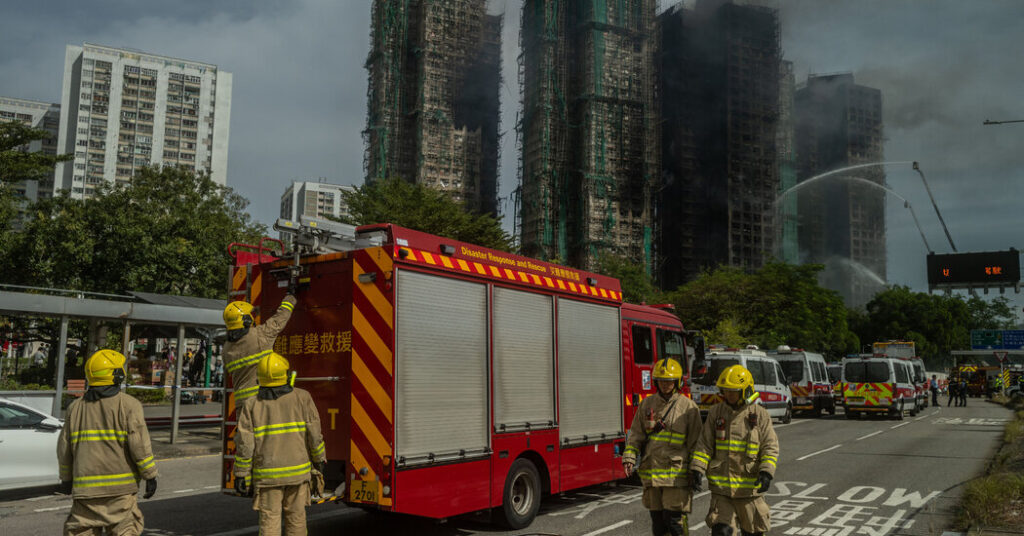
Hong Kong’s deadliest fire in decades had barely been extinguished when the city’s authorities began working to contain something else: public anger at the government.
National security police have arrested at least two people for demanding more government accountability in the blaze at the Wang Fuk Court housing estate that engulfed seven apartment towers and killed at least 156 people. One of them was Kenneth Cheung, a former elected district official who posted criticism of the authorities’ response to the fire on Facebook and was accused of inciting hatred against the government online. The other was Miles Kwan, a 24-year-old university student who handed out fliers near the fire site calling for an independent probe into the disaster. The police declined to comment on their arrests.
Over the weekend, Beijing’s national security office in Hong Kong issued a statement warning of consequences for “anti-China elements” who are looking to use the fire, which started last Wednesday and lasted more than 24 hours, “to cause trouble.”
“They have lost their humanity, disregarded facts, spread false information, maliciously attacked” the Hong Kong government’s efforts, the statement said.
The authorities’ swift crackdown on expression suggested that they were acutely aware of the risk that last week’s disaster could fuel a fresh political reckoning in a city that was engulfed with antigovernment protests in 2019. The scale of the disaster has already laid bare likely failures in oversight and preparedness that allowed substandard and flammable materials to be used in construction, and for alarm systems to fail.
Hong Kong’s chief executive, John Lee, did not deny reports of the arrests when asked about them by a journalist at a news briefing on Tuesday. “Criminals who commit offenses must be taken to justice,” he said. “I will not tolerate any crimes, particularly crimes that exploit the tragedy that we are facing now.”
He reiterated Beijing’s warning that the authorities would not tolerate any attempt to “sabotage” social unity.
The government’s strict response reflects fears of a resurgence of the social discontent that fueled the 2019 demonstrations, analysts say. That uprising was the biggest challenge to Beijing’s rule in decades.
In the days after the fire, the area around the charred Wang Fuk Court complex in the northern suburb of Tai Po evoked echoes of those demonstrations: volunteers organizing themselves to distribute aid; mourners in black clothing; public walls covered in sticky notes expressing grief and offering words of support.
Even Mr. Kwan, the university student who was arrested, presented his grievances toward the government as a list of “four demands” — echoing the “five demands, not one less” slogan that was a rallying cry for the 2019 protesters.
It was the kind of independent, community-driven mobilization that once defined Hong Kong’s civic life, before Beijing’s sweeping crackdown sharply narrowed the space for public expression and organization.
China imposed a national security law on Hong Kong in 2020 to crush the protests and stamp out political dissent. Its invocation after the fire in Tai Po shows how elastic the law is, analysts say, shifting from a tool used by the authorities to target democracy activists to one that can now be wielded to mute calls by ordinary people for officials to be held accountable for public tragedies.
“This is the biggest political crisis that the government has faced since the 2019 protests and the 2020 national security law crackdown,” said Thomas E. Kellogg, the executive director of the Georgetown Center for Asian Law. “There’s no doubt that the government will use the national security apparatus to maintain political control and to ensure that the crisis won’t be used as a platform for political and social mobilization to demand transparency and accountability.”
So far, no government officials have been held responsible for the fire. All 15 of the people who have been arrested on suspicion of manslaughter are from construction companies, the police said. Mr. Lee, the city’s leader, did not provide an answer when he was pressed by a reporter on Tuesday to justify why he should keep his job following the disaster.
Mr. Lee said the government would establish an independent committee, chaired by a judge, to investigate the causes of the blaze. Experts welcomed the move, but said that key details — such as whether the committee would have statutory powers or if the judge would be appointed by the judiciary rather than the government — would determine whether the inquiry is seen as credible.
“If the committee is seen to not be independent, that will only further disillusion people who are currently dissatisfied,” said Stuart Hargreaves, an associate professor of law at the Chinese University of Hong Kong.
The national security law has already effectively muted many voices who would have otherwise pressed the government more forcefully to take responsibility for lapses that allowed the fire to happen. Opposition politicians had once been a vocal presence in the legislature, questioning government officials and holding protests to draw attention to issues. They quit en masse in 2020 in protest; later, many were either jailed or fled into exile.
The law has also made it risky for local journalists to conduct investigative reporting, for lawyers to analyze the government’s legal liability, and for activists to organize street demonstrations demanding transparency.
“Tragedies like these happen even in fully open and democratic societies,” Prof. Kellogg said. “But the core elements of an open society can help guard against tragedies like these, and can play a vital role in shaping the response so that needed reforms are made to guard against something like this happening again. That won’t happen in Hong Kong in the national security law era.”
Despite the absence of public protests, the grief and anger over a tragedy that many believe could have been avoided with better oversight will threaten to undermine faith in the government, said Willy Lam, an analyst of Chinese politics at the Jamestown Foundation in Washington.
“A deep scar will be etched onto the collective memory of everybody because the fire started not as a political event, unlike the 2019 protests, and almost all mourners are not politically motivated,” Mr. Lam said. “Most mourners just want the government to do the right thing.”
Joy Dong, Tiffany May and Berry Wang contributed reporting.
David Pierson covers Chinese foreign policy and China’s economic and cultural engagement with the world. He has been a journalist for more than two decades.
The post The Hong Kong Fire: A Crisis in the National Security Era appeared first on New York Times.