The World Cup is turning prediction markets into a public ledger of million-dollar bets, exposing big wins and dramatic losses as the tournament attracts more money to the fast-growing industry.
More than $5 billion has been traded on the World Cup across Polymarket’s international exchange and U.S.-regulated Kalshi Inc. in 2026, according to a Bloomberg News analysis of Dune Analytics data and company records. The boom has produced multimillion-dollar winners and some painful losses, including a bet-gone-wrong on Belgium to beat Egypt that cost one Polymarket user nearly $9 million.
The wagers offer a real-time view into the risks and potential rewards of an industry pushing beyond elections and economic events into mainstream sports. They also show why prediction markets are better understood, by some users, as a form of entertainment rather than a way to make money.
The 104-match competition is now gaining momentum, with more group stage contests and the knockout rounds still to come. Already, the World Cup and NBA Finals have pushed Kalshi to its first three-day streak of daily trading volumes above $1 billion, Chief Executive Officer Tarek Mansour said at a Bloomberg event on Tuesday.
“Everything we’re seeing through the World Cup so far suggests that prediction markets are continuing on an aggressive growth trajectory,” said Chris Grove, an analyst at Eilers & Krejcik Gaming.
The leading platforms aren’t the only ones to benefit. DraftKings Inc., which expanded into prediction markets in 2025, said last weekend was its biggest for event contracts to date — surpassing even the Super Bowl in February. Total customers jumped more than 200% compared to the prior weekend, DraftKings said in a social media post, while volume rose 100% over the same time frame.
The ability to offer prediction markets in U.S. states where traditional sports betting is prohibited, like California and Texas, has allowed gambling companies such as DraftKings to target consumers they couldn’t previously, according to Jordan Bender, a gaming equity research analyst at Citizens.
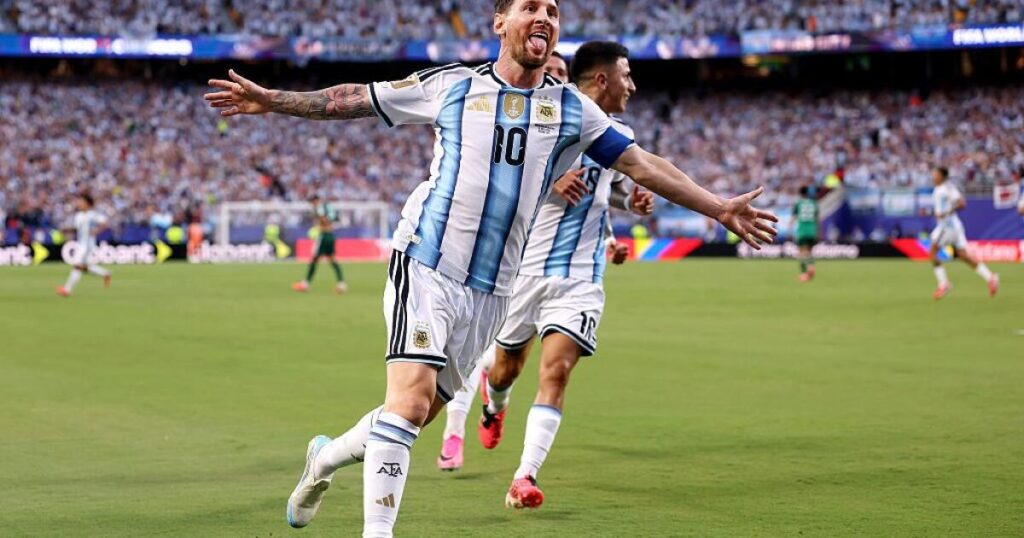
Both DraftKings and Kalshi have spent heavily on social media and TV ad campaigns to acquire new customers. DraftKings is running ads that tout its “sports app” as being available nationwide, while Kalshi is working with star athletes for the tournament, including Croatian midfielder Luka Modrić and Argentina’s Lionel Messi.
“Basically the phenomenon that’s happening here is it’s a free-for-all,” Bender said.
Big money
The relative transparency of some prediction market exchanges provides a rare look at the kinds of wagers people are placing on the World Cup, allowing visibility into betting activity in a way that’s not possible on traditional gambling venues.
Profits are not the norm. Research by Bender and his colleagues at Citizens found that retail customers on prediction markets typically lose money over the long term and fare worse than bettors using sportsbooks.
Of the 20 most profitable wagers across Polymarket’s entire non-U.S. exchange in the last seven days, only two were not related to the World Cup, according to company and blockchain records. In addition to match results, users can bet on who will win the Golden Boot for top goalscorer (France’s Kylian Mbappé is the favorite), and whether President Donald Trump will attend the final match (87% say yes).
The most profitable World Cup bet on Polymarket so far was placed by an account using the moniker “GRIMDRIP,” which turned $6 million into $13.6 million with two wagers on Czechia versus South Africa. Another user, “mintblade,” doubled their money with a $7 million bet that Iran would not beat New Zealand.
One account known as “endlessFate,” which made $5.6 million on Saudi Arabia’s fixture against Uruguay, earned another $2.7 million betting that Colombia would best Uzbekistan. The user’s track record is mixed, having recorded a $1.2 million loss on whether the US and Paraguay would tie their match last week.
Such data doesn’t always give the full picture. Users can operate multiple accounts on Polymarket, and they may have recorded losses elsewhere that aren’t visible immediately. Polymarket doesn’t conduct identity checks on its international exchange, making it harder to identify other positions. Investors may also hedge their bets via trades on other platforms where individual activity is obscured, like traditional sportsbooks and US-regulated prediction market platforms.
Emily Nicolle, Ira Boudway and Carolyn Silverman.
The post World Cup 2026 mints big prediction winners and million-dollar losers appeared first on Los Angeles Times.