The timing could hardly have been better for India.
After months of war-driven supply disruptions and soaring energy prices, one of the world’s largest importers of oil and gas was running dangerously low on fuel. A report released on Wednesday by the Council on Energy, Environment and Water, a New Delhi-based think tank, found that India had just nine to 10 days’ worth of oil reserves remaining. Japan and South Korea, which are similarly dependent on imports from the Persian Gulf, each held roughly 200 days’ worth.
If the preliminary agreement between the United States and Iran to reopen the Strait of Hormuz and begin lifting restrictions on Iranian oil exports holds, it offers the prospect of much-needed relief.
Few countries stand to gain more than India.
Though India’s economy is routinely hailed as the fastest-growing among the world’s major nations, it has come under increasing strain since the start of the war. Prime Minister Narendra Modi’s government has warned of hard times ahead, raised fuel prices and tightened restrictions on overseas spending. Shortages of cooking gas were felt in households immediately and parts of India’s industrial base eventually started shutting down.
Iran was once among India’s most important energy suppliers, before American sanctions pushed New Delhi to sever ties. As recently as 2009, Iranian oil accounted for 14 percent of India’s crude imports, making Iran its second-largest supplier. By 2019, under pressure from President Trump during his first term, India had stopped buying Iranian oil altogether.
Given the supply crunch, India has little choice but to buy oil wherever it can.
“We will take the cheapest barrel available, whether it is Russian or Iranian,” said Rajeev Lala, a director at S&P Global Energy based in Gurgaon, India. But he pointed out that India has a “rare ability” to capitalize on the return of Iranian crude.
India’s location and the flexibility of its refiners allow it to pivot quickly toward new supplies, including heavier grades of crude that require more intensive processing.
“There are very few countries that can take all kinds of crude at any volume” Mr. Lala said.
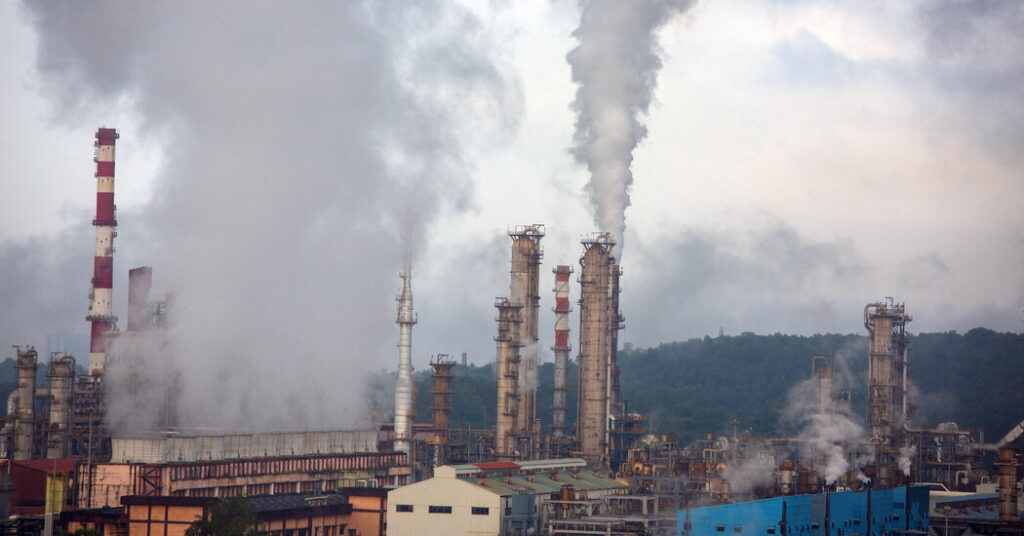
The world’s largest refinery belongs to India’s Reliance Industries and sits directly across the Arabian Sea from the Strait of Hormuz. Oil tankers from the Gulf take two to three times longer to reach China’s giant refineries. They can complete a round trip to India in less time than it takes to make a one-way voyage to ports on China’s Pacific coast.
In recent years, India has been forced to swap suppliers abruptly as Washington repeatedly changed the rules governing which countries it could buy oil from.
U.S. sanctions gradually pushed India away from Iranian crude. China, by contrast, continued buying Iranian oil and became, by far, Tehran’s largest buyer. After Russia’s invasion of Ukraine, discounted Russian crude briefly filled India’s supply gap — until Washington moved to penalize those purchases as well. Oil from Venezuela followed a similar trajectory, first prohibited and then permitted again earlier this year.
The rules regarding Russia have changed repeatedly since 2025.
Duttatreya Das, a former executive at India’s largest state-owned oil company, said it has become increasingly difficult to predict American policy because of what he described as repeated “flip-flops” on Russian oil.
“There have been so many changes, you hardly know what to expect from the U.S. now,” he said. The uncertainty, he added, makes it difficult to sign long-term supply agreements.
Even so, New Delhi may remain cautious about Mr. Trump’s latest position on trade with Iran. India still does not know whether the terms of the agreement allow it to revive stalled investments in an Iranian port that was intended to give it access to Central Asia without passing through Pakistan.
Other countries, farther from the Gulf, could also benefit from revived trade between India and Iran. India’s refiners are capable of exporting huge quantities of diesel, jet fuel and other products derived from crude oil. Its proximity to Iran’s oil fields means it is “able to turbocharge everything onto the global markets,” Mr. Lala said.
Having been burned by the current crisis, India is taking future disruptions more seriously. It is expanding its strategic petroleum reserve, blending more ethanol into its gasoline and accelerating investment in solar power and other renewable energy sources, even at the cost of deepening its reliance on imports from China, its great geopolitical rival.
The energy crunch is not the only challenge facing the Indian economy. El Niño, a weak monsoon and a weakening currency are all putting pressure on government finances. Mr. Lala said New Delhi may eventually seek to capture some of the benefits of cheaper Iranian crude by telling oil companies: “Share the savings that you accrue by buying Iranian oil.”
The post For India, the Return of Iranian Oil Cannot Come Soon Enough appeared first on New York Times.