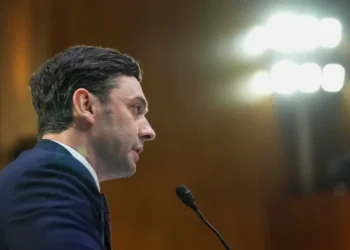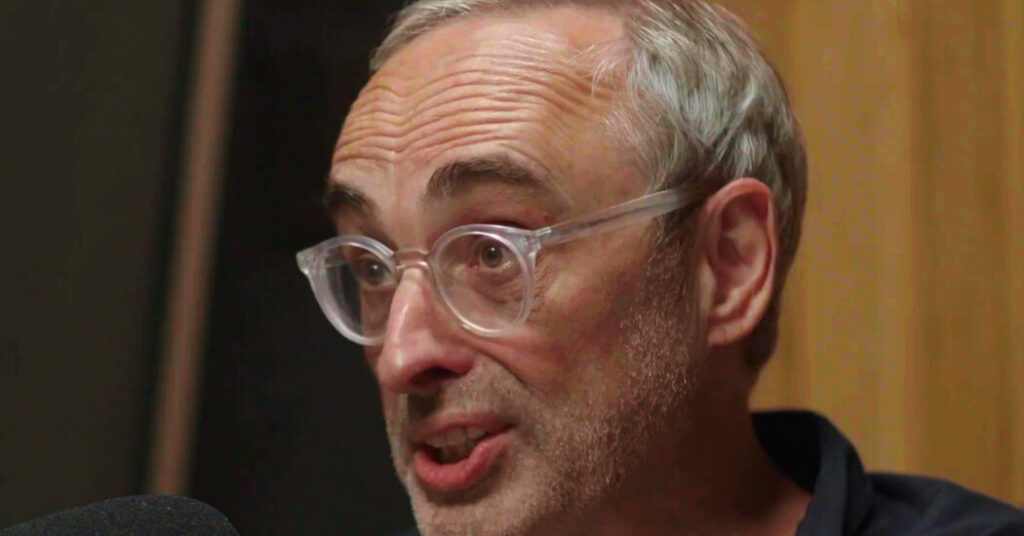
This is an edited transcript of “The Ezra Klein Show.” You can listen to the episode wherever you get your podcasts.
Over the last six months, I’ve been telling people we are living in “Super Sad True Love Story.” And sometimes they’ll say to me: What is “Super Sad True Love Story”? What do you mean?
“Super Sad True Love Story,” if for some terrible reason you don’t know, is a 2010 book by Gary Shteyngart. And I think more than any other book, it predicted the strangeness of the world we live in today — and also a lot of what it feels like to live in it.
All of the constant staring at screens, the hypervisual nature of modern life, the obsession with wellness and longevity and looksmaxxing — against the backdrop of a country that often feels like it’s falling apart. A world where everybody is upset — but grabbing at the wrong things to try to fix it.
I wanted to understand how the author had predicted all this, how he had known what it was going to feel like well into the future of when he was writing. Shteyngart has written a number of wonderful novels, including “The Russian Debutante’s Handbook,” “Absurdistan” and his most recent, “Vera, or Faith.”
He’s also written all these amazing essays on travel and cruise ships and martinis and his love of suits and watches. Many of those essays will be collected in a new book coming out in November called “The Sensualist.” That name, “The Sensualist,” I think, tells you something about what his project is, what he believes is necessary to live well in a moment like this one.
Ezra Klein: Gary Shteyngart, welcome to the show.
Gary Shteyngart: Great to be here. Longtime listener.
I’ve said to many people in my life that when I look around right now, I feel like I’m living in the world of “Super Sad True Love Story.”
For those who haven’t read it, can you just describe the world you create in that book?
Everyone carries a device called the äppärät, and wherever they go, it constantly ranks them.
But the germ of “Super Sad True Love Story” is that the main character, Lenny Abramov, will walk into a bar or restaurant, and immediately he is ranked as, say, the 23rd ugliest man in the room. That’s his thing.
At one point, he walks in, and he’s the second ugliest man in the room, and the ugliest man can’t take it, and he leaves — so that Lenny becomes the ugliest man in the room.
You’re constantly being ranked everywhere. You’re being ranked even as you walk down the street. There are giant credit poles that showcase your credit, and then you can tell Gary has 600 out of 800 points in credit. He needs to save more.
So even on that level, society is so intrusive that it tells you you need to save more. Some people need to spend more. It just constantly wants to keep people in equilibrium.
Women are very sexualized, even more so than in our world. America is run by a, well, fascist leader who has started a war in Venezuela, etc. So a lot of familiar stuff is happening.
There are two main characters. Lenny is kind of like me, a neo-nebbish who’s from Gen X, which is this interesting generation that’s a bridge between the analog and the digital worlds.
And Eunice is 10, 15 years younger than him, but she’s already a full digital native, so probably a millennial or something like that.
This is a very unlikely love affair between two people, and I think the biggest thing that holds them back is the fact that they live in two different worlds.
The thing that made me start thinking a lot about “Super Sad True Love Story” has been the omnipresence of Bryan Johnson, the longevity influencer, and Clavicular, the looksmaxxer — and the way that streaming culture and looks and ratings and hypervisual culture all seem to be now holding our attention in a way I don’t remember happening before.
So as the guy who wrote a book about all this as the future at one point, how does this look to you?
The book was written in about the mid-aughts, I would say. It came out in 2010. As I was writing it, I was thinking: Yeah, this future might be possible in, I don’t know, 30 years.
Usually, when people are writing speculative fiction, they give themselves that 30-year corridor. But it happened 10 years later, 14, 15 years later.
There’s an invasion of Venezuela in this book.
Oh, yeah, there is an invasion of Venezuela in the book.
Israel is controlled by a Smotrich-like party.
It’s called Security State Israel.
Security State Israel. It’s this kind of Jewish Iran, if you will, which I think is where we’re headed.
But one of the main things I was thinking about was the way young people, including myself when I got into social media, were into being ranked. This was something very new to me.
I guess it has always been a thing. People apply to college, and then they’re ranked to get in. Athletes are ranked. We’re in a very competitive society.
In this book, there’s a thing called Rate Me Plus technology, which constantly ranks people over and over, not just by their looks, but also on their finances — every single aspect of their being. At one point, the internet of the future goes out and the Rate Me Plus technology disappears, and young people start killing themselves because they just can’t understand how they can live without knowing where they fit into the grander scheme of things.
Yeah, I thought that was very moving. I actually have that quote here. You talk about these young people who committed suicide in the building complex, and you write:
One wrote, quite eloquently, about how he “reached out to life,” but found there only “walls and thoughts and faces,” which weren’t enough. He needed to be ranked, to know his place in the world.
Yeah. When I wrote that, I remember feeling a little chilled myself. Because I wondered if that’s what the new technology that I was being exposed to, the Zuckerberg technology, was doing to me a little bit.
I travel a lot, and there were times when I would go to some Uzbekistan-like country where, at that point, you just didn’t have constant contact with the internet. And I would find myself going through withdrawal if I went for two, three weeks. I was like: But who am I now? I’m just Gary on the block.
I fell into that trap so quickly.
I have friends and relatives who work in Silicon Valley who really create barriers between their kids and this technology. They know exactly what they’re making, and they want their kids as far away from it as possible.
Look, none of this is 100 percent new. Ever since civilization began, there was the head cave man and the lower cave man. We know that there’s always been a hierarchy. But the need to know to the infinitesimal decimal point.
It was funny. My preparation for some of this was going to a super-competitive high school in New York — Stuyvesant High School, which was full of immigrant kids like myself. I’m from the Soviet Union. Kids were from the Soviet Union, East Asia, South Asia, etc.
To this day, 86.894 was my average at Stuyvesant, and I remember it — this is the shocking thing — to the thousandth decimal point.
That, I think, prepared me in some way. Stuyvesant prepared me for this world in which every single metric is constantly deployed against you, I would say, because none of these people are enjoying life.
When you look at all these men who are measuring their cheekbone to the nth millimeter, this isn’t a good way to live.
The other interesting thing about the book, and it also comes up in your book of essays, is this simultaneous obsession with living forever without enjoying life.
[Laughs.] Right.
What I always find so fascinating when I watch Bryan Johnson — and I don’t mean to be insulting anybody’s life decisions here — but I don’t want to live like that.
Archival clip of Bryan Johnson: Your life goal is to drive down your heart rate. The reason is because the lower your heart rate goes, the better your sleep. The better your sleep, the better willpower. More willpower, better exercise, better food.
When your heart rate is high — bad sleep, bad willpower, no exercise and bad food. So resting heart rate is the most important marker of your entire life.
I think the reason he is so fascinating to people, in part, is his constantly having this level of self-examination, this level of self-diagnostics. I mean, you have a partner now, and so the first thing you do is you go online and talk about her vaginal biome.
Archival clip of Johnson: Good relationships are really rare, and Kate is important to me because she really does feel like my other half.
Archival clip: Biohacker Bryan Johnson recently boasted about his girlfriend’s top 1 percent vagina, sparking interest in at-home vaginal microbiome tests.
Yes. Have to get that vaginal biome. [Laughs.]
With Clavicular, it’s like you’ve divorced getting hot from the point of getting hot. He talks about how he can’t have a girlfriend given the life he leads. He is not fertile.
Archival clip:
Interviewer: Wait, why are you infertile right now?
Clavicular: So it’s just like a negative feedback loop when you’re not needing to produce testosterone anymore because your body realizes: OK, we’re getting it from an exogenous source.
Interviewer: So you’re not producing any testosterone naturally?
Clavicular: No. No.
Interviewer: None?
Clavicular: No.
Interviewer: Oh, I’m not taking T.R.T., bro.
We have these urges, right? We want to live because we want to enjoy. We want to be hot because we want love and children.
And this severing of all of these urges from the things the urges are supposed to do, this severing of the pursuit of desire from the thing that desire is supposed to ——
It’s incredible. Taking testosterone to look good, to attract a mate — but at the same time, taking all this testosterone causes shrunken testicles, which probably will not allow you to propagate.
So these things are completely at odds, and at the same time, it’s almost like a perversion of whatever strange biological instincts we had.
Clavicular is one of my favorites when it comes to this, because he’s just really funny — unintentionally so.
Archival clip:
Streamer: How important is it to you to also make the girl have an orgasm?
Clavicular: Not important.
Streamer: How come?
Clavicular: Well, because the amount of extra effort that’s required to do that is just not going to really have much R.O.I.
[Streamer laughs.]
Clavicular: Well, it’s true.
Streamer: That means return on investment.
He’ll talk about knowing that he can have sex with a given woman is way more important for him than actually having sex with the woman.
Oh, it’s the ranking, the mogging.
It’s the ranking, the mogging. But it’s like, wasn’t sex supposed to be enjoyable? Especially when you’re 21?
It took me a while until I started having sex, but when I did, I was like: This is the most incredible thing that’s ever happened to me. [Laughs.] I don’t care if I die tomorrow, if I keep having this for the next 24 hours. This is it! You know?
I’ll give you another example, which is a little strange. So I’ve been teaching creative writing at Columbia for about 20 years now, and my students are wonderful. They write wonderfully. The craftsmanship keeps getting better and better. But the things they write about have changed so drastically.
Twenty years ago, in the aughts, there was this John Cheever bisexual energy going on, where ——
Explain what a John Cheever bisexual energy is. You can’t move that fast. [Laughs.]
Sorry. Well, in the Cheever, Updike, Roth era — and I know that skews very masculine — people wrote about sex nonstop. I mention Cheever because he was bisexual himself, and there was an appreciation of both hetero- and homosexuality.
What I’m trying to say, in general, is that sex was appreciated as a major life force. When I read the wonderful things that my students submit now, there is almost no sex and love — no love — and almost no pleasure.
I have a collection of essays coming out in November called “The Sensualist,” which is all about my love of pleasure — but in millions of contexts. There’s sex in there. There’s food. Life is an endless buffet of pleasure.
And this Clavicular generation just says: Nah, we don’t want that.
You might as well be an algorithm. We just want to match up to all these metrics and say: Done, done, done. Check, check, check. We are the best. We won, and that’s that.
What’s your view of where that came from?
When I look at my students — we were talking about our place in the world earlier. They’re unsure of the world’s place in the world. They don’t know what’s going to happen next. Everything is a source of anxiety.
Half of what my students write, if not more, is speculative fiction of one sort or another. And the speculation isn’t that we’re going to be living in a utopia in 20 years.
The vibes, as they say, are low-key horrible. It’s like we’ve separated ourselves so much from the possibility of joy that to make it the subject of a book or of a story seems almost privileged. Like, you don’t want to touch that anymore.
I’m not saying that the Cheever-Updike crew didn’t write in a solipsistic way about their own identity as wealthy white people in Scarsdale or whatever. Obviously, there was a lot of that stuff, as well. But there was a sense that life wasn’t entirely hopeless.
When I read a lot of modern literary fiction, the driving force to me is neurosis. People being anxious, being unsure, being self-loathing.
Yeah.
I find it very, very, very depressing. Like, late mid-20th-century male writing was very horny. And 2020s writing is very nervous.
Yeah. My students call this the sad girl novel. And there have been some amazing sad girl novels. “My Year of Rest and Relaxation” reads like a really cool, smart and funny version of that.
I think sometimes what I lack — not always — but what I look for in the neurosis novel is a sense of humor that almost leads you into a path of joy.
I teach a class called So You Wanna Write Funny at Columbia and, for example, we talk about neurosis. I teach “Portnoy’s Complaint,” and that is all set in a psychiatrist’s office. It’s this neurotic, horny Jew — like, they don’t make them anymore. And he’s just chomping at the bit to get out of his particular identity and to have sex with every non-Jewish woman he can find.
And that is wrong in many ways, but also really, really funny. The pursuit of it is very, very funny. Look, “Super Sad” is — the word “sad” is the second word in the title.
But I hope that when Lenny finds the love of his life, Eunice, or when he goes out with his friends, there’s still an avenue toward an overwhelming feeling of contentment. That may go away by the next day or when the hangover sets in, but that is there at least for a while.
There’s a character in “Super Sad True Love Story” who I think is interesting for this conversation, which is Joshie, Lenny’s boss. Tell me a bit about Joshie.
So Joshie is — let’s see, how old is Joshie? Well, we don’t even know how old Joshie is. He could be in his 80s, but it doesn’t matter because he is using every anti-aging technique possible.
Joshie does not want to die. He feels — and this is interesting because I think this is true of so many of the people that use this kind of technology — that he hasn’t really lived, that he hasn’t really had a good life.
I know a lot of people in, for example, finance, because I wrote a book called “Lake Success” that was set in the world of hedge funders, so I had to spend four years hanging out with them.
Not 100 percent, but so many of the ones I met have had really unremarkably awful childhoods, and there’s a need to somehow create the perfect life and live that life, and that life is always the opposite of the rearview mirror — I don’t know, always in the windshield. You’re always looking forward to it. It never quite comes, but in order to reach it one day, one has to extend life almost indefinitely.
I remember one of the first things my parents would say about Americans when we immigrated to America, was that they always seemed so unhappy despite the fact that they were so much richer than us.
We were living on government cheese for a time, and my parents and other Russians would say: Oni ot zhira besyatsa. Which translates very vaguely as: They’re wild with their own fat. They’re so juicy and fat, and yet they don’t know what to do with it.
Just enjoy the fat.
But sometimes this greater meaning combines with this egotistical impulse to have more and more and more. And to not die is one of those almost Protestant extensions of everything. And striving. Why should the striving ever end?
Well, there’s the search for greater meaning, then there’s where you’re searching for it. One of the fundamental things about “Super Sad” that feels like a fundamental thing of modern life is that everybody is looking for it in a screen.
Right. Yeah.
One of the fun fillips of the book is that talking to other people is called verbaling. You’ve needed to create a different linguistic category for what it is we’re doing when we have a conversation.
Screens are made by corporations. Corporations have their own incentives and their own things they’re trying to do, and what they’re trying to do is not make you happy. They’re trying to make you keep coming back. And nothing keeps you coming back like a ranking.
There was a funny tweet I saw today. It said: Sisyphus’s life would’ve been much better if every time he got the rock to the top, he got some points.
[Laughs.]
And then he could exchange those points for stickers.
For stickers that he could put on the rock.
Yeah.
Yeah, that’d be great. Oh, my God, now that is really, really smart.
I mean, the way you talk about eating a bowl of pasta, it’s fundamentally erotic.
So often in a bar, I’ll see people who are together on some kind of a date, and they’re both looking at their phones. There is something about a very unfulfilling, but very compulsive world beckoning that I think is an enemy of enjoyment.
There’s a lot in there.
So verbaling is very hard for members of younger generations. I know Covid messed them up, as well. People in Generation Alpha — my son’s generation — that didn’t help, obviously. But I think verbaling ——
Verbaling. [Laughs.] Sorry.
Well, it is what it is. Letting sounds come out of your mouth as communication is very hard for people to do, much harder, obviously, than sending emojis or shortened text messages and stuff like that.
I think it’s interesting when you look at someone who is, for example, doing looksmaxxing, who is using a hammer — talk about the opposite of joy. This anti-enjoyment. You’re hammering your cheekbone in to make it a certain metric ——
Archival clip:
Interviewer: Describe what bone smashing is.
Clavicular: So bone smashing is based off of Wolff’s law that when you break down a bone, it grows back stronger.
And you feel like this is how you make yourself attractive to women.
But the real way to attract women — I learned this as a small, furry immigrant without a great deal of good looks — is by verbaling with them and saying interesting things, being an interesting human being, listening to them and then getting into conversations with them — having any kind of charisma that allows you to actually interact with somebody of the opposite or the same sex, whatever your preference is.
And this is like: No, we can’t do that. We can never achieve that level of being interested in another person or even being interested enough in our own interiority to access that kind of level of interaction.
So it’s hammer time. We’re going to get that hammer and just chisel ourselves.
There’s been a fascinating recent trend among Silicon Valley types where they’re on a tear against interiority.
You had Marc Andreessen talking about how he doesn’t want to have interiority. He doesn’t want to have introspection, which he described as looking backward — which is not quite what it is, but nevertheless.
Archival clip:
Interviewer: You said something that I love, and I never hear other entrepreneurs think about, talk about, but I think it’s super-important — that you don’t have any levels of introspection.
Marc Andreessen: Yes. Zero. As little as possible.
Interviewer: Why?
Marc Andreessen: Move forward. Go. Yeah, I don’t know. I’ve just found people who dwell in the past get stuck in the past. It’s a real problem. It’s a problem at work, and it’s a problem at home.
I’ve been trying to think on this. These are smart people. And I do think it is — if I’m being maximally generous — in some ways, a reaction to what I was talking about a minute ago, where a lot of modern intellectual culture is very neurotic and very anxious and is endlessly displaying how anxious it is.
But then you go all the way to the other side, to where you’re not thinking in a deep way about yourself at all, and not trying to self-understand at all. That is the opposite problem and dysfunction.
Yeah, that’s a very interesting and, I think, correct way to put it.
There are a lot of interesting things about who these people are. And this may seem a little out there, but I would say that you can’t look at people like Elon Musk and not think of neurodivergence, but also neurodivergence combined with terrible parenting.
Now, you have somebody like Elon, who proclaims to be neurodivergent, who was raised by possibly the worst father this side of Woody Allen. So you have someone who obviously cannot deal with somebody with special needs, and at the same time, somebody who possesses all of the gifts that those special needs, in the case of neurodivergence, give them.
Archival clip:
Elon Musk: I think when I was 5 or 6 or something, I thought I was insane.
Joe Rogan: Why’d you think you were insane?
Musk: Because it was clear that other people’s minds weren’t exploding with ideas all the time.
Rogan: So they weren’t expressing it. They weren’t talking about it all, and you realized by the time you were 5 or 6, like: Oh, they’re probably not even getting this thing that I’m getting.
Musk: No, it was just strange. It was like: Hmm, I’m strange. That was my conclusion. I’m strange.
So you have this strange combination where, in growing up, these people were not given the opportunity — by the school system, by their parents, by relatives — to look inward. Looking inward was considered something so wrong that there was never a skill developed for it.
Let me go back to the Mark Andreessens of the world, because I think what they might say on your riff on Elon Musk there is — and Musk hates his father, to note that here. But listen, it created the greatest industrialist of our age, the richest man in the world, a guy who is able to put reusable rockets in space.
Isn’t that success? Isn’t that what humanity needs to go forward, even if the New York literary class doesn’t like it?
Let me tell you this. I do think that space colonization really is not something I’m terribly interested in. I don’t think going to Mars is going to answer any of our problems. I don’t think we’ll ever live there on the kind of scale we live in.
We have a really nice planet here that we’re destroying. We really don’t need to discover the marvels of Mercury anytime soon. So a lot of this is complete [expletive] as far as I’m concerned — that part of it.
Now, of course, popularizing electric cars, all that stuff is very good. If anything Musk did was good, it was Tesla, which will now probably be brought to scale by Chinese automakers. That will make it cheaper and possibly better at some point.
But when I look at what the great industrialists of the world have given us lately — the last 25 years, 30 years — have they really been that great in terms of life?
Let me bring it down. I know that perhaps if you’re living somewhere, if you’re living in Kenya, far away from Nairobi, and you have a cellphone — a new technology — that is really helping you in a way that not having a cellphone would have hurt you 30 years ago.
But at the same time, this is not a happy life that has been wrought by these wonderful industrialists who create screens and algorithms that have destroyed my life to a very large extent.
I write at a much slower clip. I don’t write as introspectively as I used to. I am as addicted — and by the way, please follow me, @shteyngart on X, Instagram, Bluesky, Substack. I mean, it never ends. This never ends.
Why are you on them then?
Well, it’s part of the marketing, you know.
Is it?
Absolutely, it helps.
You’re a big deal, man. Do you actually need to be there?
I don’t think I’m that big of a deal. I still need it. Everyone needs it. And I do get that dopamine kick from it.
Yeah, I think that’s the more honest answer right there.
Both profit and dopamine.
Let me say this. When I started writing “Super Sad” in the mid-aughts, I didn’t know much about this technology. But I had this great intern. He was very young, and he was into Facebook and — what was it called? — MySpace, I think, was the thing.
And the moment I got on it — this was the germ of “Super Sad” — I thought: This technology is going to destroy everything.
Why did you think that?
When you’re a writer or an artist, you are at least partly a narcissist. Because what do you do this for? You don’t just do this.
There was a great way of putting it in the Soviet Union, when people were writing things that the system would hate so much that you knew you could never publish it. It was called pisat’ v stol — to write into your desk, literally. That is the highest level of writing, right? Because nobody will see it.
But I did not want to write into my desk. I was, like I said, this small, furry immigrant, strange sense of self. I wanted people to read my books and say: Oh, look at this. These people exist, too.
But when I saw MySpace and Facebook, I thought: Everyone is a writer now. There are no barriers.
Now, on the one hand, that sounds great. Woo, more democracy than ever, right? Everyone is Aristotle. Everyone will express themselves.
But then I lived for about a year more on those platforms, and I thought: This is just garbage. We’re on this all the time. Half of what I read are complete lies. Lies seem to get more clicks. I’m now addicted to this to the point where it’s hard for me to start reading and finishing a book.
And books are the best way to get into interiority because, what is a book? It’s a communication between one consciousness and another.
I love film and theater and TV and all this other stuff, but this is the fastest. This is like a mind-melding Vulcan technology. You’re in somebody else’s head, and somebody who’s completely different from you, hopefully.
When I started using that, I thought that this would be a problem for personalities, especially personalities like mine. And then I thought it would be a problem for the rest of society.
I’m very influenced by this thing Ryan Broderick, who’s an internet writer, has said. He talks about it as the porn theory of the internet — that all content now, or at least a lot of content on places like TikTok and Instagram, is creating an instant surge of sensation.
I see this even when we’re creating clips from the show. We need it to make you feel something immediately.
It’s like the way porn evolved on the internet. But now it’s like people pulling apart cheese sandwiches. Like, you have to feel angry or curious or hungry — or something — immediately.
Yeah, yeah.
You’re, again, writing this some time ago. There’s a section in the book where Lenny is reading from “The Unbearable Lightness of Being,” a book by Milan Kundera, to Eunice. And Lenny says in the book:
I felt that Kundera had put too many words around the fetish for her to gain what her generation required from any form of content. A ready surge of excitement, a temporary lease on satisfaction.
And now you hear everybody talking about how kids can’t follow a long book anymore, everything is too long. I mean, that’s all really there in that book.
So as somebody who writes books, somebody who has clearly thought about this a lot, how do you think about what happened, what it is doing to us as a country, as a collective, as a world, when we get trained to expect that the things we see will immediately create a reaction, a sensation? As opposed to something we have to follow along and interpret ourselves.
I realized that if I post something on Instagram — @shteyngart — and then I start reading something, it’s impossible. Every two pages, even if I’m reading the most incredible — I was reading this incredible New Yorker article about Ukraine. Ukraine obviously is a subject that I’m very involved with — and I couldn’t.
Every three, five minutes: Well, who liked that? Oh. Oh, look at that. I thought this person never liked me, but I guess they like me. Oh, someone at university liked this. Wow, life is really good.
Do I think that there’s a future in long-form fiction? I think it’s going to be very much just, speaking of fetish, a very small, tiny group of people who do this.
Even today, I think something like 47 percent of Americans have read a full-length book in the last year. So this is obviously going to be a very minority position. But when I write myself — what do people in Silicon Valley call it? — the end-user experience.
For me, because I hope I write funny, I think the humor is the thing that gives you that little hit. It keeps the reader, hopefully, somewhat attached to the page.
So this is this interesting thing: Will we have books that explode while you read them in order to get your attention in the future?
That could be a great technology. Or it releases a plume of smoke or something like: Oh, yeah. Right. I have to get back to this.
There’s an interesting tension around that in the book. Because one of the other main characters is Eunice, who is the much-younger partner of Lenny.
And Lenny is a writer and a reader, and he has actual physical books, which is a bit of a gauche thing to have in that world. And they smell bad, they smell musty.
Not to spoil too much of any of the book, but at the end, when some of their communication with each other has been discovered by others, it’s Eunice who is considered the great writer — and she is internet addled.
Everybody is texting on a service called GlobalTeens, which is very funny. But I actually thought that, too, when you’re reading it, her writing is much more vivid because it is less self-conscious. You can read Lenny writing to be read.
There’s nothing worse than reading the journal entries of somebody who wrote a journal hoping somebody would one day read their journal entries.
Right, right, right.
Those get released a lot.
Oh my God, that’s half of literature these days.
That’s half of literature.
There’s a lot of life in the writing that comes without that self-consciousness.
Yeah, absolutely. Sorry, I keep talking about the craft of writing, but hopefully listeners won’t mind. But it’s this idea when we start teaching a workshop: What I’m looking for in the first paragraph, the first page, the first chapter, is a sense that there’s a really active voice that’s unlike any other voice I’ve read before, and that has something to declare that’s so desperate to declare that they need to do this or they won’t survive.
That’s maybe overstating the case, but some sense of that “Call me Ishmael.” You can’t look away from that.
Lenny thinks of himself as being very literary. He’s actually not a writer, per se, but he thinks of himself as journaling a lot. And so a lot of what he writes is very much meant for a certain kind of Brooklyn reader — or Brookline, Mass., reader, let’s say.
Whereas, what I loved about writing Eunice was that Eunice wrote in this completely GlobalTeens way. She’s buying this, she’s buying that. She’s buying clothes. She’s looksmaxxing in her own way.
And at the same time, she has an ability, especially as the novel continues, to look more inward and to see the dichotomy between what the society wants from her and what she wants to be.
Going back to the subject of Clavicular: I find him to be a very tragic figure. Doesn’t seem happy to me.
I just saw pictures of him after getting a rhinoplasty, a nose job. His nose seemed fine to me before. And he just is miserable in a wheelchair, and his small legs are out, and people are making fun of him on the internet.
Oh, my God.
And you just think: This guy has achieved a level of social notoriety that is remarkable. The most successful streamer of the age — and how much happier he would probably be if he had never touched it.
I’m not in there, but this is not good for people to be putting that much of their lives forward, to have so little backstage in their own mind.
You’re writing there about a world in which this has become very, very common — the number of people with a brand, everybody on TikTok.
I wonder what you think it does to people when they keep offering up things that are so cherished to them and important and that they’re insecure about: How do I look? Am I loved? Am I successful? Who am I?
And they keep giving it out to the public and saying: What do you think? What do you think? What do you think? What do you think?
And then they’re dependent on what the people around them think.
Yeah. Since I’m mid-Gen X, we grew up sitting around bars talking to each other, counseling each other, helping each other. Everybody had different things they could do. One friend could really write a great C.V. Another friend could do something else really well for you. We really were a small village unto ourselves.
It was just wonderful. Did we get into fights? Yes, and breakups. But we were still a wonderful unit.
I don’t think these people have that on that level. What our society has done, what these platforms have done, is they have made being mentally ill a very profitable thing — being openly mentally ill a profitable thing — and I think that reaches up to our commander in chief.
There is this sense that if you flaunt the fact that you don’t know what you’re doing, you’re completely out of it, but you do it in this way that combines humor and trolling and all of that stuff — it’s almost like a carnivalesque atmosphere: Look, I’m completely crazy. I’m beating myself up with a hammer!
And people will pay for that. They will pay for that.
But what happens to that person is nobody cares. If tomorrow he OD’d, I don’t think even his followers would care. They’d be like: OK, that was interesting. I’m going to find someone else who beats his nose with a hammer — or whatever.
That’s interesting, and a very grim way to put it, that these relationships feel real, but they’re not real.
They’re not real. And again, people or these industrialists will say: But Gary, you’re living in the past. Society moves on.
And, in fact, if you think social media did anything to destroy the sense of people hanging out in your bar, talking to each other, rubbing elbows, hitting on each other — wait until A.I. enters the chat, and then you won’t even need friends. You’ll just have six or seven A.I.s hanging out with you, possibly helping you as you pleasure yourself, so you don’t even have to.
Hey, save time. You can get it all without even leaving the comfort of your own bed. The concept of bed rotting.
So I think they would say we’re only getting started here.
Now this creates interesting challenges on a political level because nobody is having children in the developing — I don’t even know what you call it anymore, the opposite of the global south — the global north? Nobody’s having children.
The wealthier world.
The wealthier world. East Asia, wonderfully, leads the pack. I go to South Korea a lot because my wife is Korean American. Nobody is having kids there. If they do, it’s one kid. I say this as also with someone with one kid. But there, nobody’s replicating themselves in those societies.
Tell me what you see when you’re there from that perspective. Because the low fertility rate is happening in the background of “Super Sad.” And it could’ve been something you’ve thought about for a while.
So when you go to South Korea, which is a society that, if trends continue, will shrink geometrically. It’ll shrink very, very, very fast.
What’s it like?
It’s amazing. First of all, if you’re into technology, even if you like a dystopian version of that, it’s all technology, all the time. There’s a wastebasket that says it’s honored to accept your waste. I mean, it never ends. Everything is the internet of things.
I remember I did a piece for The Smithsonian, where I went to visit Korea. One of the ways they advance is that the government decides: Oh, now we’re going to do this. So: Oh, now we’re going to do flat-screen televisions — this is decades ago. And LG and Samsung took over the market in that.
The last time I was there, it was like: Oh, we’re going to take over robotics. Obviously, robotics is a thing.
So I went way outside of Seoul to this place where they were creating bull robots. You stood there with a red hankie, and this bull would charge you. And they’re like: Yes, we’re trying to corner the toreador market in Spain because people don’t want real bulls to die anymore. So we’re developing these toreador bulls.
[Klein laughs.]
And this bull looked pretty fierce, and I’m like: Jesus Christ. There’s no end to it. Every single part of our lives is going to be replicated.
But when you hang out with people in South Korea, they are exhausted. They’re exhausted. And they will drink.
As a Russian, I can drink, but nobody drinks more than people I’ve met in Korea. They will drink themselves into a stupor and then talk about how: Oh, at work I’m on the B team. I want to be on the A team. I’m glad I’m not on the C team, but being on the B team isn’t great, either.
The metrics are even more finely attuned than they are in America. But when you’re also working 80 hours a week, and if you have kids, you have to put them through these schools to get into a university that will take up half your paycheck already.
So having one kid is already a gigantic undertaking. Having two is basically an impossibility for most Koreans — and I think that’s where we’re going, too.
I think there’s a really interesting way this actually connects to rankings. One fascinating thing about fertility rates around the world is that people tend to have a lot of kids sometimes when they’re very, very rich, but also when they’re quite poor. And then in the middle, it’s too expensive to have kids.
Right.
And it’s not that that’s wrong, but it has to do with the positional competition of having kids, when you are in richer countries, in particular.
Obviously, there are other things going on here, birth control and women’s liberation and a million different things.
But there is a reality that you go to much poorer places, and they have a lot more children.
And then you go to Brooklyn, and everybody is like: It’s too expensive to have kids. And it’s not that that’s fake. It’s true. But it has to do with the fact that we have made having kids very, very expensive.
We’ve made having kids very, very expensive. We’ve also made it too competitive.
I was just in Palo Alto, and then I flew back to downtown Manhattan, where I live, and in both of these precincts, there’s this feeling that you’re not just having a child, you’re having a mini-corporation that has to do really, really well.
There’s competition among these kids — because it almost feels like these parents and the kids recognize that the pie is so small and that it’s so easy to get kicked out of the upper middle class, the coastal elites, whatever you want to call it. So the competition is breathtaking for just a little smidgen of the pie.
God bless, Clavicular. As an economic agent, he’s figured out his own path forward. He’s making about $1.2 million or something a year by doing this complete [expletive]. That’s incredibly cool for him.
And I think that is the model that so many Americans are looking at. It used to be: I’m going to be a basketball player. Or: I’m going to be in a cool rock ’n’ roll band.
Now it’s: I’m going to be mentally ill on TikTok, and I’m going to make a lot of money off that.
And you were talking about this earlier: People are trying to commodify their own sense of grief. There’s griefmaxxing now, where people talk about all the grief that they’ve suffered. Which, I guess, is called a novel. But now it’s also a TikTok.
But again, these kids I’m looking at, what happens to them? I know parents who are decamillionaires, centimillionaires, and they’re still incredibly worried for what their kids will do.
And so this isn’t fun for the parents. It’s not fun for the kids. It recreates that sense of metrics that creates Claviculars down the line.
I find this very frightening. I have a first grader and another one who will be in kindergarten next year. And I know it’s coming for them. I know it’s coming for them — and for me. So there’s a sadness to this for me.
I look at my son studying his Pokémon card binder every morning. It’s not for anything — he just likes the cards because he likes the cards.
And I know homework is coming in a real way. And I know the competitions are coming, and I know it will be important for him to at least do well enough in them. And obviously, for my younger one, when it’s his turn.
And I just feel this dread of so much of the joy being drained out of their life.
One thing I can suggest is to mind when your kid develops a real love, especially a love of something creative.
My son loves composition, musical composition. Loves it, and he’s going to a school next year, during the weekend, that will prep him if he wants a career as a composer someday. I don’t know, maybe A.I. will do that, too. But he loves it.
And he’s sitting there in a class — he may like the class, he may not like the class — but he’s humming to himself.
I think this is an interesting bridge to this book of essays you have coming out, called “The Sensualist.”
You could really see this in Lenny. You can see this in some of your characters over the years. It feels like one of the arguments you’ve quietly been making, and then making more loudly in your nonfiction, is that it is a radical act in a bodily, physical way to just enjoy this life.
Right.
So first, what is sensualism to you?
Well, first of all, it’s not even just about the senses. It is, in a more Buddhist or meditative way, if you want to take it that way, enjoying what’s happening in the present moment.
Thank you for pandering.
I am. Very nice pander, but also I know that there’s probably some Buddhist listeners out there, and I love all of you. I do a little Headspace here and there, when life requires it.
But I was walking here today — I’m mostly upstate in the summer, but I came down for this interview — and I’m walking down Broadway, and I looked up, and I’m just noticing the beautiful mansard roofs of some of these buildings.
Now, I spend half my year in New York. I forgot all about these mansard roofs. I’m like: Damn.
Somebody did something right architecturally. New York is such a hodgepodge of good and bad architecture. Maybe that’s one of the things that makes it such a cool city is that it’s not beautiful-beautiful, it’s just this mélange.
When I moved here, which was only a couple of years ago, I read Michael Kimmelman. He has a book called “The Intimate City,” and he says: The beauty of New York is the juxtaposition of this with that.
And that allowed me to see the beauty of New York. It was like a single sentence that reshaped how I looked at a whole place.
“This with that,” “this with that.”
I agree with that. A wonderful man, a wonderful lunch date.
This and that — I’m going down the street, and this and that is creating a feeling of great pleasure in me. Is it one of the senses? Yes, this is sight, which is probably the most boring sense.
If you had to rank them.
If I had to rank them, well, it’s the most obvious one.
Recently, I got a dachshund — which is the world’s best dog, clearly — and this giant sausage is completely out of control. Bernie is his name.
I dedicate “The Sensualist” to Bernie, my furry sensualist, because he is a very sensual dog.
His great sense is smell, obviously. So he will walk down the street, and there’s a corner where every dog pees, and he approaches it like a Talmudic scholar. He sniffs here, he sniffs there: Yes, Rocco was here at 12:30. That’s right. That’s right. Let’s remember that.
You know? He loves it, and his tail is wagging away. He’s just enjoying the hell out of life. He enjoys this more than — I mean, he loves food, obviously.
But we all have this part in us that is able to enjoy things on this crazy level. Most of it is free. Some of my hobbies are slightly expensive, but most of this stuff is wonderfully free. It’s all around us.
The more I live, also, I find that this sense of ambition that younger people have diminishes in some good ways. As I sort of see what the rest of my life will look like, I’m fine with it. Maybe good things will happen, maybe some terrible things will happen, but I’m more or less OK with it as long as that sense of enjoyment doesn’t leave me.
The other thing that I talk about in “The Sensualist” is that recently, two of my most sensual friends died. It was remarkably sad to watch them die of cancer in their early 50s, in my generation.
Incredibly sad, but to the last moment, they found things to enjoy. Almost to the very last moment, there were things that they enjoyed, and I think the thing they enjoyed the most was talking — verbaling, if you will — with their friends.
Nobody wants to verbal in Sloan Kettering. That’s the worst place you want to do it. But if it’s there, it still beats not having cancer and hitting yourself with a hammer to create the sense that you’re meeting some metric.
The interesting thing you’re doing across these essays, which are about martinis and suits and all kinds of things. Capybaras.
I love capybaras. Oof.
Capybaras, that’s how you say it?
Well, I’m trying to be a little more Latin American, given that they mostly live in Brazil.
There is something about the way elite culture flaunts the repression of enjoyment.
Yes. Yes.
I saw there was this clip that had gone viral the other day from the guy who hosts “The Diary of a C.E.O.”
Archival clip:
Steven Bartlett: I had a year of not drinking. I decided to have a drink again. It ruined three days of my life. I had a couple of glasses of wine, didn’t get drunk. It ruined three days of my life because of the domino effect it caused.
It meant that I got worse sleep that night. I ate more poorly the next day because my dopamine system, or whatever, the cortisol system was all messed up.
Chris Williamson: Less resilience.
Bartlett: I podcasted worse. I didn’t go to the gym the day after — that day or the day after — because I felt really bad.
I then slept worse, and I was like: Oh, my God, those three glasses of wine had this hidden domino effect that I must have been living with.
I thought it was a little bit unfair to him how viral it went, but it hit a nerve because it was hitting this culture, right? It was like an example of this culture in which there is a status in optimizing everything — the Oura Ring — you never have a drink.
I do think people have this feeling of like: Well, what about enjoyment? What’s the point of all this?
A.I. can already do a bunch of the things we can do. If we’re not going to be here to enjoy music, enjoy a drink, enjoy great food — if you’re going to endlessly be having a glucose monitor, and you’re not a diabetic, and then you’re like: Well, pasta really spikes my glucose.
Fancy that.
If you listen to some of the top podcasts that have all kinds of health influencers on — and I’m not saying necessarily even that they’re wrong about what they’re saying, sometimes they are — but it just sounds so joyless.
I was watching something go around the other day that was from this study, and it was like: Turns out that doing 12 air squats every 45 minutes is better for you than running two — whatever it was.
I don’t want to say I would rather die than do 12 air squats every 45 minutes.
I don’t even know what an air squat is.
But it didn’t seem like a way to live.
No. I think the other way I could title a book about the current state is: “No Way to Live.”
[Klein laughs.]
None of this is a way to live.
I posit — and I don’t know, there could be some blowback or pushback on this — that this is a problem for us as Democrats. Because so much of this is a part of what you hear and see in certain elite Democratic precincts.
Silicon Valley obviously has a lovely fascist wing now, but there are still quite a few people who are Democratic in some way or another.
The one thing about Trump is that humor is always, even when it has this very nasty edge, seen as a kind of joyous thing. And he would belt things out, and then he would go: Meh, beh, beh, beh. And people listened.
Emily Nussbaum wrote the best piece ever on that when she wrote in The New Yorker about Trump really stealing, appropriating, as they say, the humor of Jewish borscht belt comics of a certain period. And then using it for his own evil purposes.
I think a lot of the other Trump wannabes try to do this. Many of them fail, but there is that kind of motion.
Trump is a sensualist. He loves a pretty room. Thinks a lot about interior design. Loves a good musical.
Oh, that’s right.
JD Vance is not a sensualist. Marco Rubio is not a sensualist. Trump is.
I think you’re absolutely right. Maybe there is, in a horrible way, something that we can take away from this that the people that we nominate to be our leaders can’t be — I mean, Kamala Harris, she talked about joy so much that you knew that there wasn’t that much joy going on, you know?
It was this: Look at the joy! It’s what we call in fiction telling, not showing: Joy, joy, joy!
But we need leaders or candidates who can evince not just the unhappiness of everything we’re confronting — from climate change to inflation to the mess that’s going to be left to us when the president leaves.
And that’s not easy to do because we’re so programmed to this idea that we have to democracy-max and we have to be constantly talking about all the terrible things instead of talking about the things that give us pleasure, the things that we love, the parts of community that make life livable.
There’s a lot I want to say in response to that.
One is — and this, I think, is fairly bipartisan — this sort of elite display of discipline. It is a positional competition to show that you are optimizing your body — and your mind, how much you’re reading — within an inch of your life. And I’m not saying, by any means, I’m free of this.
The other side, which I think is more specific on the left, is that pleasure is problematic for all different kinds of reasons. Maybe the things you enjoy are not politically centered. The jokes are too gauche. There are million reasons.
But I do not find that people are comfortable admitting to a lot of enjoyment. The discourse is critical, not appreciative.
Look, this is a Protestant country. There is this kind of Protestant background.
Many of the immigrants who come here, including my own family, are Protestant in a sense, too, in that they live to work instead of working to live. That’s part of the coda.
So it’s very hard for people to appreciate things that bring you joy because joy itself is kind of suspect: Well, do that on your own time. Don’t talk about that. Just leave the joy out of there. You know?
I think people miss the idea of being able to talk — or in my case, write about the things that I love. The writing is almost the second pleasure I get when I try to think about what all these things mean to me, and I get to live in that world for a while.
I was just in Spain with my kid and my wife, and I was showing him Andalusia — which is considered the poorest region, or one of the poorest regions, of Spain.
I think I was listening to this on a former podcast of yours where we were talking about how Mississippi is richer than almost every European state.
Well, I have spent time in Mississippi. Mississippi, if anything, reminds me of Russia, where there are a couple of superrich people with gigantic houses and pools, and then there are people living in conditions that almost anywhere in the world would be seen as very poor, and the average of that becomes whatever that number is.
You go to the poorest region in Spain, life is beautiful. I’m not saying that it’s completely free of poverty, but the communal connections are so strong. The things that bring people joy are so celebrated, whether it’s wine or a large midday meal or people having sex with each other and then talking about it and loving it.
They love their culture, even though, statistically, they’re making half of what Mississippi makes. It doesn’t matter. They’re three, four, five, six, eight times as rich as we are in almost every other context.
Say more on this. Because these numbers are true. I’ve looked into this debate, and it’s not just averages, it’s medians, and you can cut this a lot of ways. We’ve gotten a lot richer than Europe in this country.
But — this is a thing we’ve actually been exploring on the show recently — we’ve just gotten a lot richer than we used to be, maybe not as much as we could have, and people hate the way the economy feels.
Everything is incredibly expensive. The prices are going up. They feel nickel-and-dimed. They can’t afford a home. So there’s a lot that your wages and your income does not say about how life feels.
Some of this can all be resolved down to economics, but some of it can’t. When you say people are six, seven, eight, nine times richer in these places than we are despite the wealth differential, why?
For example, if you’re living in Southern Europe, you could be very content with a 600-square-foot apartment where you live. It could be two, three people are living there. Stuff that we in America would, especially outside the larger metros, consider a horrible way to live.
This is complete poverty. How can you live in such a small space, not have a backyard, often not have a car?
I’m using Spain as an example, but it applies to others. But Spain has one of the most wonderful transit systems, both within cities and interconnected transit systems. Everything you need costs a lot less.
In some ways, America and China have more in common because there’s such a lack of a safety net that people need to save constantly in order to be able to make sure that if things do turn against them, they’re not one paycheck away from complete bankruptcy. Or if they go over their deductible on a horrible medical bill, they’re not completely bankrupt.
All this stuff doesn’t exist in a place like Spain. That’s where the wealth is. The wealth is being taxed at a different rate, obviously, a much higher rate than we are, but also knowing that these aren’t real problems that you’re going to face.
And Spain also figured out the fact that the Spanish are also not having any children. And actually, if they let in a certain number of immigrants, life is even better. Now there are people working for less, doing more, and the society keeps expanding despite the fact that they should be shrinking. It’s not that crazy.
You just have to be a little less xenophobic, and you have to figure out the things that really mean something to you. Is it having a 4,000-square-foot McMansion, half of which you don’t even see? Or is it sitting around with friends, having a botellón — having an open bottle in a square — and enjoying their company?
I think this is very important. It’s important to the conversation we’re having about kids, about rankings — which is the role that expectations and positional competition play in degrading the quality of life or making it feel so hard to enjoy life.
Because we do buy more. We have more air-conditioning here. A lot of people die in Europe every year because of heat. That doesn’t happen here nearly to the same degree. We want bigger homes. In much of the country, we want cars. New York is a little bit unusual in that.
But there’s the treadmill of what the trappings of a good life are, and then you look around, and you’re unhappy, and you’re atomized, and you’re far from family, and you live in a place you didn’t quite intend to live in.
It’s this feeling — and I think it’s quite poisonous — that you did everything right, and this wasn’t how you were told it would be or feel. There’s never a resting space.
Right. I mean, look at all the young people who voted for Zohran Mamdani, who used it also as a protest vote against the fact that here we are, professionals in New York, and we can’t afford to live on what we’re being paid. This is a nightmare.
Since the Thatcher-Reagan years, there has been a project to destroy as much of the middle class as possible. That’s not how it was stated, but that was the effect of it, I think — creating an upper middle class and above that still has access to stuff, and then people who are living in some degree of precarity.
That’s what’s been happening. And I think that creates the need to find even better rankings.
But there is still a sense that life can be slow and pleasurable, and I think that’s all I really want out of life. I think that’s all I really wanted.
Growing up, I had very few friends. I didn’t speak English. Once I started making friends, and once I started enjoying my life with them, and learning to create distances between me and my parents, I am more and more ready to spend my life not just thinking about happiness, but actually being happy because I know how to do it.
I know how to do it walking down Broadway, looking up at a masterpiece.
What is your advice on how to be happy?
Again, I’m not trying to suck up with this Buddhism, but the advice really is present-moment living. It’s that simple.
But also, not saying no to things that are against the Protestant thrust of this country.
So if it’s 4:30 p.m., and a Negroni beckons, you’re all by yourself. One shouldn’t drink alone, obviously, but the day is beautiful. There’s sunshine. There are people walking by, and you sit down by yourself at the bar, and you order that Negroni, and you sip it. Somebody comes up and talks to you. You talk back. You verbal at them first maybe, in a nonaggressive way.
I can’t believe I’m even giving this as advice.
I just see the thing you are doing is being in the present moment. Having read a number of your essays now and a number of your books, I think you search out beauty.
You have this beautiful piece in “The Sensualist” about the perfect suit and the perfect martini. I told you this before we started, but I feel like I got a hangover just reading your piece about your martini runs. Some of us may not have the same constitutions.
But I think this is important. I could say this in politics, where I think we have sacrificed beauty as a political virtue and as a social virtue, and I think it has been a mistake.
But I could just say it in life. I think it requires a certain navigation to seek out beauty, a certain intention to seek out beauty.
To counter some of my own episodes here, I do think some present moments are better than others. And I think decisions you make are meaningful.
And I think that trying to find ways to be in beauty — it can be expensive — but I find Prospect Park to be a place of extraordinary beauty in the spring and in the summer.
I feel like you’re making a real argument about this, so I want to hear more about the search for beauty.
First of all, I don’t know if the search needs to be as systematic as that because one can also create a kind of martinimaxxing or suitmaxxing.
I started collecting watches, for example, only in 2016 because I knew Trump was going to win the election, and I knew that I needed something to take my mind off things.
Now, many people find, for example, that watching sports, if not participating in them, allows them to do that. I’m not a sports person, so it doesn’t do that for me.
But finding even a relatively hilarious hobby like watch collecting — first of all, watch collecting allowed me to meet — I had very few male friends, most of my friends have always been women. But when you go into this very male space of watch collecting, there are all these men who come up, and they’re talking about the X34 movement on the Rolex SFG3 reference, and what they’re really saying is: I’m lonely, and I’m just so happy that I can hang out with seven or eight other men who share this affliction.
This isn’t even about money. Some people will bring their Casio G-Shock, something like a $58 watch — but it’s a very specific $58 watch — and it makes them so happy, and you’re so happy that they’re happy about that watch.
So curation may be a part of it, but it’s not even all of it.
I’m just going to stop you because I’m going to actually ask a question and be dumb about this. I don’t get the watch thing. Help me get it. I’m sure your watch is very nice. The Casio G — why that one?
I made that up.
[Laughs.] Help me with the watch thing.
Well, look, the watch I’m wearing now was made in Germany, in Glashütte, Germany. It’s called A. Lange & Söhne, and it is made by hand. The back, the movement and the markers of it were made by hand.
There is a woman whom I met in Germany. Her entire job is to create a floral motif around this. It is a work of art. She spends hours, days even, sitting there and freestyling this beautiful flower, right?
And there are a number of workers there who make this, and there are a number of workers who create the striping called Glashütte striping. So that when you bend the watch backward and forward, you see a different kind of shimmer across the dial.
The back is much more interesting than the front.
Exactly. You don’t want to show off in front. This is not a watch that anyone’s going to rip off your wrist.
But in the back, there’s this secret — there’s almost a city going on here, a vibrating city. When you watch them put the escape wheel, which is this thing that is spinning, the balance, onto it, and you see it spin, it’s almost like it’s been given a soul. Because all of a sudden, this static movement has come alive, and it’s spinning. Different gears are turning. It’s all mechanical.
One of the other reasons I love watches is they keep me from using my phone, because I would take out my phone, wondering: What time is it? — and then I’d spend seven hours on Twitter arguing with some fascist.
Now I don’t have to do that. Oh, it’s 1:20. Done.
[Laughs.] How did you get into them?
It’s funny because I went to a very horrible yeshiva when I was a kid, and I was bullied all the time because I was the stinky Russian bear. I wore a giant shapka, this giant fur hat and stuff, and nobody was friends with me.
But somebody, I guess my grandma, bought me a Casio Melody Alarm Watch, and it played songs from around the world. This was when Japan was very ascendant and created technology nobody else could. And one of the songs was “Kalinka Malinka,” the Russian song. [Sings.]
So I would hide in the bathroom away from all of the bullying Jewish Queens kids and listen to that song, and it would take me back to a world that I understood.
Not that I missed the politics of the Soviet Union, but I missed having a language and a culture that I understood. So this one watch had this in me.
And then, of course, a bully stole the watch, and my grandmother, who spoke three words of English, had to go to the principal’s office and say: Boychik steal watch.
The principal made the bully give it back.
Also, this is one of the other things that happens. This is a bit of an aside, when you live life fully and among people instead of just working at home, socializing on the internet. You actually get stories. Stories happen. Interesting things happen.
I want to go back to the search for beauty, the orientation toward beauty here.
One of the things that you’re describing in your love of that watch, which I feel pulled toward, I found reading “The Sensualist” — again, the rest of you can’t buy it yet, but you will be able to soon ——
November.
I found it very inspiring.
Oh, thank you.
And what it pulled me toward it was craft.
You have an adoration of craft in that book, across the watch essay, the suits essay, the martinis essay. You’re drawn to human beings doing beautiful things that have taken them a lot of work to do at that level.
Yes. And a lot of training to be doing.
Tell me about that.
Well, look, am I the greatest writer who ever lived? No. But I’ve worked my butt off to craft sentences, and then to make sure that the sentences are crafted into paragraphs.
There’s the original fun of writing a sentence or a paragraph: Oh, look at me. I got this great idea. And then you return to it, and you’re like: What the hell? This is the ugliest sentence ever written.
So you craft it over and over, you chisel away here, you expand there. It’s endless.
I love people who do this. But you don’t have to be a writer or even an artist. You can be somebody who crafts, who designs a beautiful part of a watch movement. You could be an incredible mixologist.
Part of the great fun of writing that martini article is that I hung out with people who make some of the best martinis ever. In the end, maybe the best martinis are made in Shibuya at Le Zinc, a bar in Tokyo.
Why?
I have no idea. This is one of those things — the same way that I don’t quite know how to fashion this piece of this watch.
I make my own martinis. They’re pretty good. But there are skills and proprietary formulas that just make for a better martini — in both directions. For example, a very dry martini or a very wet martini. There’s a great martini at the Eel Bar in New York.
So it’s finding a place where the person has a history to what they’re doing, and so often it has been perfected over generations. And then figuring out what they do really well.
And that is beauty.
I wonder how much you think beauty and efficiency are opposed.
Yeah, I would say so.
The reason that I got to that in my head was that, as you would expect with me, I went to Japan. I was like: How do all these things exist?
And it turns out they have — in at least many parts, and Tokyo is one of them — a public policy structure that just makes it quite affordable to have shops and restaurants that not that many people are going to shop or eat at.
They have decided to not maximize the efficiency of retail space. They have decided to allow people to do a lot of very specific and unusual things.
Tokyo also builds a tremendous amount. It’s an important part of it.
Chris Murphy, the senator, just gave this interesting speech at a commencement about the problem with the American pursuit of efficiency.
Archival clip of Chris Murphy: You are about to step into a world that prizes efficiency and the annihilation of drift and friction above all else. Every day, technology companies are rolling out new technologies that cut the time it takes to do everything in your life, from eating to shopping to dating, for getting from one place to another. Those aren’t products designed to make you happier. These are products designed to make you more efficient.
And it’s not that efficiency is never good. It’s often great. But the most beautiful things are not going to be efficient.
Yes. But look, this is funny — and I agree 100 percent that this is part of a policy thing — but we also suck at things that are super-efficient.
We should have, for example, high-speed rail — talking of Japan, but also talking about Spain, all the countries we talked about previously. Italy, which is not technologically the most advanced country in the world, has an excellent train system.
I’m trying to fix that, man. I’m working on it.
OK. Please do, because I love high-speed rail.
But my friends in Japan have told me several things. First of all, in Japanese culture, craftsmanship and small-store craftsmanship, on a smaller scale, has always been viewed as even higher than the merchant.
In many other societies, the merchant class is above the craftspeople. The craftspeople and artisans are seen as being below that.
So you want policies that sustain this kind of thing. There’s just this great sense of pride in making very particular things as beautiful as possible.
What efficiency does, I think, is it takes smaller things that are done well, and it says: Well, we’re going to do eight million examples of that.
And then, of course, it’s not going to be that good.
There’s another side to this, which can be a darker side, which is how much is beauty a function of scarcity — which also makes it a function of cost? If things are beautiful, we honor them, in part because not that many people can have them.
If the watch you had was mass-produced and everywhere, it might be no less beautiful in some way, but it would not be rare.
Scarcity creates meaning in things. And we do compete with each other.
So how do you think about this relationship between what we give this honor to and admiration to, the kinds of elite craftsmanship we’re talking about, and its relationship as a positional good in some ways, where we love it because there’s not that many of it? And if there was more of it, we wouldn’t love it as much?
A lot of the generations that should be making them are dying out. Actually, some of them may die out just because there won’t be enough people to service these watches, to make these suits.
But, as much as I love watches and as much as I love my crazy blue suit, I love eating more, and I also think that is absolute artistry.
You can walk around from Elmhurst to Astoria — I’ve done exactly this — and go from Nepalese to Filipino to Egyptian to Greek cuisine in a day.
You can wander around, and you can see people — grandmothers, their granddaughters — making art. There’s no rarity to it. I mean, as long as there’s papayas in the world, these cuisines will exist. But they do something so loving. You marvel at it.
Last time I walked down Roosevelt Avenue on a weekend, it was half as many people, because this was when ICE was especially prevalent. So you could see how this administration is trying to destroy beauty, the beauty of the fact that so many of us are from different places and create things that are beautiful but are not indigenous to America.
But what I found through my very long research with very, very wealthy people, is that these are some of the least happy people I know, by far. Every aspect of their life is horrible.
Yes, having more money, it’s better, I guess, but to a point. And after a certain while, it’s worse. It’s much, much worse.
So many of the people I would meet, who are hedge fund managers, spend their whole day competing with one another over different trades, different bets, as they call them.
And then what do they do when it’s over? They go and play poker for $10 million stakes with each other. The competition has to continue forever, and there’s no appreciation of anything else. You sit in a horrible club, you eat garbage, and you compete with each other some more.
That’s what America thinks is the highest level of success possible. You’re so successful if you can do that, that you should probably run the whole country, right?
I know “The Sensualist” is not meant to be a self-help book. I know you’re not presenting yourself here as a guru. But let’s say you’re somebody who reads it or is listening to this and thinking: Yeah, I don’t actually seek out that much beauty in my life.
And you don’t have a lot of money. You’re not able to go traveling to the great capitals of the world.
What do you tell a student in one of your classes who’s like: Where do I start?
It’s interesting. I think a lot of young people have already figured out that the life that the corporations are asking them to live is not a good life.
I think that’s why you’d think that, for example, watches would be an old man’s hobby. But often when I go to these very secret meetings of watch enthusiasts that happen in New York — they have to be secret because if we all get robbed, it’s the end of the world — so many of them are superyoung, and they also hate their phones.
They don’t want to look at those things. They want to look at their wrist and see something beautiful on them.
Every American metro has incredible, inexpensive food that will blow your mind. People complain about Houston to me, but this is the best Vietnamese food outside of Vietnam. Any city, even a city designed for the car and the parking lot, even those have incredible moments of beauty.
I was just in Uzbekistan, one of the poorest countries in the world. I’ve never seen cities that beautiful — Bukhara and Samarkand and Khiva. These are works of magnificence. To pass through them — wow, what an honor it is to be alive in the world and see things like that.
I think that’s a good place to end. Always the final question: What are three books you’d recommend to the audience?
I’m going to start with a book by one of my students. I love my students — such good work. The book is called “Men Like Ours,” by a Columbia graduate from a couple of years ago. Her name is Bindu Bansinath. I hope I pronounced that correctly.
It’s set in New Jersey. I love anything set in New Jersey. Talk about dystopia, right? That is the best. Really dark humor, but as dark as it is funny. I can’t say enough about it.
A second book is one that’s coming out, I think in August, by my mentor Chang-rae Lee, the wonderful Korean American writer. “A Tender Age,” I think, is the name of the book. There was an excerpt in The New Yorker.
This is his most memoiristic novel. I think a lot of his own background goes into this. A joy to read. He meant so much to me, both as a teacher and as a friend, and as a sensualist. He is as sensual as one gets living in Northern California. He’s incredible.
And the third book is Julia Ioffe’s “Motherland,” which was a National Book Award finalist. She’s an old friend of mine, also Soviet-born, Moscow to my Leningrad.
It’s a book about how the Soviet Union was ostensibly this feminist progressive society. But guess what? It treated women like [expletive].
This book really helped me understand a lot of my own background and also about what the Soviet Union did to people on every level — here, through the prism of women, but also through Jewish women.
It is a remarkable book.
Gary Shteyngart, thank you very much.
Thank you.
You can listen to this conversation by following “The Ezra Klein Show” on the NYTimes app, Apple, Spotify, Amazon Music, YouTube, iHeartRadio or wherever you get your podcasts. View a list of book recommendations from our guests here.
This episode of “The Ezra Klein Show” was produced by Annie Galvin. Fact-checking by Michelle Harris with Mary-Marge Locker. Our senior engineer is Jeff Geld. Mixing by Isaac Jones. Our recording engineer is Johnny Simon. Our executive producer is Claire Gordon. The show’s production team also includes Marie Cascione, Rollin Hu, Kristin Lin, Emma Kehlbeck, Jack McCordick, Marina King and Jan Kobal. Original music by Pat McCusker. Audience strategy by Shannon Busta. The director of New York Times Opinion Shows is Annie-Rose Strasser. Transcript editing by Sarah Murphy and Marlaine Glicksman.
The Times is committed to publishing a diversity of letters to the editor. We’d like to hear what you think about this or any of our articles. Here are some tips. And here’s our email: [email protected].
Follow the New York Times Opinion section on Facebook, Instagram, TikTok, Bluesky, WhatsApp and Threads.
The post I Keep Telling People We’re Living in This Dystopian Novel appeared first on New York Times.