The memorandum to end the U.S.-Israel war with Iran is a document of diplomatic loopholes, Western officials and experts said, with hazy pledges to “undertake” steps in search of a lasting peace, a two-month timeline to solve issues that have vexed negotiators for years, and calls for finding an unspecified “mechanism” to enforce terms of any final deal.
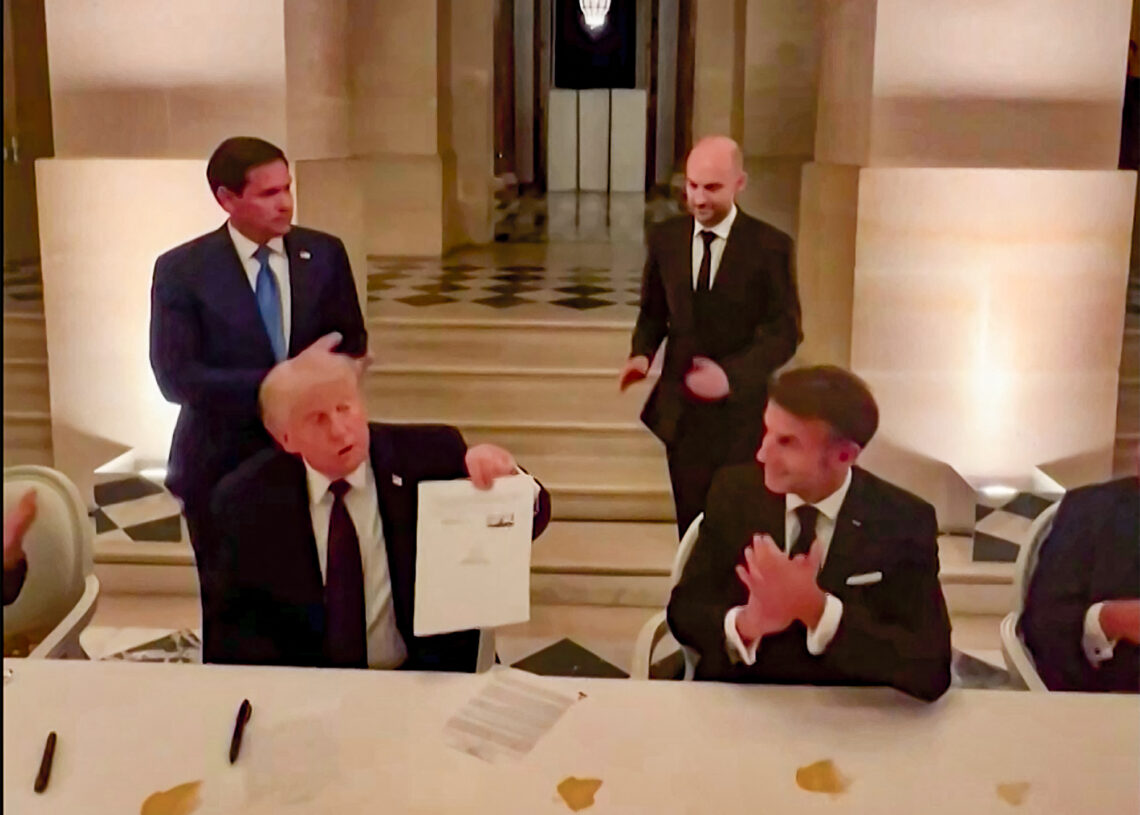
The memorandum of understanding — which President Donald Trump signed to applause that echoed faintly at the Palace of Versailles on Wednesday night — puts the onus on the United States to deliver early concessions including lifting sanctions, freeing billions in frozen assets and dismantling a U.S. naval blockade of Iran’s ports.
At least one provision appears to have been violated before Trump’s signing at Versailles, though after a digital signature had been applied Sunday by Vice President JD Vance. The opening paragraph requires both sides “to refrain from the threat or use of force,” language that did not stop Trump from warning at a Group of Seven meeting in France this week that he was prepared to resume “shooting at them, dropping bombs on their head.”
Trump and Iranian President Masoud Pezeshkian have described the MOU that brought an uneasy end to the four-month-old war as a diplomatic breakthrough and a road map to a potentially far-reaching accord between decades-long enemies.
“This is a historic document and a message from a powerful Iran: peace will be achieved through mutual respect,” Pezeshkian said in a social media post.
But Western security officials and analysts described the agreement as a flawed document that presents no clear vision for how the United States and Iran can resolve deep-seated differences over Iran’s nuclear program and other issues, and is written in a way that suggests Iran at least temporarily has seized the upper hand.
“The MOU is structured to bring Iran to the table,” said Matthew Levitt, an Iran expert at the Washington Institute for Near East Policy, a think-tank. “And it demonstrates that the United States wanted this deal even more than Iran did. It is front-loaded with more deliverables from the United States and its allies toward Iran than the other way around.”
European security officials said the reaction in Western capitals to the document has been one of bafflement.
“So many terms are not defined” and “Iran benefits the most,” said a European official, who spoke on the condition of anonymity due to the subject’s sensitivity. Publicly, European leaders have praised the deal as a valuable initial step, the official said, “because we don’t want to publicly say that it is a fool’s work.”
Much of the criticism of the MOU, especially from Israel, the U.S.’s ally in the war, has focused on what it fails to address: Iran’s buildup of arsenals of armed drones and ballistic missiles, its backing of Hezbollah, Hamas and other regional proxies, and its record of human rights abuses.
Trump administration officials have emphasized that the memorandum was not intended to be a template for solving every point of friction with Tehran, but to end a war that disrupted the global economy and to secure a commitment from Tehran to negotiate the dismantling of its nuclear program.
One provision says that both sides “have agreed to resolve the disposition” of Iran’s stockpiles of highly enriched uranium and that at a “minimum” stored material will be “downgraded” to levels far below purification levels needed for a nuclear weapon.
“The fact that they’re conceding to that is a major, major win for the United States of America,” an administration official said on a call with reporters Wednesday in which the text of the MOU was read.
In turn, the United States agreed “to terminate all types of sanctions against the Islamic Republic,” according to the document, a reward that some analysts said might have been enough to induce Iran to surrender its nuclear fuel without resorting to war had Trump offered it during talks that were cut off when the bombing started on Feb. 28.
Gaining custody of Iran’s enriched uranium now depends on negotiations that are scheduled to get underway in Switzerland as early as this week. The memorandum sets a target date of 60 days but describes the timeline as “extendable,” raising concern that Iran could drag out discussions through the remainder of Trump’s term.
Those talks will also include discussion of “the issue of enrichment” and “matters related to the Islamic Republic of Iran’s nuclear needs,” according to the memorandum, a provision perceived by some experts as a surprising accommodation of a country that has long maintained that its nuclear program was only for peaceful, civilian purposes even as it produced near-weapons-grade uranium stockpiles.
Only a handful of the document’s provisions require immediate action “upon the signing of the MOU.” All but one require the United States to deliver on Iranian demands.
One obligates the United States to “end the naval blockade” of Iran’s ports “within 30 days.” Another requires the U.S. Treasury Department to issue waivers enabling Iran to bypass long-standing sanctions on oil sales. A third would release “frozen or restricted funds and assets of the Islamic Republic.”
Combined, those measures could give Iran immediate access to billions of dollars in assets and oil revenue, providing a potential economic lifeline to hard-line leaders of the regime.
It was not clear whether the United States had begun taking action on any of those measures after Trump’s ceremonial signing.
The main immediate provision that applies to Iran required it to allow tankers to resume transiting the Strait of Hormuz, a Persian Gulf waterway that accounts for one-fifth of the world’s oil supply. Regional reports indicate that some vessels have begun traveling through the strait in recent days.
Even so, the terms were tentative, obligating Iran only to “make arrangements, using its best efforts” to allow ships safe passage without charging tolls “for 60 days.”
The post First steps in peace deal demand far more from U.S. than Iran appeared first on Washington Post.