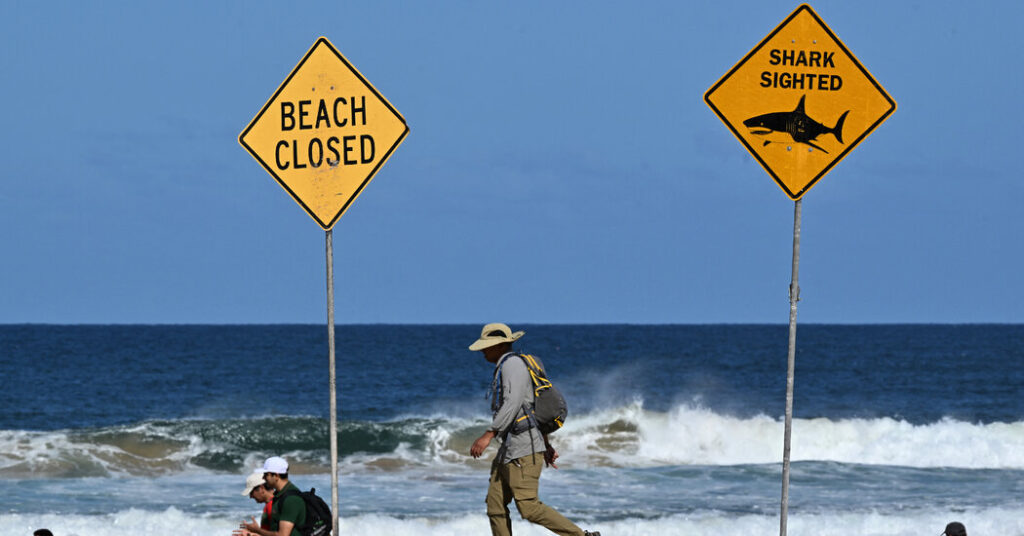
Hauling his surfboard up a walkway at Sydney’s Bondi Beach, Mat Chin said he did not think nets strung beneath the waves were doing anything to keep surfers like him safe from sharks.
At the same time, he said, “it just feels more comforting to know they’re there.”
Australia is one of only a few countries to use shark nets, a contentious form of beach protection. Some experts say the nets aren’t the best way to keep people safe — and that they trap and kill an unnecessary number of other marine creatures.
Officials in New South Wales, Australia’s most populous state, had planned to begin removing nets at three beaches as part of a pilot program. But when a surfer was killed by a shark at a Sydney beach in September, that plan was put on hold. Then, last week, a swimmer was killed by a shark at a remote beach a few hours north.
All of that has reignited a long-running debate over how best to keep surfers and swimmers safe.
Some beachgoers want the nets gone. That includes Ernie Garland, 52, a veteran surfer and swimmer. “Shark nets are a very antiquated form of protection,” he said at Bondi Beach hours after the most recent shark attack, sitting on a shoreline crowded with swimmers, surfers and sunbathers.
But for Mr. Chin, 18, and some other beachgoers, skepticism about the nets’ effectiveness runs up against an instinctive discomfort about removing them.
“We already have cases of shark attacks with the nets,” Barbara Satie, 25, said during an interview at Bondi. “If we take the nets out, maybe we’d have more.”
Australia is a hot spot for shark attacks, along with the United States.
Fatal attacks are extremely rare, but Australia has done more than perhaps any other country to try to mitigate them. That may be because its national identity is so closely tied to beach-going, said Christopher Pepin-Neff, a professor at the University of Sydney who studies shark attack prevention.
Shark nets were first introduced in New South Wales in 1937 after a spate of attacks. Today they are used at 51 beaches across the state, including Bondi, an emblem of Australian surfing culture.
Sharks can and often do swim around the nets, experts say. Most shark nets are about 500 feet by 20 feet. At a beach like Bondi, which is over 3,000 feet long and has one net, most of the swimmable area is unnetted.
Many Australians mistakenly assume that shark nets prevent sharks from entering a beach, said Culum Brown, a professor of marine biology at Macquarie University in Sydney. “They think that the nets are a barrier — and they’re not.”
In fact, they are designed to reduce the likelihood of attacks by trapping and killing sharks, said Robert Harcourt, an emeritus professor of marine ecology at Macquarie.
“It’s just a fishing technique, the same as we use to catch fish to eat,” he said.
That’s where conservationists see a problem. Although beach staff regularly check and release animals caught in the nets, many die in the meantime. Official figures from New South Wales show that beach netting caught 24 sharks and 199 other marine creatures last summer. Only about a third of all those captured were released alive.
Whether shark nets keep people safe is a complex question.
Professor Harcourt said the number of shark attacks beaches with nets fell significantly in the years after their introduction in New South Wales, largely because they reduced the nearby shark population.
Over the decades, other factors added to the decline. For example, Sydney moved away from ocean dumping of sewage and offal from abattoirs, which had attracted small fish and the sharks that eat them.
Newer methods also have been introduced at beaches, such as drones and so-called smart drumlines, floating traps with hooks that snare sharks and alert officials so they can be released. It’s difficult to isolate the effect of an individual method.
Then there is this: Although the average number of shark bites in New South Wales fell after the nets were introduced, it has increased since 2016 to nearly the same level as before 1937.
Explaining this is challenging, partly because shark bites are so rare that scientists don’t have enough data to draw definitive conclusions, said Charlie Huveneers, a professor who leads a shark ecology group at Flinders University in South Australia. But, he said, it was likely a result of a mix of factors including population growth and climate change.
A 2024 study did not find a significant difference in shark bites at netted versus unnetted beaches in Sydney since 2000. But that is not necessarily a gauge of the nets’ effectiveness, said Professor Huveneers, the study’s lead author.
Two opposite outcomes could be true, he said: Either the nets did not kill enough sharks to make a difference, or they did and therefore reduced bites at beaches with and without nets.
Because there is no effective way to test which hypothesis is correct, he said, it’s hard to say whether the nets are worthwhile. Many experts argue that newer technologies provide more targeted and less lethal forms of protection.
Over the past few years, several local councils in New South Wales voted to withdraw support for shark nets in favor of alternate methods, including Waverley Council, which administers Bondi Beach. Earlier this year, Waverly was one of three councils that agreed to participate in a state government trial to remove one net from a beach belonging to each council.
After the fatal attack in September, Chris Minns, the leader of New South Wales, told The Daily Telegraph, a local newspaper: “It would be the wrong decision to remove them at this time.”
Public opinion has been turning against shark nets in recent years, but the issue remains emotionally and politically fraught, especially after a shark attack, said Professor Pepin-Neff.
“It’s about blame avoidance,” Professor Pepin-Neff said. “It’s not about risk, and it’s not about sharks.”
Yan Zhuang is a Times reporter in Seoul who covers breaking news.
The post A Question Circling Sydney’s Beaches: Do We Still Need Shark Nets? appeared first on New York Times.