Their week starts on Wednesday. It ends on Saturday night.
Every “Saturday Night Live” craftsperson is intimately familiar with the whirlwind process of taking sketches from Wednesday afternoon’s read-through and bringing them to life by Saturday night. It’s a process that requires odd hours, sleepless nights and a deep well of creativity.
It’s not something that every crew member is immediately on board with.
“To be honest, it sort of took me until the ‘50th Anniversary Show’ to finally go, I think this is the place for me,” said costume designer Tom Broecker. “I think it speaks to so many different parts of my process, so there’s something exhilarating every week about it and something incredibly challenging every week about it. Every show is still a learning curve.”
Production designer Keith Raywood, who ended Season 51 of “SNL” by putting up his 814th episode with the show, had a unique path to joining the long-running sketch series. Raywood met Lorne Michaels through Eugene Lee, the show’s original production designer, during the period where Michaels was no longer running his creation.
“In 1985, there was a meeting, and Lorne was telling people that he was going back to ‘SNL,’ and at that meeting, I was sitting at the table, and he pointed at me and said, ‘Oh, and we’re going to bring Keith with us too. I was kind of the kid in the room. I may be the only person who was told he was going to work on ‘Saturday Night Live’ and didn’t ask for the job,” Raywood remarked. “Mike Myers’ then-wife Robin [Ruzan] said to me, ‘So let me get this straight: You had one job interview your entire life?’ I guess you could put it that way.”
Broecker, Raywood and most “SNL” craftspeople kick into high gear on Wednesday night, scripts now in hand. That’s not a lot of time to get things from the page to the live show (the pre-recorded sketches, which shoot on Fridays, have even less).
“A great part about ‘SNL’ is that, because it’s a writer-driven show, the writers tend to be very specific in their desire as to what the visual is,” Broecker said. “As designers, we help them articulate that sometimes because they can’t necessarily articulate it.”
Broecker, who has a team of six people for live shows and four people for pre-tapes, works from 10 p.m. to midnight on Wednesdays, meeting with actors and writers before returning at 8 a.m. the next morning. Raywood follows a similar schedule, meeting with director Liz Patrick on Wednesday nights to make a game plan for each sketch.
“Wednesday night is kind of our production meeting on each sketch,” he said.
Of course, sometimes the people behind the sketches try to throw the craftspeople a few obstacles to keep things interesting.
“At least every other show, there’s always some very challenging sketch. To tell you the truth, those are the ones that are really fun,” he said. “Mikey (Day) and Streeter (Seidell) in particular for a while used to be like, OK, what are they going to come up with us to do now? It was almost like Streeter had this little devil on his shoulder.”
“Our job is to say yes,” Raywood continued. “If we don’t think it can happen, for the most part everyone believes us. But saying no never seems to be the option. It’s not what we want to be putting out there.”
Once they’ve homed in on an approach, Broecker and Raywood both start their teams on a mad dash to get things show-ready as soon as possible. They each have their own archives, allowing them to draw on decades of sets and costume pieces used for old “SNL” sketches. Raywood knows, for example, that when a sketch like Jack Black’s recent Five-Timers monologue rolls around, he has plenty of old pieces to help mount that now-classic set.
Broecker, meanwhile, refers to the costume archive as a “magic closet,” one filled with garments that he can pull back out to play. He just has to make sure that he and the writers are on the same page.
“Sometimes writers write things that they may not actually understand what it means in terms of a costume, so it’s sort of also getting them to really pinpoint down sometimes,” Broecker said. “Is that really what you mean? You’re saying 1890s, but you described something from 1860s.”
This season, Broecker said he was particularly proud of the costume design in an episode hosted by Ryan Gosling, an actor who’s “not afraid to really go for character and really go for wanting to make it a little larger than it may need.”
“’SNL’ lives in a space between naturalism and farce, I think,” Broecker said. “Ryan understands that aesthetic and sort of pushes the limit to what we do. It’s always nice to have that, and also it’s nice to have repeat people who sort of understand, who aren’t afraid, who want to get in there.”
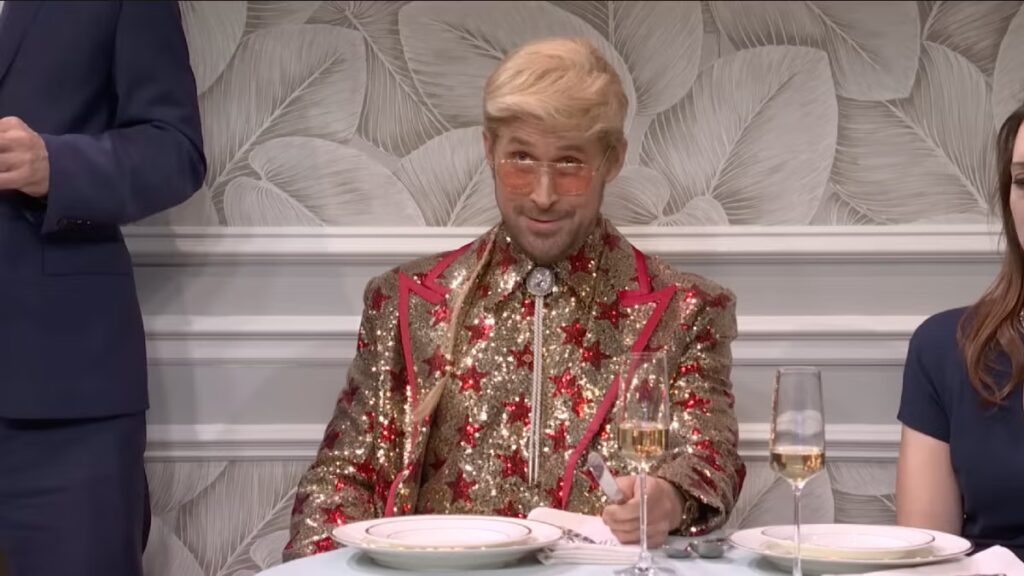
One sketch featured Gosling as a strange man (dressed in a gold-sequined suit with red glasses, a bolo tie and a Padawan braid) trying to force a bride and groom to repeatedly kiss at a wedding. A pre-recorded segment saw Gosling don a Willy Wonka-esque outfit as the leader of a bakery with Oompa Loompa-like minions who keep killing themselves.
“One of the things that was really fun to do was trying to figure out in the monologue what the weird bug heads were going to look like. Ryan had described something to us, he said, ‘A space alien praying mantis head,’ and because they were dancers and female, we had to figure out how they were going to be danced in. I did this weird sketch, and watching them translate this sketch into three dimensions.”
Raywood, meanwhile, took particular pride in an episode hosted by Black. Since this was Black’s fifth hosting appearance, Raywood got to dust off the old Five-Timers set, adding fun new layers as needed for the sketch.
“We had to set it up on the floor and then we had to rig it so that we could move the bookshelf. The bookshelf had to slide in order to reveal Jack White coming through. Suddenly, there was smoke, there were lights, so on,” Raywood said. “For a monologue, that’s a lot. Then also, as soon as the monologue’s over, we had to clear it all off the floor to make room for other sketches.”
The production designer remarked on how the needs of his department can change as various cast members cycle in and out of the show. While the second-season all-star Ashley Padilla relies more on her own physical comedy than elaborate sets, Raywood noted, cast members like Sarah Sherman can bring frequent fun challenges to the production design department (such as buckets of goop and slime).
“We’ve always joked about this in the art department, and I’m sure Tom feels this: We get older and the cast seems to always stay the same age,” the longtime “SNL” designer said.
The post How ‘SNL’ Craftspeople Pull Off a Show in Just 3 Days: ‘Our Job Is to Say Yes’ appeared first on TheWrap.