Amid the tumult surrounding President Trump’s decision to appoint an ally with no national security experience to become the acting director of national intelligence, some critics are asking: Should the job even exist?
The post was created in the aftermath of two major intelligence failures: the Sept. 11, 2001, terror attacks and the incorrect assessment that Iraq had weapons of mass destruction.
The idea was that a high-ranking intelligence official, independent of any particular spy agency, would improve coordination and communication among various departments.
Today, the office oversees the work of 18 intelligence agencies including the C.I.A., the F.B.I., the National Security Agency and a range of smaller offices inside the Pentagon, the State Department and other parts of the government.
Critics say the office has become too large and inefficient in the past 20 years and question its utility. Supporters say the office’s primary functions are as crucial now as they were at the beginning of the century.
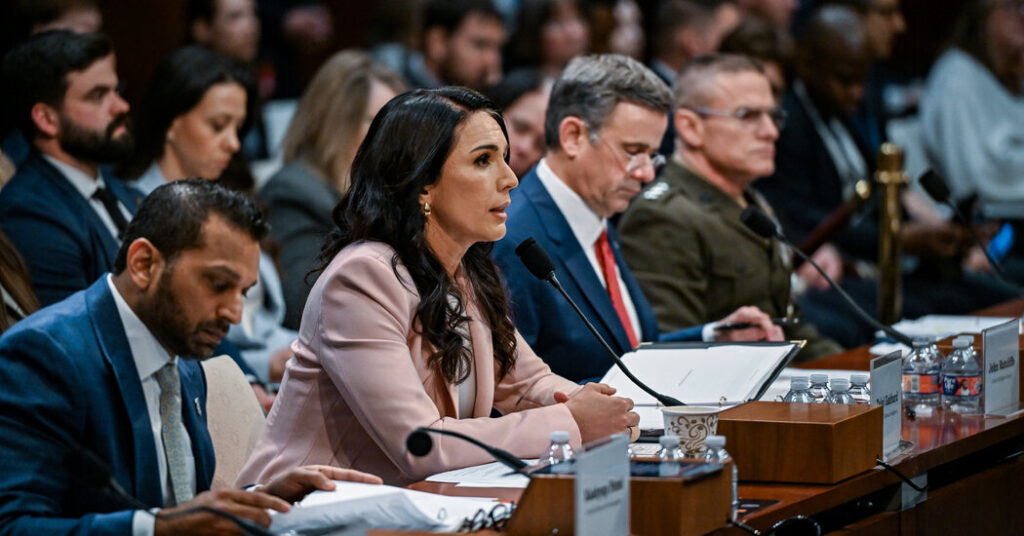
This month, President Trump announced he was appointing Bill Pulte as acting director, replacing Tulsi Gabbard, who is stepping down in the wake of her husband’s cancer diagnosis.
Democrats and many Republicans condemned the interim pick, citing Mr. Pulte’s lack of national security experience and his role in pursuing Mr. Trump’s perceived political enemies.
The Senate rushed to approve Jay Clayton, Mr. Trump’s choice for the job on a permanent basis, hoping to deny Mr. Pulte the chance to hold the office temporarily.
But then Mr. Trump pulled back Mr. Clayton’s nomination, at least for now, paving the way for Mr. Pulte to take office on Friday.
With the administration giving Mr. Pulte the task of shrinking the office, questions about the future of the post are once again before Congress.
Those who believe that the office is vital to national security say the director is needed to evaluate intelligence from multiple agencies objectively.
If that job was handed back to the C.I.A. director, whose responsibility it was before 2005, the natural bias would be for the spy agency to prioritize its own material. The Office of the Director of National Intelligence can ensure that dissenting or minority views are heard.
“The office was not created by accident,” said Senator Angus King, the independent from Maine who caucuses with Democrats and sits on the Senate Intelligence Committee. “It was created as a result of the lack of communication between intelligence agencies before Sept. 11 and that can still be a problem.”
The office pushes intelligence agencies to focus on broad national priorities, and it has some power over how those agencies spend their money. The director of national intelligence also works to connect the dots on potential threats especially as the line between foreign and domestic threats becomes fuzzier.
And then there is the issue of having a high-ranking official who can evaluate intelligence coming from so many different sources — human, communications intercepts, satellite imagery and more.
“It is critical to have an ‘honest broker’ capable of coordinating all source analysis,” said Avril Haines, who served as director of national intelligence in the Biden administration. “Not to get everyone to agree but rather to surface disagreements and force a discussion among analysts that actually reveals why those disagreements exist.”
Benjamin Friedman, the policy director at Defense Priorities, a think tank skeptical of overseas interventions, said there was value in having a high-ranking official manage the intelligence community. But the problem with the office is that it has responsibility without power, he said.
To be effective, the office should have great authority to move funds around and alter budgets, powers jealously guarded by the C.I.A. and the Pentagon.
“It is basically impossible to do the job as it was envisioned,” he said. “They just don’t have the power to direct the agencies they supposedly coordinate.”
Other critics say the office makes the process of synthesizing intelligence slow and bloated. Fred Fleitz, a National Security Council official in the first Trump administration, has been perhaps the most prominent voice calling for the complete elimination of the office.
He has called on the next director to “finally eliminate this huge redundant intelligence bureaucracy.”
Mr. Fleitz argues that the C.I.A. could do the coordination work. He noted that John Ratcliffe, the C.I.A. director, has served as the primary intelligence adviser for Mr. Trump, delivering the most important analytic assessments on Iran.
Some of the office’s most important functions — including assembling the President’s Daily Brief — already take place at the C.I.A.’s Langley headquarters.
But on Capitol Hill, the debate has centered on shrinking the office, not eliminating it.
Senator Tom Cotton, the Arkansas Republican who leads the Senate Intelligence Committee, has introduced a bill that would cap the office at 650 people and transfer some of its functions to the F.B.I. or C.I.A.
Mr. Cotton and Mr. Pulte have discussed how to make that happen.
“I have every confidence that Bill will reduce bureaucracy to refocus our intelligence community on stealing secrets from our adversaries,” Mr. Cotton said on Thursday.
Ms. Gabbard has already cut about 40 percent of the office, reducing it to about 1,300 people.
However, some critics of Ms. Gabbard say she cut the wrong things.
One office she slashed was the Foreign Malign Influence Center, which monitored attempts by adversarial countries to influence U.S. elections and helped warn the public about those threats.
Some Republicans bristled at the Biden administration’s efforts to counter election interference. Former officials, however, say the first Trump administration authorized the criteria to evaluate election threats that sought to denigrate both Republicans and Democrats.
For supporters of the office, the election work was something a director of national intelligence was ideally suited for. Protecting elections is an inherently political endeavor, so having the Office of the Director of National Intelligence do the work insulated the C.I.A., N.S.A. and F.B.I. from criticism, former officials said.
But protecting the country’s elections was not necessarily among the main reasons the office was created.
The 9/11 Commission, an independent investigative panel, found that the F.B.I., C.I.A. and other intelligence agencies had failed to share information with one another before the attacks. The commission pushed for the creation of a director of national intelligence, with a small staff, to break down the barriers between the agencies.
As Congress debated the commission’s recommendations, questions grew over the U.S. failure to find weapons of mass destruction in Iraq that the intelligence agencies in 2002 had said were there.
Lawmakers pushing for the creation of the office invoked the intelligence community’s failure to make an accurate assessment of Iraq’s chemical and biological weapons programs — and also faulted it for not telling policymakers or Congress about dissenting views.
The new office was not initially required to document dissenting views, but in 2022, Congress mandated that the intelligence agencies highlight substantial differences.
For his part, Mr. King said that he does not object to shrinking the office but that Mr. Pulte should not be the one doing it.
And Mr. King says the post still provides a critical role.
During the Afghanistan war, the Defense Intelligence Agency and the C.I.A. would provide very different assessments of the conflict, he said.
“I remember coming out of one of those meetings thinking: Are those guys all in the same country?” Mr. King said. “But that is OK as long as there is some referee who will try to meld the analysis and probe it. If you abolish the director of national intelligence, that referee would be lost.”
The post Trump’s Intelligence Pick Renews Debate: Is the Office Needed? appeared first on New York Times.