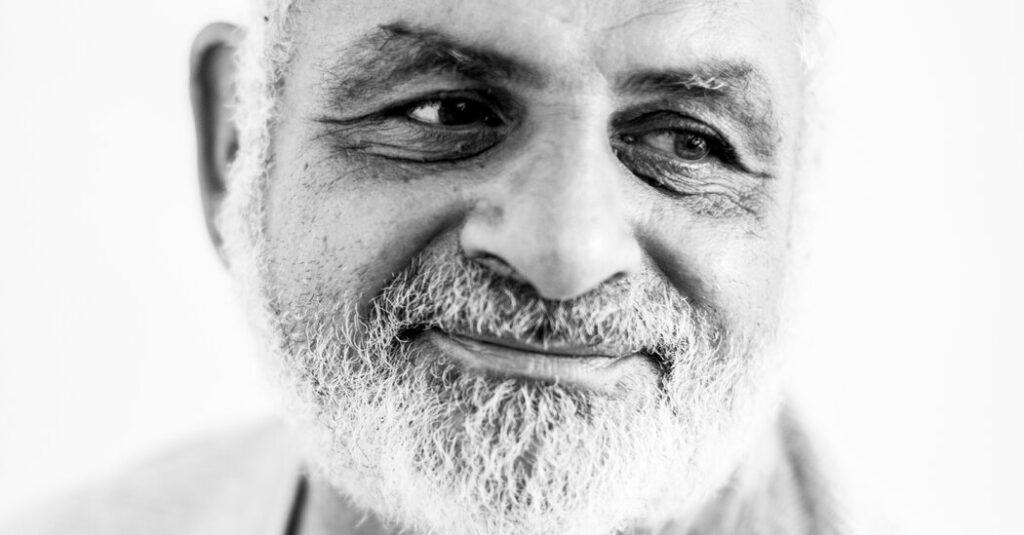
Tariq El Sawah, an Egyptian man who had been captured early in the U.S. invasion of Afghanistan and whose long military detention at Guantánamo Bay, Cuba, drew scrutiny as his health deteriorated, died on March 31, a decade after the United States sent him to Bosnia and Herzegovina for resettlement. He was 68.
Mr. Sawah had been hospitalized in Zenica for about two months before he died, his brother Jamal said. No precise cause was given, but his brother said Mr. Sawah never overcame his time in U.S. custody when, U.S. records showed, he developed illnesses including diabetes, coronary artery disease and an eating disorder.
The Obama administration had sent him to Bosnia in 2016 as part of its unsuccessful effort to close the prison by repatriating some detainees and sending others to countries that would resettle them in support of the U.S. goal. He spent his last decade of life penniless, unemployed and sickly.
“He was haunted by his time in Guantánamo,” said Sondra Crosby, a physician and a professor at Boston University who evaluated his health at Guantánamo and later saw him in Sarajevo. “He suffered from significant mental and physical health challenges, from which I don’t believe he ever recovered.”
Mr. Sawah was captured by U.S.-allied Northern Alliance forces in Afghanistan in late 2001 and spent nearly 14 years in U.S. custody but never went before a court.
Prosecutors periodically considered charging him before a military commission on allegations that he had trained to be a Qaeda explosives expert in Afghanistan. They drafted charges, and a lawyer from the Marine Corps was assigned to defend him, but that case never moved forward.
In 2005, he filed a habeas corpus petition in federal court challenging what he called his “illegal concentration camp incarceration in Cuba” and signing it, “greatly thanks, Tariq”; no judge ever ruled on it.
He also had a succession of public defenders, including Ketanji Brown Jackson — now a Supreme Court justice — who briefly worked on his case in 2006 while at the federal public defender’s office in Washington.
At that time, the courts were still establishing how to handle the hundreds of uncharged Guantánamo detainees, and his case later bogged down in disputes over what evidence the government had to disclose.
Tarek Mahmoud El Sawah was born on Nov. 2, 1957, to an accountant and a homemaker in Alexandria, Egypt, and grew up admiring the United States, his brother said.
He was described in U.S. military documents as having been imprisoned as a young man for ties to the illegal Muslim Brotherhood after the assassination of President Anwar Sadat by members of the Egyptian Islamic Jihad in 1981.
Mr. Sawah left Egypt for Greece in 1989, then went to work for a relief organization in Zagreb, Croatia. He joined the Bosnian Army in 1993 at a time when Serbs were attacking Muslims in the Republic of Bosnia and Herzegovina, and foreign Muslims were coming to their aid. He married and became a citizen before leaving for Afghanistan in 2000, when it was under Taliban rule.
In a handwritten note to a U.S. court in June 2005, the basis of his habeas corpus petition, he said he left Bosnia because the 1995 Dayton Peace Accords that ended the Bosnian War required forces of foreign origin to leave the country.
Afghanistan was the only country that took in men like him, Mr. Sawah said, and while he joined the “Afghan army,” he said he never took part in any attacks against the United States.
A leaked U.S. intelligence profile of him in 2008 described him as “a very proliferate source” of information about Afghanistan.By then, he had been frequently questioned by U.S. military interrogators who spent years seeking a broad range of information from hundreds of detainees to find Osama bin Laden and confirm their captives’ identities and ties to Al Qaeda.
Mr. Sawah’s story was included in a New York Times investigation in 2016 that described the mental health damage afflicting detainees who had been held and brutally interrogated by the C.I.A. in covert overseas prisons and at Guantánamo Bay.
At the military prison, to curry favor with his captors, he became a prized informant, telling interrogators what he thought they wanted to hear. He spent much of his time there segregated from the hundreds of other prisoners — in a hut with a garden and television and supplies from the base McDonald’s and other fast-food establishments there.
On his 5-foot-10 frame, his weight ballooned to more than 400 pounds. Prison records showed he had weighed 215 pounds the day he arrived, May 5, 2002.
A 2019 study by Physicians for Human Rights based on medical examinations of him and his records in 2012 and 2013, blamed his morbid obesity on “interrogators exploiting an eating disorder by offering him excessive amounts of food in exchange for information.”
Lawyers and medical experts who met him at the compound said he took up painting as a form of therapy.
Mr. Sawah was released during a period of downsizing of the detainee population by the Obama administration. In February 2015, a U.S. government panel of national security and intelligence agency representatives called Mr. Sawah “one of the most compliant detainees at Guantánamo” and recommended he be “transferred to a country with appropriate support, including adequate medical care.”
The last entry in his federal court file, in January 2016, notified the court that the military transferred his custody “to the control of the Government of Bosnia.”
In addition to his brother, who lives in the United States, he is survived by a sister, daughter and granddaughter. He was divorced from his Bosnian wife while he was in Guantánamo.
Mr. Sawah’s return to Bosnia proved tragic, his brother Jamal said. He was given no identity papers except a refugee document in later years. He could not travel, never was able to collect a pension and lived off contributions from Muslim charities and from his daughter, who had grown up without him.
“They couldn’t convict him of anything,” the brother said. “Why not let him live in dignity?”
The post Tariq El Sawah, Guantánamo Prisoner Sent to Bosnia, Dies at 68 appeared first on New York Times.