Dorothy Chin is a psychology professor at Santa Monica College and a writer in Los Angeles.
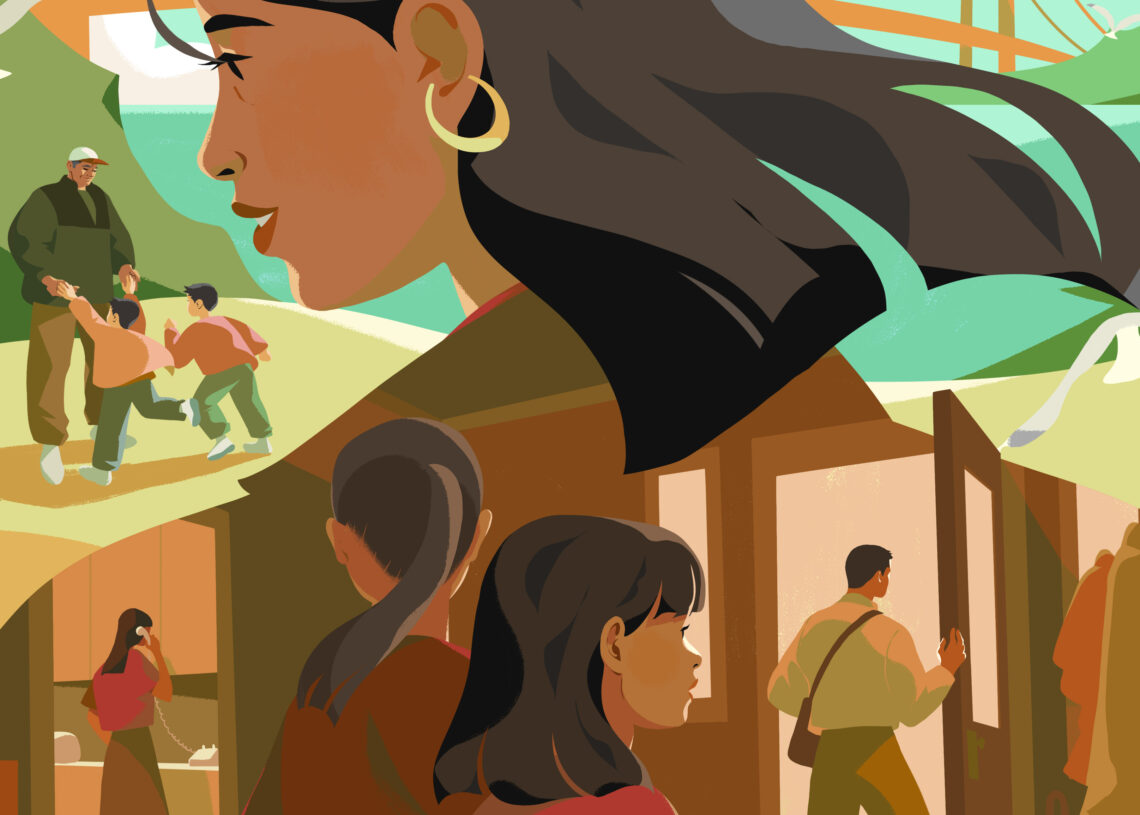
In one of my earliest memories, I am watching my father get dressed for work, as he drapes his tie around his neck; when he leaves, I call out: “Daddy, hurry home!” I thought he had the most important job in the world. In actuality, he was a manager at one of the largest retail shops in Hong Kong, a nice position but not well-paying enough for a man with a young family of six to support. My father had always wanted to be educated beyond the couple of years of junior college he attended. And when he couldn’t, he wanted that for his children. So he entered the lottery to emigrate to the United States, and when our number came up, there was no question. We were going.
It was in America that my view of my father changed, first slowly, then all at once. After we arrived, he worked at my uncle’s tiny cafe in San Francisco’s Chinatown, washing dishes and slapping American Chinese dishes like sweet-and-sour pork and egg foo yong on tables. But my father was a white-collar kind of guy, ill-suited for the fast-paced, sweaty world of restaurant work. After a few months, he found a desk job at a hospital doing patient billing. Meanwhile, my mother, who also worked at my uncle’s restaurant for a time, got a waitressing job at an American cafe. To learn the names of all these unfamiliar foods, she brought a menu home to study, memorizing “hotcakes” and “two eggs over easy.”
If this sounds like a hopeful beginning to our new life in America, it was. But I also remember my mother being unwell a lot of the time. She lay in bed in the afternoon after work, and she was moody when she was up and about. We learned to tiptoe around her moods, pleasing and placating when we could. My father, in the meantime, found that the English he had studied here and there wasn’t good enough for his job. Whenever the phone rang at his desk, he panicked. At home, he disappeared emotionally, calling on us kids to manage my mother’s moods, to prevent her unhappy outbursts, to soothe and apologize when we failed. “Go to your mother, go!” he would say. On Mother’s Days, we timidly presented our cards early in the day, because one year we were late and she was angry.
My mother took up with another man around this time. The affair was a secret only to my dad. She stood in the hall talking to the man for hours, her ear attached to the beige house phone that sat in an alcove; she brought my older sister along when she met him for lunch; she disappeared often. After my father became suspicious, they screamed at each other in the evening. We kids prepared dinner and ate on our own.
I hated both of them, but I hated my father more. I hated how he depended on us to deal with our mother, how he couldn’t be strong enough to stop what she was doing, and worse, how he involved us in it. During my teen years, I absented myself from him, even as we lived in the same house and ate at the same table. But a moment stands out from those miserable years: I moved into the basement bedroom after my sisters left for college, and I offhandedly asked if I could bring the television down there, too, since no one else watched it. “No,” he said, “we would never see you.” It never occurred to me that he cared. Had he been “seeing” me all that time?
I wish I could say that my view of him changed right then, like an epiphany in a Hollywood movie. But it didn’t, not for decades, as I tried to gain emotional distance from my family and build my own life.
Then, finally earning his pension from that same billing clerk job that once caused him to freeze on the phone, my father retired. He traded in his signature suit and tie — he was the only one to dress like that at his office — for baseball hats and a North Face fleece. When I became engaged to a man with financial means, my father said, “Good. You won’t have to worry about money,” and I realized how crushing that weight had been for him. Earning the pension loosened him from the grip of his anxieties. He had done his job; he had sent four children to college, he was able to retire and support himself and his wife.
When I had kids, my father seemed to come out of himself even more. He adored my twin boys, devoting to them a loving attention I did not know he possessed. His stoic face softened whenever they were near, and he wrote neat little notes to them with puns like “fun funds!” along with a check. Our relationship grew more personal. Over the phone, I regaled him with stories of their swimming prowess, grades and evolving passions, and he would laugh in delight. It was as if we were both making up for lost time. At the 75th anniversary of the construction of the Golden Gate Bridge, he told me he had written poetry (in Chinese) in celebration. Poetry! He was 82.
It was as if a blurry picture of my father were gradually coming into focus. What it showed was a gentle man who deeply wanted to be educated, would have wanted to be a professor but knew that could not happen, who poured everything he had into me so I could achieve that instead.
The biggest change, though, happened when my partner left when our kids were 2. The realization was profound. My father, like countless men, could have walked away when my mother had the affair. But he stayed. Even when he was struggling to feed his family, when he felt humiliated and betrayed, when he was emotionally beaten down, he stayed.
My father will turn 96 in a few months. He and my mother, 88 now, celebrated their 67th anniversary last year. Now, I see him as an extraordinary man. I feel lucky for the gift I have received through the passage of years.
Purposeful estrangement from family has become more common, even celebrated as healthy. Understandably, some choose to cut ties from family dynamics so traumatic that healing becomes impossible. But I wonder if, for others, it closes off the possibility of change. We tend to think only about ourselves as individuals who grow, but everything grows and changes, all around us, in time.
The post What retirement revealed about my father appeared first on Washington Post.