Subscribe here: Apple Podcasts | Spotify | YouTube | Overcast | Pocket Casts
Democrats fall in love. Republicans fall in line. Or at least that’s the old joke.
The quote, often attributed to Bill Clinton, spoke to a political reality. After all, in a contest of tradition versus change, it’s no surprise that the party of tradition more easily comes to consensus than the one seeking change.
But where the “falling in love” of politics once implied progressive dreams of one change figure or another, it now seems to apply most to the cult of personality around President Trump. And the passion on the right has led to a kind of pragmatism on the left. In a world where Democrats fall in line, few people have been more successful at making that happen than Nancy Pelosi.
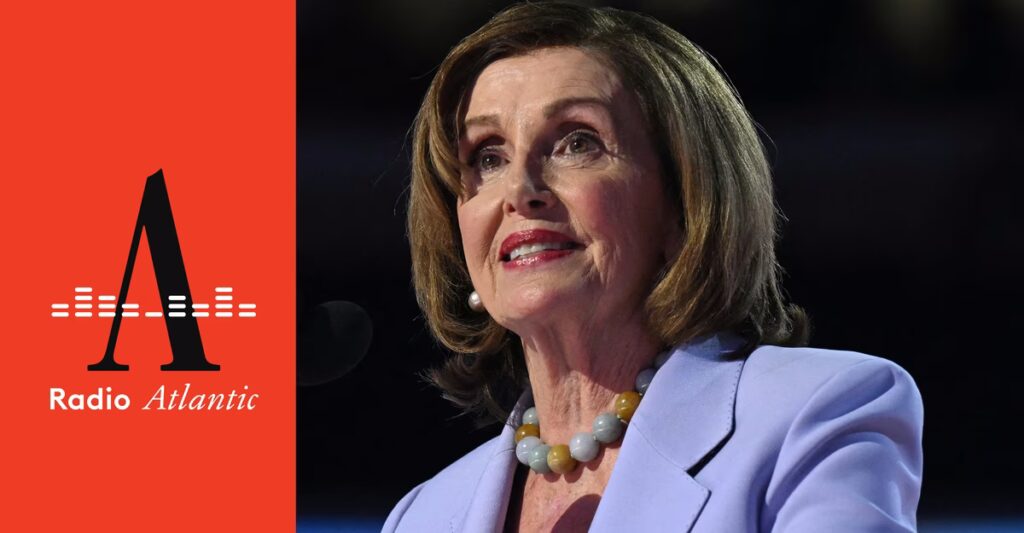
The longtime California member of Congress is the only woman to ever serve as speaker of the House. And her tenure was marked by uncommon party unity, even before Trump became the party foil he is. She says she did this with consensus, listening rather than telling.
“Democrats know what they have to be, and that is we are not a monolith,” she told the Radio Atlantic host Hanna Rosin earlier this month at the Cascade PBS Ideas Festival, in Seattle. “I can’t go in there and say, Everybody should be like me because I’m from San Francisco, and this is the right thing to do. We have to listen to other people’s views and, hopefully, across the aisle.”
On this week’s episode of Radio Atlantic, that live conversation with Pelosi. She shares her thoughts on gerrymandering, the midterms, the progressive wing of the party, and her 39 years in Congress.
The following is a transcript of the episode:
Hanna Rosin: Hey. Before we get started today, we have an announcement. This show is adding three new dimensions. Number one, episodes now every Monday in addition to the Thursday episode. Number two, we have a new host, Adam Harris. You have probably heard him on the show. He’s co-hosted. He’s also been a guest on the show. And number three, the Monday show is gonna be on video. You can watch it on YouTube.
Adam, how you feeling about that? You looking good?
Adam Harris: I am feeling great. It’s been really exciting to get this show off the ground, and I’m excited to get started.
Rosin: So if you had to make a show right now—this week—what would it be about?
Harris: There’s just so much in the news. You have the Iran deal. You have the sort of ongoing, unfolding dimensions of the Jeffrey Epstein scandal. You have the start of the World Cup. I think one of the reasons why I was really interested in coming back and joining you as a co-host on Radio Atlantic is because there is so much to explore. And there’s just so much news to cover. And so it’s honestly a bit of a blessing that we’re able to look at the world through this lens of this magazine that’s been around for 170 years.
Rosin: But let’s say you could do a show about literally anything you wanted. lt wouldn’t even have to be news related. Would you create an alternate reality where the Spurs won?
Harris: 100 percent.
Rosin: (Laughs.)
Harris: 100 percent. Both in 2017 and now.
Rosin: Got it.
Harris: (Laughs.)
[Music]
Rosin: I’m Hanna Rosin. This is Radio Atlantic.
Nancy Pelosi is a lot of things. But one thing a lot of people can agree on is that she knows how to get things done. And if she doesn’t like you—especially if you’re a president she disagrees with—she won’t try to hide it.
Pelosi was a key figure in pushing through the Affordable Care Act under President Obama as speaker of the House. An icon of Democratic politics for the last few decades: whipping up votes, negotiating bills, and, in one memorable moment from 2020, ripping up a speech at the State of the Union.
News anchor (from NBC News): A stunning moment here at the end of the president’s speech, Nancy Pelosi tearing up what appeared to be a copy of the president’s speech.
Rosin: Earlier this month, I sat down with Pelosi at the Cascade PBS Ideas Festival in Seattle. We talked about the midterms, if the Democrats could win back the House, possibly the Senate. We talked about gerrymandering and the future of the Democratic Party—just as she is about to retire from it officially. (Audience claps.)
Rosin (in interview): So we’re coming on—it’s 39 years—
Rep. Nancy Pelosi: Yeah.
Rosin: —about, which is amazing.
Pelosi: June 9. Next week.
Rosin: June 9 is the anniversary of your swearing in, right?
Pelosi: Right.
Rosin: Yeah. Amazing.
(Audience claps.)
Rosin: Which means you have five months to go.
Pelosi: Right.
Rosin: How are you liking the term emerita? Do you feel relieved, like, Oh, I don’t have to do this anymore? Or do you feel panicked, like, What do I do now?
Pelosi: Well, I’m only there for one reason right now, in addition to meeting the needs of my constituents, but my purpose is to win the House for the Democrats.
(Audience claps.)
Pelosi: And that’s it. That’s it. So right now, it’s like every day counts and you have to make every day count. And so I’m not looking in terms of five months or what. That’s what it is. Five months minus about three days, and we will have the election. And we wanna make sure that everybody knows that the election will be safe and will be protected, that we will win the election, and what we will do when we do. So I’m busy.
Rosin: Yeah. I knew you weren’t gonna sound like a person who’s five months from—the way a lot of us would sound if we were five months from retirement. It’s just impossible to imagine: When I think Nancy Pelosi, I think action verbs, like wrangling. There are things we associate with you, and none of them are fishing.
So looking at the House map, help us understand from your perspective: is looking at the map of the nation and winning the House—do you think of it the same way you think of winning a vote, like gathering your people? Is it the same kind of thing?
Pelosi: Well, let’s define our terms. When we say winning the House, let’s think back to our founders. As we celebrate—mostly—celebrate the 250th anniversary of [our] July 4, 1776, and then what they did after that to write the Constitution. They wrote in the Constitution very clearly about the House and its purpose. So in order to talk about what we want to do, it’s important to note this: Our founders thought that the House of Representatives should be a reflection of the American people, and that’s why there’s proportional representation.
The Senate at the time—you know, we have 40 million people in California. We have two senators. Some other states have one million persons, and they have two. But that’s what we take an oath to protect and defend. And they were, at the time, just appointed by the state legislature, just to go back in history a bit.
But the founders, the one thing that they had total agreement on is they did not want a monarch. So the way they set up the Constitution for the election was: the president would have a four-year term and the House would have a two-year term. So people ask me all the time, including members, How come we have to run every two years? It’s because that’s the genius of our founders. They wanted the race for the House in two years to be a referendum on the executive. And that’s exactly how it turns out.
So when we say we have to win the House, that means we have to be a referendum, as our founders intended, that we not have a monarch. So we fully intend to do just that.
Rosin: What would you put the chances of Democrats winning the House right now?
Pelosi: Not only are we going to win the House—
(Audience laughs.)
Pelosi: —we’re going to win big, and that’s what our plan is.
(Audience claps.)
Rosin: So that number of 100. That’s 100.
Pelosi: I guarantee you Hakeem Jeffries will be the speaker of the House, and he will be great. And right now he’s planning how we win, how we protect the election, and what we will do when we win.
Rosin: What about the Senate? I know the House is your baby and you love the House more, but just asking: What about the Senate?
Pelosi: That’s true. But I only speak about what I really know, and I know on the ground what is happening with the House. People say, Are you being a little arrogant? I said, No, I’m being confident. We’re gonna win the House.
The Senate has real possibilities. The bigger we win the House, the better chance for them to win the Senate. But if we win both, that would be a dream come true for our founders. That’s what they had in mind.
(Audience claps.)
Rosin: So the person you’ve been alluding to but not mentioned by name, I remember hearing you on a podcast right before the presidential election—and this is painful to read now—what you said was, “I can’t even envision a situation where he could win. If he were to win, and we didn’t win the House, imagine how horrible it would be. I can hardly sleep at night as it is, but that would be unthinkable, impossible for our country.”
Now, your wish did not come true, so the question is: Has it been just as you expected?Worse than you expected? How has it rolled out?
Pelosi: Let us again define our terms.
(Audience laughs.)
Pelosi: You’re talking about what’s-his-name?
Rosin: He Who Shall Not Be Named.
Pelosi: He shall not be named.
Rosin: Since you’re not naming him, I’ll take your lead, yeah.
Pelosi: No, it’s worse. This is worse. The fact is that I didn’t come here to talk about him, I came here to talk about me. But okay, we’ll talk about him.
(Audience laughs.)
Pelosi: No, I’m teasing. Look what is at stake: a constitution where people are represented, where freedom of the press, freedom of speech, all democratic freedoms in the Bill of Rights. And then you have rule of law, due process, separation of powers—my personal favorite: independent judiciary, Supreme Court. So there’s so much at stake in this election coming. Not that we can change the Court right now, but this is an election we must win.
But I say to people—because there are people who are concerned about our democracy, and we need to be—but I said, When we campaign, we just can’t be talking about—we save our democracy at the kitchen table. This is about lowering the cost and increasing the availability and accessibility of health care, and it’s about ending the corruption that is going on in Washington, D.C. That’s what people vote on. We always have to make a distinction, Hanna, between what is important—and we can all agree on so many important things—and what people vote on, which is what is important to them at that time: the cost of living, affordability. And that’s the fight that we are in.
Rosin: In your book, The Art of Power, you talk about managing George Bush. You talk about John McCainjust how you handle each one, your intuition. How did you handle Donald Trump? Like, if you had to strategize or you had to get something done or sort of you needed the White House for some reason, how did you do it?
Pelosi: Well, I didn’t manage any of those people, but I respected them. You always want the President of the United States to succeed. And for the most part, Democratic or Republican, that was never an issue. We always were patriots, and as I say, you want the president to succeed.
In order for there to be cooperation and all the rest, there has to be some truth—I guess that’s the best word I could say—some validity as to what that person’s agenda might be for our country. So we’re having a difference of opinion on policy. I’d rather not talk personally about…
(Audience laughs.)
Rosin: I am genuinely curious because you’re so strategic in the book. You’re so good at reading people—
Pelosi: Yeah.
Rosin: —understanding what you need from each person and how to get it, to get everything on everybody, all the House members. It’s so many people. It’s like you have 10,000 children and you have to get them all in line. It’s kind of amazing.
So I did wonder about when you’re faced with a situation like this, but you do have some duty to the country—did you have any personal interactions or any insights about, well, how do you get something done here?
Pelosi: Well, the first term was better than the second term.
Rosin: Mm-hmm.
Pelosi: You know? But then we had to impeach him twice, so.
(Audience laughs.)
Rosin: So he wasn’t a fan.
Pelosi: A fan? No, no. (Laughs.) But the thing is, somebody said to me the other day, I fought really hard for you to impeach the president. I said, You didn’t do any such thing. There’s only one person responsible for the two impeachments of Donald Trump, and that person’s name is Donald Trump.
[Music]
Rosin: After the break: Nancy Pelosi on that moment when she ripped up a copy of Donald Trump’s speech.
[Break]
Rosin: Do you all remember the moment that Representative Pelosi ripped up the speech? Okay—
(Audience claps.)
Rosin: It was so meme-able. I feel like it’s just gonna be around forever. Did you think of that on the spot?
Pelosi: Yeah, I did.
Rosin: Really?
Pelosi: I’ll tell you, on a couple spots. One, here’s the way it was.
(Audience laughs.)
Pelosi: We go to the State of the Union, and again, wanna be respectful. They’re guests in our House, the House of Representatives. So anyway, when the president comes in, you probably notice that they hand a copy of the speech [to] the vice president, a copy to the speaker. So I had my copy there, and he starts to speak, and what I was hearing was not consistent with fact. So I tore a little piece and I said, I have to remember that on this page it wasn’t true.
(Audience laughs.)
And then the next page, it wasn’t true. And then the next page, it wasn’t true. The whole speech was really a manifesto of misrepresentations. So at the end I thought, I have to tear this speech up, because the whole thing—every single page—had misrepresentation. But worse than misrepresentation—lies.
But it’s on parchment, so you just can’t do this. You have to do this and this, and… (Laughs.) But I’ll tell you something, I go all over the world, and I’m like, We’re so proud of the Affordable Care Act and all these things that we did legislatively. All people wanna do is…
(Audience laughs.)
Pelosi: But also they don’t like when I point—this past week, for some reason, today I was in the airport and a young woman came up to me and she said—she had her phone with a picture on it—and she said, I’m the person who took this picture of you in the Cabinet office pointing at the president.
Wow. I didn’t know who took that picture. But in that picture, everybody tells me, That’s the one I want autographed. That’s the one I want autographed. Because in that picture I’m saying to the president, I’m leaving this meeting now because with you, Mr. President, which I called him, all roads lead to Putin.
So that to me was a more serious assault on what he had to say than just tearing up his manifesto of misrepresentations. Lies.
(Audience laughs.)
Rosin: I wanna talk about Congress more broadly. What do you think about the gerrymandering war that has opened up? Your successor, Hakeem Jeffries, has said, “Maximum warfare everywhere all the time.” The Democrats have definitely jumped into the gerrymandering war. How do you feel about that?
Pelosi: Oh.Let me back up on that. When we won the majority in ‘18—so ‘19 we went in and then when President Biden was elected in ‘20—our first bill was H.R.1, For the People Act. And one of the major provisions of the bill was no more partisan gerrymandering.
We have to get to that place. Now—
Rosin: But the Democrats don’t seem to take that position anymore, not really.
Pelosi: No, no. They do. You slap me in the face, I’ll slap you right back. So they did what they did in Texas. Winning this election is too important, so we did what—we didn’t wanna do what we did in California. But if they’re gonna try to take five seats in Texas, we’ll take five seats in California. Let me say this—
Rosin: But that is partisan.
Pelosi: —I would rather not have done that, but I’m not gonna let them get away with taking five seats and then going here and going there.
(Audience claps.)
Pelosi: I know some people like to say, Turn the other cheek. No. I’ll turn once I punch you in yours.
(Audience laughs.)
Rosin: Okay. I feel like I wanna rip up my speech just for—
(Audience laughs.)
Pelosi: (Laughs.) No, I don’t mean to sound that way, but that is our bill. We have in California commission redistricting. And we said we will take this departure right now because what they did in Texas—and return to commission redistricting. We have to have it in every state of the union so that everybody knows that’s not what it’s about anymore. It’s about not politicians choosing their constituents. It’s about constituents choosing their elected officials, and that’s where it has to be.
(Audience claps.)
Rosin: After the last election, there was a lot of handwringing among Democrats: Who do we need to be? What do we need to evolve into? What should our policies be? What should our message be so that this doesn’t happen again? Do you have a clear answer to that? What the Democrats need to evolve into or change?
Pelosi: No. I think the Democrats know what they have to be, and that is we are not a monolith.
Your job title and your job description, one and the same: representative. So I can’t go in there and say, Everybody should be like me because I’m from San Francisco, and this is the right thing to do. We have to listen to other people’s views and, hopefully, across the aisle. So there are elements, exuberances in the party now that should be heard and the rest.
But when we have that vote the first couple of days of January, we will all—not me, ‘cause I won’t be there—they will all be voting for Hakeem Jeffries for speaker. And then they will—you build the consensus. You recognize the importance of every voice, and everybody doesn’t think alike. We are the Democratic Party.
The Republican Party has a different attitude. They just do what they’re told. That’s not what we are. That’s not what we are.
Rosin: One theory that I hear a lot, and which I am dying to hear your response to, is there’s a powerful young generation of politicians whose style is different. It’s sort of movement, grassroots politics plus social media influence. AOC is the most prominent example.
There was a perception, maybe a media perception initially, that you were maybe resistant to that because it would fracture the Democratic Party or it would somehow not keep the party together. Is that perception true? And has your view evolved on how to bring in this new style of politics?
Pelosi: Well, let us again define our terms. I was not for candidates coming in and running against our incumbents because we needed to win the House. In other words, weighing the equities, we had to win because we were the referendum on that executive in the White House. We had to win. So no, I wasn’t happy about people saying, Let’s spend a whole lot of money challenging Democrats. You wanna do that, do that. But don’t think that that’s something that is good for this year. Do it a year when we have the luxury of having the majority. You can’t gain by losing.
So AOC is wonderful. She’s much more operational than I think people may think. So that wasn’t the case. The big difference is just social media—
Rosin: How? How? How do you notice that?
Pelosi: One of the tragedies or the victims of social media is truth. There’s nothing that is sort of, We all agree that this is the choice that we have. It’s a lot of misrepresentation. But with all due respect to whatever you’re quoting there, we’re gonna win this election.
There will be those, like in San Francisco—we just had a race where there’s a guy who was going after Hakeem, going after me, going after da-da-da. It’s over for him. Okay?
(Audience laughs.)
Mm-hmm. Because that’s not—I mean, what is the point? You have to be respectful of all that new energy and young people coming and seeing things in a different way. But the idea is that there will be those who will be out there to just take down the incumbents when this is our year to honor the Constitution of the United States. I’m not for that.
You run any time you want and do whatever you wanna do. But don’t expect that to be welcome when we’ve gotta stay completely focused on saving the Constitution,but more importantly, helping people at the kitchen table. But that’s, again, that’s the Democratic Party. Look, I was chair of the party in California before I was ever in Congress. And I loved it because I would prepare candidates to go out there and win, and I knew how to win elections.
But I’m a progressive leftie—San Francisco. I had the left-left on my case all the time, and that’s their right. But it doesn’t mean that I’m against them when you say, Have you changed your mind? No, I haven’t changed my mind. I’m for winning.
(Audience laughs.)
Rosin: We’re out of time. There’s gonna be a lot of debate about your legacy, everything that you’ve accomplished for a long time after you leave the House. I will say, for me, personally, one of the great legacies that you’ve left for me in my life is the Nancy Pelosi clap, which I employ all of the time. So let’s give Nancy Pelosi a Nancy Pelosi clap.
(Audience claps.)
Rosin: Thank you so much.
Pelosi: Let’s thank Hanna for putting up with me all this time.
(Audience claps.)
[Music]
Rosin: This episode of Radio Atlantic was produced by Jinae West. It was edited by Kevin Townsend. Genevieve Finn fact-checked. Rob Smierciak engineered and provided original music.
Audio and video recordings by Fremont Studios and the Cascade PBS Ideas Festival.
Claudine Ebeid is the executive producer of Atlantic audio, and Andrea Valdez is our managing editor.
Listeners, if you enjoy the show, you can support our work and the work of all Atlantic journalists when you subscribe to The Atlantic at TheAtlantic.com/Listener.
I’m Hanna Rosin. Thank you for listening. And don’t forget: We now have a show on Monday morning with new co-host Adam Harris.
The post ‘You Slap Me in the Face, I’ll Slap You Right Back’ appeared first on The Atlantic.