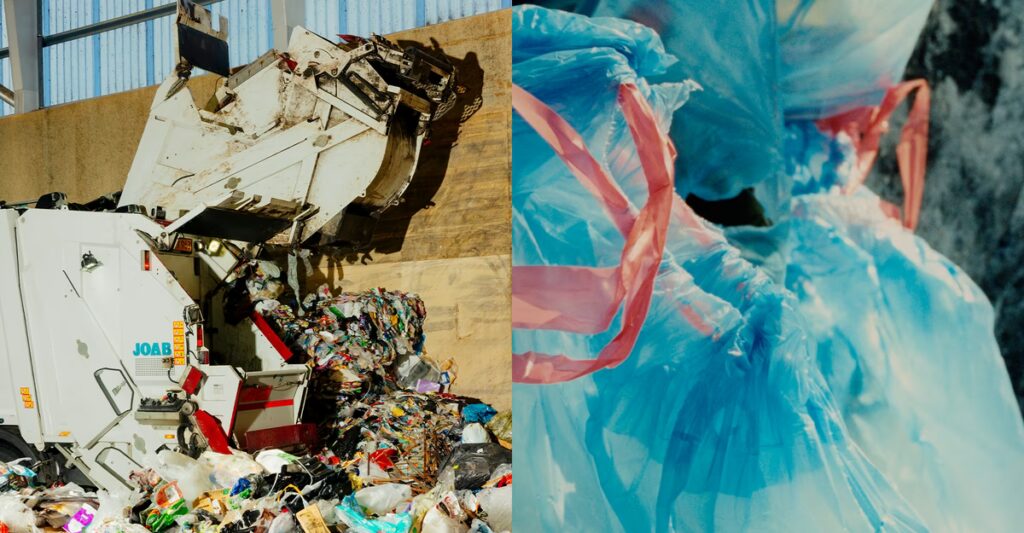
Like many small children, my daughter reveres garbage trucks. In the mornings, she goes to the window and asks, eyes shining, whether today will be a “garbage-truck day.” When she sees or hears one, she reacts with a giddy, half-afraid delight that I imagine she’ll reserve, someday, for roller coasters or getting a body part pierced. Once, I had to spend half an hour teaching her the concept of synonyms because she was so upset that I’d referred to the sacred trucks’ contents as “trash,” not “garbage.”
According to the Montreal garbageman Simon Paré-Poupart, toddler garbage fandom is a manifestation of the age-old human appreciation of strength and daring. In his memoir, Trash!, a French-language hit recently translated into English by Pablo Strauss, Paré-Poupart explains that children are “so impressed by the truck that they worship the man who seems to tame its force.” But really, his book argues, garbagemen wage war against a force far more powerful than any engine or trash compactor: their fellow humans’ tendency to acquire more stuff than they need. Paré-Poupart loves his job, but he also knows that by tidying up the “detritus of the most polluting civilization in human history,” he and his colleagues make it too easy for everyone else to forget how much waste they really create. In Trash!, he challenges his readers to pay more attention—to see the age of DoorDash and same-day delivery as garbagemen do.
It doesn’t look good. Trash! is a street-level portrait of both lack and excess, an exposé of rich societies’ overconsumption and waste. Every day, Montreal’s garbagemen throw the results of too much buying into their trucks and receive too little in return: low wages, long hours, no job security, no aid for the athlete-level wear and tear that come with the job. And they don’t get much respect, never mind that if they weren’t there to clean up the city, it would grind to a sick, smelly, rat-infested halt.
Paré-Poupart takes Francophone literature to particular task for leaving his colleagues out of the cohort of “‘working-class heroes’ celebrated in popular culture, from Quebec’s novels of rural life to Émile Zola’s miners. Nobody writes novels about garbagemen.” He seems to be writing for those who need to imagine, not remember, what it’s like to take an accidental “shower in compost bin juice” or have the man whose garbage cans you’re wrangling sneer at you, “I went to school so I wouldn’t have to do a job like that.”
[Read: The interior lives of hoarders]
Trash! is an intriguing attempt to broaden the parameters of this kind of book. Paré-Poupart has a distinctly 21st-century knack for swirling together theoretical and visceral language: René Descartes on one page, and grubs “wriggling and swarming in every garbage bag” on the next. His grab-bag writing is reminiscent of the internet at its rare, educational best. Paré-Poupart’s style gives his book a rambunctious spirit, a sense of a hungry, catholic mind at work. All sorts of dilemmas come together in Trash!, which reveals them to be expressions of the same core issue. Paré-Poupart shows readers a society whose members, with too few exceptions, seem to treat both their belongings and the workers who ultimately handle them as disposable.
Paré-Poupart is, by his own account, an unconventional garbageman. As a teenager, he was a Dungeons & Dragons devotee with academic dreams unusual for his middle-class community, in which “liking school didn’t command respect.” His family wanted him to go to college, but only because doing so would lead to higher pay. What his stepfather really valued, at least, was masculinity: While Paré-Poupart was still in high school, he got hired to run behind garbage trucks after his stepdad challenged him to “be a man.” (In Quebec, trucks often drive at a crawl while collectors jog after them, tossing in trash.)
Garbage put Paré-Poupart through college and graduate school in sociology, and even as he pursued work in research and social services after earning his degrees, he kept “right on throwing trash, where the physical challenge, camaraderie, and steady income balance out the intellectual satisfactions of other jobs.” In Trash!, he brings his two careers together, although he never allows the writer side of himself to outshine the garbageman. Take his critique of recycling, which he describes as a “magic trick, or more properly a sleight of hand.” It’s an illusion, in both Quebec and the United States, that most plastic really goes anywhere except an enormous drift in the ocean or a giant heap in one of the poorer countries that buy rich ones’ refuse. To Paré-Poupart, this reality is not just a planetary insult but also a personal one. The contaminated plastic that recycling companies ship from Montreal to India, he writes, includes “recyclables I picked up with my own two hands.”
Elsewhere, too, Paré-Poupart takes care to explain the links between trash and garbagemen’s working and living conditions. Citing the sociologist Zygmunt Bauman, he writes that our “world generates a glut of both actual garbage and what Bauman terms ‘human waste,” meaning those whom society has rejected or deemed unproductive—or, as Paré-Poupart has it, anyone who “never had a chance.” He includes most garbagemen in this category, and his evocation of their rough lives is potent evidence of profound social lack. In Quebec, waste collectors historically haven’t had strong labor rights or protections. Many struggle with poverty; Paré-Poupart mentions one garbageman whose truck meets him daily on the corner where he sleeps.
Paré-Poupart describes this man, and others like him, with grace and admiration, though he can veer into idealization. Of a 52-year-old nicknamed “Beaujeunehomme” who generally arrives at work “in a state of inebriation that would make even the hardest drinkers stagger,” Paré-Poupart writes, “Everyone in the garbage business accepts him just the way he is, unconditionally, few questions asked.” And then he adds, “Beaujeunehomme is a castoff who feels right at home surrounded by garbage.” Trash! regularly expresses this vision of garbagemen as rebels united by their work, which can be unsettling when Paré-Poupart is writing about men with much less social mobility than he has. He doesn’t convince me that Beaujeunehomme is accepted, not trapped.
If Trash! were exclusively stories of Montreal’s Beaujeunehommes alongside that of Paré-Poupart himself, it might seem unsavory. Its author’s education—and, more important, his power as the lone narrator of his world—already risks creating too much of a divide, on the page if not necessarily in person, between him and the men he writes about. Its intellectual components are the reason it works. Even though I’m skeptical of Trash!’s account of Beaujeunehomme, I can appreciate its analysis of—and anger at—the conditions garbagemen deal with on the job, which Paré-Poupart often puts in cerebral as well as anecdotal terms. It’s when he combines these two modes that his argument grows most convincing.
Consider Paré-Poupart’s discussions of garbageman strength: He describes one man who can “ride a garbage truck like a human flag”—as in, hanging onto it while his torso projects horizontally over the street—and another who was once seen to “pick up a washing machine and throw it into the hopper, with one hand, without stepping off the truck’s running board.” As far as he’s concerned, these men’s work “resembles elite sports for its combination of performance, toil, and pushing yourself to new feats,” but rather than the men being rewarded with massive contracts and advertising deals, “workers’ strength is a commodity to be exploited until their dying day, with no regard for their well-being or will.” As is often the case in Paré-Poupart’s book, the string of connections here—garbagemen showing off, pro athleticism, and some pretty Marxist language—is unusual enough to jar readers, which is an excellent strategy for getting them to stop to really consider how taxing trash collection must be.
[Read: A better way of buying—and wanting—things]
But Trash!, for better and worse, is never content to make a point without putting it into perspective. After explaining that the highest praise among garbage collectors is to say that someone is strong enough to work a grueling shift like a machine, Paré-Poupart asks, “Isn’t the fact that we’re forced to work at this inhuman pace a sure sign that we’re drowning in waste?” In his view, the answer is so evidently yes that he’s given up on consumption to the extent that he can: He writes that he scavenges and salvages nearly everything, and believes that repairing rejected goods is the only plausible reaction to living in an overproducing, overdiscarding world.
Paré-Poupart’s constant need to connect and contextualize can be a little exhausting, as I imagine his dumpster-diving lifestyle might be. Still, the book is exhilarating (also like dumpster diving?) on every page. Paré-Poupart’s hyperactive, genre-mixing writing suggests that writing about contemporary labor and its place in consumer societies may benefit from being associative and capacious. Whether the work is online or in the physical world, it is ever more influenced by the too-much-ness of the current era, and seems to call for a different writing style than the methodical, thorough one that 19th- and early 20th-century authors used to evoke the slaughterhouse or the factory—or, to return to Zola, the mine.
Of course, Zola was hyperactive in his own way. Germinal, his book about coal miners, belongs to a 20-novel cycle that follows a sprawling family through the reign of Napoleon III. Germinal is perhaps the most famous of the series, but I first encountered it through The Ladies’ Paradise, which came out in 1883 and explored the then-brand-new world of the department store. It’s a tale of greedy bosses and exploited workers in a society that urges anyone who can to shop endlessly. Although Paré-Poupart might not like the comparison, it came to me as I read Trash!, which demonstrates that garbagemen, like miners and shopgirls, can be literary heroes too.
The post A Close-Up Look at the Waste of Modern Life appeared first on The Atlantic.