Maria Castilleja was 5 the first time she went underwater. Her sister told her to jump, and she did. She still remembers it clearly: the water closing over her head, her brother pulling her out of the pool, the panic that swallowed her.
“That was a trauma,” said Castilleja, 66.
It would take her nearly 60 years to learn how to swim.
Throughout her life, she tried swimming with friends, took classes and worked with private coaches. Each time she got in the water, panic would return.
“I was worried about drowning, and that fear made me sink in the water even when it wasn’t too deep,” she said. “I would swallow water, inhale water — and once you get that you are so uncomfortable. It was a major, major fear.”
Castilleja — who lives in Long Beach, California — grew up in Caracas, Venezuela, the youngest of six siblings, all of them swimmers. She moved to the United States when she was 20 and became a teacher, and eventually a school principal.
On land, she ran 10 marathons and 44 half-marathons. But near the water, she refused to go in past her feet.
“I would have anxiety attacks. I would be trembling,” Castilleja said.
About 40 million American adults report they do not know how to swim, according to the Centers for Disease Control and Prevention, and more than half have never taken a swimming lesson. Black and Hispanic Americans are disproportionately represented among non-swimmers: More than 1 in 3 Black adults cannot swim, and nearly 3 in 4 Hispanic adults have never taken a lesson, according to the CDC. White adults have the lowest proportion of non-swimmers at 7 percent, while about 22 percent of other adults — including Asian, Native American and multiracial populations — reported not being able to swim.
The reasons are layered. Harley Hicks, a London-based swim coach, said cost, access and historical exclusion from public pools all play a role, as well as difficult childhood experiences.
The first thing he does with every swimmer is ask: Why did you never learn to swim?
“Quite a few have a fear because they were pushed into the water, or the method of teaching was too authoritarian, or they got out of their depth too quickly,” said Hicks, lead coach at LDN Swim, which conducts retreats for adults several times a year to help them become more confident in the water. “That bad experience made them stay away from the water ever since.”
Hicks — who was featured in the documentary “Black Stroke” about the racial disparity in swimming — has also seen firsthand how quickly that fear can be overcome. This month, he led a group of 16 adults who were afraid of water on an intensive retreat in Greece, which cost about $1,600 per person. Only a handful had been in open water. By the final day, all 16 were swimming in the sea.
“They jumped into the open water, and it was quite deep and quite far out from the shore, and every single one of them achieved that,” he said, explaining that the swimmers become calmer in the water through exposure therapy. “Being able to unlock the doors for humans who have gone 30, 40, 50 years without having any benefit of the water is super fulfilling for me.”
About a year and a half ago, Castilleja decided it was time to finally face her fear.
“I wanted to be able to go in the ocean with my grandson,” she said. “I felt like I couldn’t enjoy life fully because I had this fear.”
She signed up for lessons at a local gym and found a coach who promised to work with her until she felt comfortable.
“I explained to him my anxiety, and I said, ‘I’m willing to take lessons, but you have to be willing to stick with me,’” Castilleja said.
For the past year, Castilleja has been swimming four days a week. She sometimes still gets a pang of fear when she enters the deep end, she said, but she is no longer afraid of being in the water. In fact, she has come to find it comforting.
“It just gives me so much peace and calm,” she said.
Another late swimmer, Mickey Power, 70, avoided swimming for most of her life. Now that she has learned, she said, it is her salve — as it gives her needed time away from technology.
“I’m not that unconnected at any other time,” said Power, who lives in Chicago. “It’s just you and the water.”
Power had run marathons for years, but in her mid-40s, her joints began to ache. At age 47, she decided to give swimming a serious try.
“I would start out in the shallow end, and as soon as I knew it was over my head, I would start to panic,” Power said. “I couldn’t swim to save my life.”
She took lessons at her local YMCA for two years and forced herself to push through the panic.
“I just kept throwing myself in the water,” Power said. “And then one day, and I can still remember that day, I went back and forth without stopping six times.”
Before long, swimming became her primary hobby. Power now swims three days a week.
“I will tell anyone that will listen to me they should swim. … I’ve never felt better or stronger,” she said, noting that, unlike some other forms of exercise, “it’s not as hard on the body. It doesn’t hurt when you’re done.”
Science suggests a positive correlation between swimming and longevity. One study of more than 80,000 adults in Britain found that participants who swam regularly had a 28 percent lower risk of death by any cause, and a 41 percent lower risk of dying from cardiovascular disease compared with non-swimmers.
For older adults, especially, the low-impact nature of swimming makes it an ideal workout, as many other forms of exercise can take a toll on the body. Researchers have also found that swimming has mental health benefits, including that it can reduce fatigue and anger and alleviate depression. Plus, for many, the sport can build community.
Jeff Hopkins got hooked on swimming about 15 years ago. Then in his mid-40s in Takoma Park, Maryland, Hopkins was helping organize logistics for his two teenage children’s competitive swim team. He could barely swim himself — in college, he recalled, he wore a life jacket when he was playing around with his friends in the pool.
“I wasn’t that comfortable,” Hopkins said.
But seeing how much his children enjoyed swimming, he was keen to learn.
“I understood the health benefits, and I understood that it’s unlikely to get hurt swimming,” he said. “I knew it was a good form of exercise. … I was looking for a way to change my lifestyle.”
He signed up for a one-hour class, swam a few laps and was completely fatigued — but stayed committed to learning.
Now, he runs a masters swim club — an organized swim group for adults to train together and have friendly competition. There are about 100 people of varying skill levels in the group, and they range from about 35 to 80. They meet for lessons five times a week.
“It’s a way to unplug and enjoy the people you’re with and what you’re doing,” Hopkins said, adding that he’s made many friends through the club.
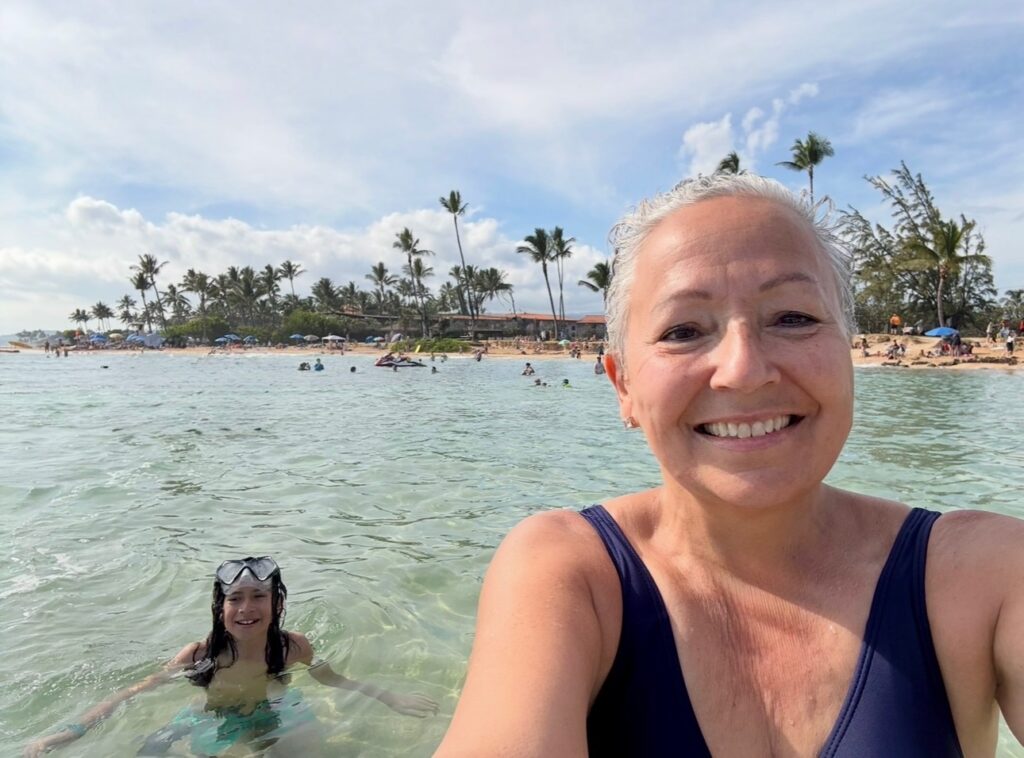
For Castilleja, learning to swim was never just about herself. She wanted to set a positive example for her grandson Oliver, 12.
“I’m sure he was perceiving the panic that I had,” Castilleja said.
Since overcoming her fear, she and Oliver have gone swimming together.
“I’ve built his confidence,” Castilleja said, “because I feel confident in the water.”
The post These adults were terrified of water. Here’s how they learned to swim. appeared first on Washington Post.