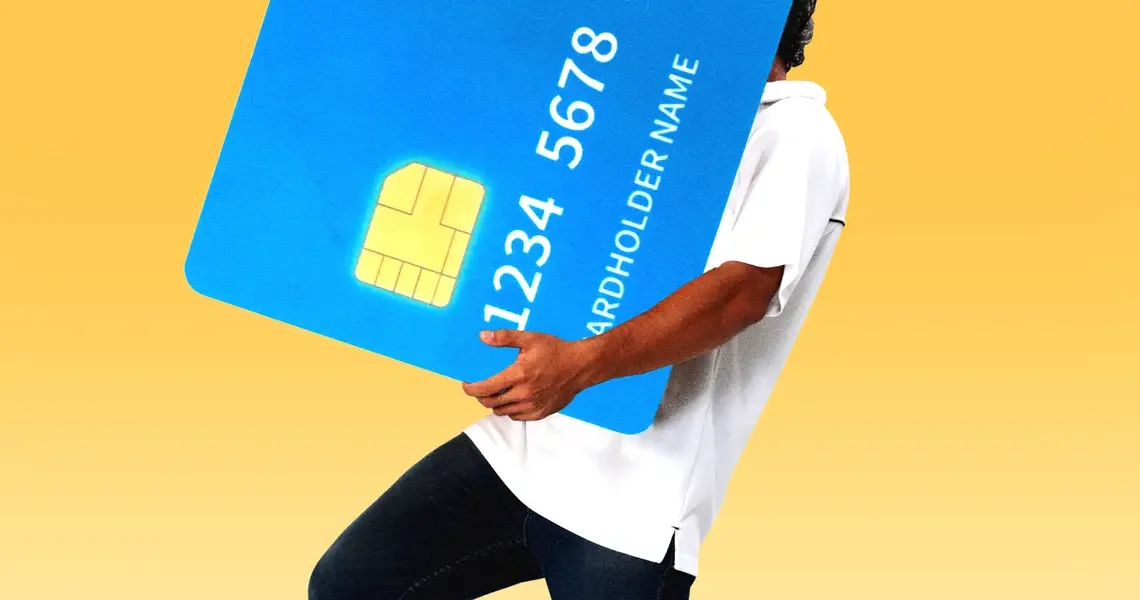

The prospect of paying almost a thousand dollars just to have a certain credit card in your wallet is, when you really think about it, ridiculous. Imagine trying to explain to your 10-years-ago self that someday you’ll cough up a big chunk of a paycheck so you can eat mediocre food in an airport lounge — assuming you can even get in.
And yet many Americans are doing exactly that, because credit card companies have become remarkably good at making annual fees feel less like a cost and more like an investment. They convince people that premium rewards cards are a good deal, enticing them with various points and credits and discounts. Sure, you have to do some financial and mental gymnastics, but that Apple Music subscription will make it worth it. But the math on premium plastic is not a simple “yes.” Annual fees keep rising. Benefits are increasingly convoluted. And many cardholders may be inadvertently saying “yes” to a lot of extra spending.
I’m not saying to throw your fancy rewards card in the trash, but maybe start sliding toward the bin. After talking to personal finance gurus and economists, it’s clear that everyone with a premium card should at least take a hard look at whether they’re reaping the benefits — and how it may be shaping their behavior.
These cards are marketed as tools for lifestyle optimization, but they often look more like a luxury tax in disguise.
Premium rewards cards have never been more popular. Gen Z loves the American Express Platinum. The Chase Sapphire Reserve continues to ride the wave of being the world’s “first viral credit card.” Four in five Americans have at least one credit card, and the vast majority of credit card spending is on rewards cards.
Premium rewards cards have also never been more expensive. Last year, Amex announced it was upping the annual fee on its platinum card from $695 to $895, and Chase similarly increased its yearly charge from $695 to $895. Hoping to get in on the action, Citi launched a new Strata Elite card with a hefty $595 annual fee.
Rewards cards often do much more than simply ‘reward’ spending.
The appeal of premium rewards cards rests on a simple promise: spend money, get money back. Companies justify the fee hikes by highlighting benefits — both Chase and Amex say their perks are worth upward of $3,000. Premium cards have turned into high-end coupon books that nudge consumers toward partners. They offer credits with brands such as Uber, StubHub, Equinox, Resy, and Peloton, as well as cash back on bookings at certain (often luxury) hotels and restaurants. It’s a layup for the credit card companies, whose merchant partners pony up to attract their clients. For consumers, the calculation is a little more complicated. Not only does it take some work for customers to ensure they’re coming out ahead, but rewards can also change how consumers think about spending in the first place.
Research shows that consumers tend to spend more when using credit cards vs. cash. Cards reduce the pain of payment, because the consequences of the spending become a later problem and aren’t felt as immediately as seeing less cash in your wallet. This decoupling of the “yay” of the buy and the “boo” of the cost makes the “yay” feel stronger. A 2021 study from MIT Sloan found that credit cards activate the brain’s reward center and create an “anticipation of pleasure in the form of a purchase,” comparing it to the smell of baked cookies triggering your appetite.
Rewards cards may make this more salient because consumers get both the excitement of buying the thing and the stimulus of earning points. The more they spend, the more rewards they get, even when the spending is unadvisable.
“Rewards cards often do much more than simply ‘reward’ spending — they can reshape how consumers mentally account for purchases, justify upgrades, and perceive value,” says Sumit Agarwal, an economist at the National University of Singapore who has done extensive research on rewards cards. A card that offers extra points or cash back on premium travel might lower the perceived difference between economy and business class, he says, even when that business seat is still much more expensive in absolute terms. But consumers “tend to focus on the reward or status benefit rather than the total expenditure.” Amex recently rolled out a 10% discount for airfares on international flights — as long as they book premium seats.
One of Agarwal’s recent papers found that a small 1% cash-back incentive led to a 32% increase in spending and 8% increase in debt among cardholders. Consumers with lower amounts of cash on hand and lower levels of financial literacy showed the greatest behavioral shifts.
Rewards cards leverage our psychology and biases in other ways. There’s loss aversion — once we’ve got the perks, we don’t want to let them go — and mental accounting — I can justify that Amex fee by telling myself that the $300 in hotel credits I get back actually makes my overpriced stay “free.”
“Did you save $15 or did you spend $35 more than you otherwise would have?” says Ted Rossman, a principal analyst at Bankrate. “They are definitely trying to incentivize spending.”
People may be overly optimistic about how many of the benefits they’ll use when signing up for a card, and once they realize they’ve failed, they keep it anyway because it feels like a sunk cost, and hope springs eternal that they’ll utilize it better later.
“There is a lot of nudging and incentivizing and trying to exploit some of the behavioral biases and frictions that economists have been pointing out for decades,” says Dominik Supera, an assistant business professor at Columbia Business School.
Premium cards also make people feel special. Twenty-somethings don’t just like the Amex because of the perks, they like the social status that comes with it, too.
Besides annual fees and interest payments, credit card companies make money from the interchange fees they charge to merchants every time someone swipes their card. The more people spend, the more cash the issuer has in the bank. The promise of rewards is a way to get people to buy more and even to direct where they’re shopping. Credit card companies would like people to buy high-end.
“They are leaning more into luxury, whether it’s travel, dining, retail,” Rossman says.
In April, Amex’s CFO told Marketwatch that luxury spending is outperforming overall spending on its cards. Both Amex and Chase’s card refreshes last year were aimed at perks that would appeal to big spenders — exclusive experiences, upscale partnerships. Luxury spending is where the money is.
Not everyone is so eager to go along. The lean toward luxury is part of what prompted Elizabeth Lee, 31, and her husband to ax their Sapphire Reserve after last year’s fee hike. The San Francisco-based couple liked the travel benefits and lounge access, but when they examined the full list of perks more critically, they decided they were “nice to have but not essential.” The high-end stuff doesn’t really align with how the couple lives.
“It felt like you had to play the game,” Lee says. She didn’t want to.
Credit card debt in America has ballooned, reaching $1.25 trillion in the first quarter of this year. Given how high credit card interest rates are — nearly 24% on average — that’s expensive debt to carry, including for premium cardholders, since rewards cards often have higher interest rates than ordinary cards.
Experts say it’s absolutely not worth having a rewards card if you’re carrying over a balance from one month to the next, called revolving in personal finance parlance, because interest charges far outweigh whatever little perks and cash back you’re getting.
“It doesn’t make sense to revolve on a rewards card,” Howard Beales, a professor emeritus of strategic management and public policy at the George Washington University’s School of Business.
Are you using the card to support your lifestyle, or are you shaping your lifestyle to support the card?
But many people do, including high-spending affluent consumers with high credit scores. Indeed, those are the “golden goose” customers for credit card companies, says Chenzi Xu, an assistant professor of economics at UC Berkeley. “These are absolutely zero-risk consumers who, for whatever reason, are carrying credit card debt,” she says. “If you can get those guys, it’s amazing, and the data say that they exist and there’s actually a fairly reasonably high number of them.”
A lot of consumers don’t think they’ll wind up carrying a balance when they sign up for rewards cards, Columbia University’s Supera says. But the data says they do.
“In our research, we find on average around 60% of accounts end up being borrowers, end up revolving the account, which is a pretty sizable number,” he says. He echoes Xu’s point that it’s often high-credit-score customers, too — about a third of people with a FICO score of 800 or up revolve on their cards. “It can be pretty costly in the end,” he says.
And, again, even if people aren’t carrying debt on the cards, they still may be leading to splurging.
In a statement to Business Insider, an Amex spokesperson said that its platinum cards aren’t “one-size fits all, and consumers should choose the card that best matches their spending habits and the benefits they’ll actually use.” A spokesperson from Chase said that its premium cards are designed for customers who already spend in categories like travel and dining,” and that it provides a “wide range of products so consumers can choose what fits their lifestyle and financial needs.”
It’s unlikely that rewards card fees are going to go down — credit card companies say that, thus far, customers are sticking with them. But individual consumers would do well to evaluate what’s in their wallets and decide whether flashing around that heavy silver card is making them better off.
Nick Ewen, editor in chief of The Points Guy, tells me there are certain cards he considers “slam dunks,” and premium rewards cards aren’t one of them. People need to make an honest calculation not only of whether they’ll spend to use the benefits but also if this is spending they would definitely do otherwise. Otherwise, it’s not money back in their pocket, it’s money out of it.
Consumers should also ask themselves whether they really want to invest the time in tracking their points, utilizing the bonuses, and the like. Ewen says there’s a “wide range” of how valuable points are on the Amex Platinum, for example, and if you just want to use them for a statement credit because figuring out anything else is too hard, “that’s going to give you the lowest value on a per point basis.” Not to mention that issuers often change the rules around rewards, including sometimes diluting them and making them harder to use.
If you’re on the fence about keeping the card, you can also call the issuer to ask if they’ve got some kind of retention offer for you, which may or may not be successful.
Your fancy credit card may be generating savings and enhancing your lifestyle. But it might also be making you spend more and shop at brands you’re not really into. The best way to tell is to ask yourself a straightforward question: Are you using the card to support your lifestyle, or are you shaping your lifestyle to support the card?
Do you think rewards cards are worth it? Tell us what you think.
Emily Stewart is a senior correspondent at Business Insider, writing about business and the economy.
Read the original article on Business Insider
The post The sneaky luxury tax hiding in your wallet appeared first on Business Insider.