Mobs of masked men tore through parts of Belfast, Northern Ireland, last week, setting fire to cars and homes. Their primary targets were people of color, and the prompt was a knife attack for which the authorities charged a Sudanese refugee. Graphic video of the attack was shared on social media.
About a week earlier, riots had followed the release of body camera footage of the December murder of Henry Nowak, an 18-year-old student in Southampton, a city in southern England. The video showed that the police handcuffed Mr. Nowak as he lay dying after being stabbed by a British-born Sikh who lied to officers at the scene, falsely claiming that Mr. Nowak had carried out a racially motivated attack.
These events had echoes of previous summers. In 2025 mobs targeted homes of immigrants and a recreation center that was being used as an emergency shelter in Ballymena, Northern Ireland, after two teenagers were accused of attempted rape; the teenagers denied the charges and spoke through a Romanian interpreter. The charges were later dropped. In 2024, a horrific knife attack at a dance class for children in Southport was quickly framed as a consequence of Britain’s openness to asylum-seekers, even though the assailant was born in Wales.
Episodes like these punctuate the British calendar with grim familiarity, following a template that is troubling for the direction of British democracy. First, rumors, allegations and fabrications circulate on social media — particularly on X, whose owner, Elon Musk, seems peculiarly dedicated to aggravating ethnic conflict in Britain. A narrative quickly coalesces around the perpetrator and the wider political causes: the excesses of immigration and liberalism, and a state and a police force that is sympathetic to everyone except white Britons. Violence follows.
And, as the far right becomes a fixture of British politics, prominent voices are willing to abstain from condemning the violence, excuse it, or even appear to encourage it.
The anti-immigrant, nationalist Reform Party, led by Nigel Farage, has been steadily moving from the fringes to the mainstream. With eight lawmakers in Parliament, it consistently tops polls and is increasingly talked about as capable of winning the next general election. Mr. Farage described the reaction of “our leaders” to Mr. Nowak’s death as proof of “a two-tier culture in this country, where the rights and privileges of white people matter less than those of ethnic minorities,” and urged Britons to respond with “pure, cold rage.”
A more explicitly far-right party, Restore Britain — formed by the lawmaker Rupert Lowe, a breakaway from Reform, and endorsed by Mr. Musk — responded to Mr. Nowak’s murder in a long post on X that said, “Enough is enough,” and that keeping alive the “savage” who killed him served nobody.
As Britain’s traditional two-party democracy disintegrates, and voters splinter in five or six directions (Reform may lead the polls, but gets only around 25 percent support), the boundaries that once distinguished the center-right from the far right have collapsed. As the writer Daniel Trilling describes in his book, “If We Tolerate This,” flagrantly racist ideas and claims that would have been utterly beyond the pale just over a decade ago now circulate among conservative newspapers and politicians as they struggle to keep up with the rage bait of far-right influencers. Last year, for example, an up-and-coming Conservative lawmaker named Katie Lam told The Times of London that legal residents needed to “go home,” leaving Britain more “culturally coherent.”
There is a troubling sense in Britain that only the right seems to possess the momentum and theatricality that succeeds in this new quick-fire videographic era of politics. Be it in Westminster or on the street, the right — including the far right — takes the initiative and sets the agenda, leaving those in the liberal mainstream to denounce sporadic outbursts of violence without confronting the wider political and ideological climate that encourages and condones it. Few seem willing to, for example, defend the progress made in the effort to make the police force less racist over the last 30 years — an effort the right holds responsible for Mr. Nowak’s death.
Prime Minister Keir Starmer’s ineptitude for leadership is a well-rehearsed problem. His most likely successor, the mayor of Greater Manchester, Andy Burnham, is hoping to win a Parliament seat this week and mount a challenge to Mr. Starmer’s leadership. But if Mr. Burnham becomes prime minister, he will face the same problem: how to overcome the sense of inertia that has swept liberal institutions.
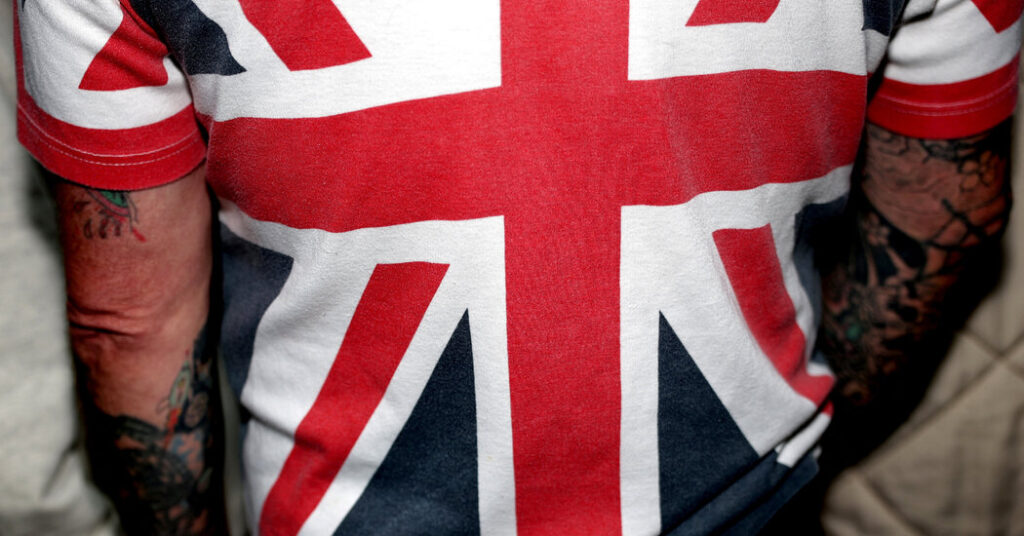
Britain is no stranger to far-right mobilizations or organized street violence. Belfast has its own distinctive history. The National Front was a visible presence in the 1970s. Football hooliganism was a notorious scourge in the 1980s and ’90s. The recent Unite the Kingdom rallies — organized by the agitator Tommy Robinson, real name Stephen Yaxley-Lennon — resembled the drunken, aggressive, flag-waving England football fandom of, say, the Euro 2000 tournament in Belgium and the Netherlands.
What’s different now is the sense of the centrality of this hostility to immigrants to British politics, even though it’s not clear at all that far-right policies have the support of anything like a majority of Britons.
The ascent of the far right in Britain has been acquiring a feeling of inevitability, as if it can be delayed or slowed but never really reversed. Its opponents urgently need their own figureheads and movements if they are to demonstrate that they can do more than throw up their hands in horror.
William Davies is the author, most recently, of “This is Not Normal: The Collapse of Liberal Britain.”
The Times is committed to publishing a diversity of letters to the editor. We’d like to hear what you think about this or any of our articles. Here are some tips. And here’s our email: [email protected].
Follow the New York Times Opinion section on Facebook, Instagram, TikTok, Bluesky, WhatsApp and Threads.
The post In Britain, the Far Right Is Setting the Agenda appeared first on New York Times.