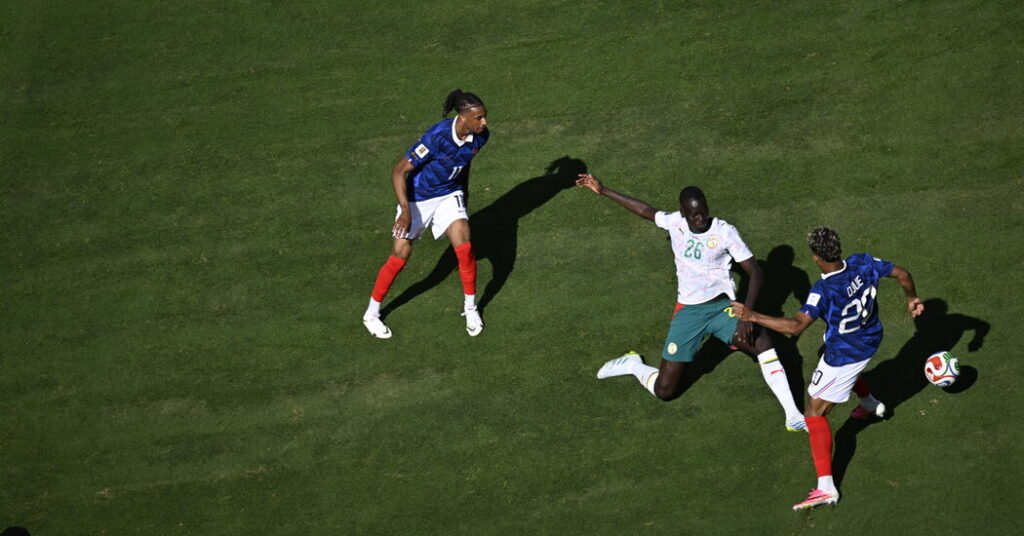
For many across Africa, the Senegal versus France match on Tuesday was one of the most anticipated games in this year’s World Cup. That was partly because soccer fans on the continent saw a chance for Senegal to settle a score against its former colonial master.
Senegal had already done that once, improbably, during the World Cup 24 years ago. But this time, the African heavyweights could not stop a French team that was dominated by African players.
Senegal has become a force in African soccer, reaching the past four consecutive finals of the Africa Cup of Nations, winning the competition once. Last year, they defeated Morocco in the finals, but the trophy was ultimately handed to Morocco after cup officials ruled that Senegal had forfeited the match because of a walk-off protest.
“Senegal offers the best potential for an African success at the World Cup,” said Mark Gleeson, a South African sports commentator, adding that the intense rivalry between France and Senegal was rooted in colonial heritage. “Senegal is umbilically attached to France, but they don’t want to be perceived that way. It is a strange relationship.”
Migration, colonial ties and changes in FIFA rules have reshaped national teams to the point that many are barely recognizable compared with those of ten years ago. European teams have seen some of the most significant changes, though Arab countries like Qatar are catching up, with a squad that features players from 11 foreign nations, mostly from Africa.
But nowhere compares to France.
Way back in 1998, the French team that won the World Cup included several first-generation African immigrants that formed part of a phenomenon known as the “Black-Blanc-Beur team,” or Black, white and Arab team.
Now, it is more African than ever, with 8 out of the 11 players that started against Senegal on Tuesday being first- or second-generation immigrants.
Kylian Mbappe, France’s 27-year-old striker, scored two of the three goals against Senegal. He was born to a Cameroonian soccer player who moved to France to become a youth coach. Bradley Barcola, 23, another French player, was born to a Togolese father.
The most outstanding player for France on Tuesday was Michael Olise, 24, born in the U.K. to a Nigerian father and French-Algerian mother.
Many African migrants in France and across Europe see soccer as an opportunity to climb out of poverty. However, the current flows in both directions.
African national teams have massively benefited from diaspora talent nurtured in elite European soccer academies. All ten of the African nations competing in this year’s World Cup field teams are heavily dominated by European-born talent.
Ten of Senegal’s players were born and trained in France. Cape Verde, which made an impressive debut this week, has one of the largest contingents of Europe-born players, mostly from the Netherlands.
Before the match on Tuesday, a Senegalese politician, Ousman Sonko, who frequently criticizes France’s colonial history in Africa, said that “whatever the result, Africa would have beaten Africa.”
Not all fans saw the match the same way.
Senegal’s only goal on Tuesday was scored by 18-year-old Ibrahim Mbaye, who just last year represented France in a youth tournament before switching allegiance to Senegal.
Mr. Mbaye was not yet born in 2002 when Senegal opened its first World Cup competition by defeating France, the defending champions. It was one of the greatest upsets in the tournament’s long history.
When Mr. Mbaye scored Senegal’s only goal on Tuesday, Lamine Thiam, a 56-year-old Senegalese man watching the match at African Renaissance Monument in Senegal’s capital, Dakar, jumped up and down and punched the air in celebration.
But barely a minute later, Mr. Mbappe netted the third goal for France, becoming the team’s highest goal scorer, and just two goals away from the world record of 16 goals at the World Cup.
“They had only two tasks: to keep Mbappe and Olise from playing because they’re very dangerous, and they could not do it,” Thiam said, criticizing the Senegalese team for its loss. “This is a national shame.”
The post Africa Beats Africa: How Diaspora Talent Helps Define the World Cup appeared first on New York Times.