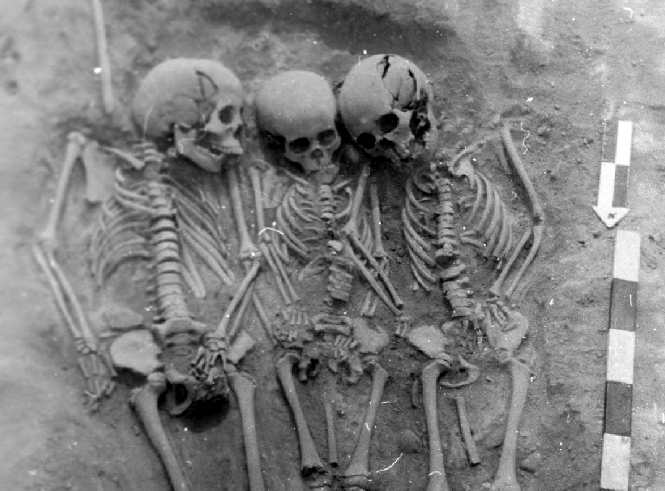
For years, an ancient hunter-gatherer cemetery near Lake Baikal in southeast Siberia has posed a tragic puzzle: an unusual number of children and adolescents.
By examining DNA extracted from the teeth of 46 people buried at this and nearby cemeteries, scientists have discovered the likely culprit: the earliest known plague outbreaks. In a study published Wednesday in the journal Nature, researchers recovered genetic fragments of the plague-causing pathogen, Yersinia pestis, in more than a third of the individuals — marking two phases of an outbreak, starting about 5,500 years ago.
The new find pushes back the timeline on how long the bacterium that causes plague has been jumping from rodents into humans by a couple of centuries, unearths the earliest known plague strains yet and helps resolve an open debate about whether those early versions of plague were lethal.
“I think what is particularly interesting here is the age profile (kids are often not included in ancient DNA studies because their bones are more fragile and less likely to preserve well) and the human genomic data showing the relationships among individuals,” Anne Stone, an anthropological geneticist from Arizona State University who was not involved in the study wrote in an email. “This provides a really interesting portrait of how this pathogen was affecting communities.”
It also complicates an idealized notion of hunter-gatherer lifestyles. For years, mass disease outbreaks have been seen as a consequence of the transition to an agricultural lifestyle, after humans began living in closer contact with domesticated animals and each other.
The new evidence suggests that such outbreaks aren’t a distinct hallmark of modern life, but a continuous thread woven through human existence, even when people were living more lightly on the landscape.
“Myself, I had this very romantic notion … if we could just go back to that time, we’d be in a much better state,” said Eske Willerslev, a leader of the study and an evolutionary geneticist at the University of Copenhagen who was previously a fur trapper in northeastern Siberia. “You get a result like this, and it just rocks the boat. You’re happy you’re born when you are, you know?”
The long, secret history of plague
For a decade, ancient DNA studies have been illuminating the early history of the plague pathogen. Thousands of years before the Plague of Justinian weakened the Byzantine Empire or the “Black Death” tore through medieval Europe, plague was jumping from rodents into other groups of humans, those studies revealed.
Genetic analysis of the early strains, however, had raised questions about how severe they were and how they were transmitted. Earlier strains of the plague-causing pathogen lacked adaptations that made it incredibly catastrophic for humans later — including the ability to be transmitted via insects that feed on blood, such as fleas.
Yersinia pestis, the bacterium that causes plague, arose at least 5,700 years ago according to the new research, splitting off from an ancestor.
In the Lake Baikal region today, marmots still carry plague. The researchers think that thousands of years ago, marmots were also the likely vector for the disease, spreading when people ate undercooked marmot meat or inhaled blood droplets when hunters were skinning them.
The pattern in which closely related family members died around the same time suggests that the disease then spread person-to-person, perhaps when they were caring for one another.
At one cemetery called Ust’-Ida I, 11 of the 31 individuals who were studied had plague DNA fragments in their teeth, signs of the systemic infection.
Plague DNA doesn’t preserve well. At a medieval plague pit at Smithfield in London, where presumably everyone had plague, only 20 percent tested positive in modern analyses, said Ruairidh Macleod, a postdoctoral research fellow at University of Oxford. These hunter-gatherers buried around the same time may all have died of plague, he said, even if scientists couldn’t find traces of the pathogen.
“Probably the same thing is true of the late Neolithic in Europe — outbreaks of plague that are affecting communities and groups of people, but you don’t have something like Black Death ravaging the entire continent,” Macleod said.
The post Ancient graves held a grim mystery. DNA revealed the oldest known plague outbreaks. appeared first on Washington Post.