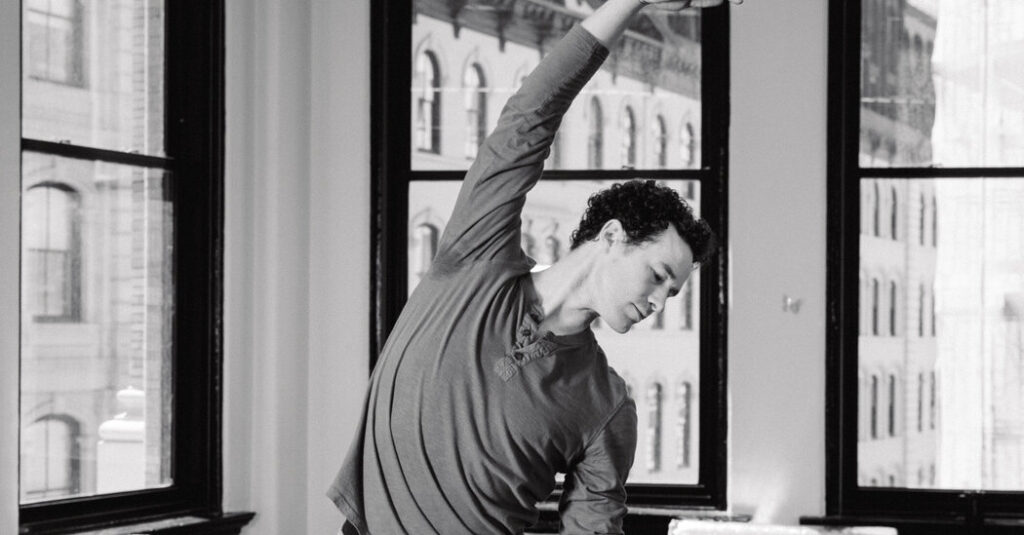
Cory Stearns, the longtime American Ballet Theater star, had planned to dance his final performance with the company on June 27.
“It wouldn’t have been my first choice,” Stearns, 40, said in an interview. “It would have been nice to dance a few more years.”
His farewell was supposed to be in the title role of “Onegin,” which he has performed 10 times, by his count, since he joined the company 21 years ago. “It was always a dream of mine to retire with ‘Manon,’” he said. “That would have been ideal, but it didn’t work out that way.”
But even the “Onegin” plan was not meant to be. Stearns had surgery — arthroscopic partial meniscectomy — on his right knee on April 20. On Tuesday, he said he would not be ready to return to the stage by the time of his last scheduled dance.
“My knee is not ready,” Stearns said. “It was probably a foolish pipe dream, but I needed to try, and my surgeon’s optimism allowed me hope, at least. Unfortunately I haven’t been able to rehearse properly for 10 days, after a promising initial period of progress.”
It was a dispiriting end to what had begun as a dispiriting final season. Stearns learned in November that his career with the company was ending. He went to see Susan Jaffe, Ballet Theater’s artistic director since 2022, to talk about future seasons, and she told him that his time had come and there were younger dancers eager to fill his spot.
It was not, Jaffe said, an easy conversation.
“Some dancers make the call to retire themselves,” she said in an interview. “Some dancers need to be guided toward that decision,” adding that this was her least favorite part of her job.
“This is not only Cory,” she said. “This is natural for all older dancers.”
Even before the latest knee surgery, Stearns was getting injured a lot, Jaffe said: “And as you are older, you are not jumping like you used to and you are not doing a lot of things you used to be able to do. It’s a really hard life.”
Stearns has danced nearly 1,000 performances since he joined the company in 2005. Over the decades he has won praise for his grace, his skill as a partner — deferential and supportive to ballerinas — and for his physical presence onstage. “Mr. Stearns is a dreamboat — the Prince requires no less — chivalrous, handsome and calmly glowing amid virtuosity,” the critic Alastair Macaulay wrote in The Times, in a 2015 review of “Cinderella.”
Stearns, born on Long Island, began training to be a dancer at 5. After attending the Royal Ballet School in London with a full scholarship, he joined the American Ballet Theater Studio Company in 2004. He became an apprentice with American Ballet Theater in 2005; in 2011 he became a principal dancer, a position he will hold for two more weeks.
“He is a top-of-the-line A.B.T. dancer,” said Kevin McKenzie, the former artistic director of the company. “He has had a great career.”
McKenzie, whom Stearns describes as a mentor and major force in his career, said that if Stearns had not stepped down this year, he would almost surely have had to retire by the end of next season.
“It’s not a scandal,” McKenzie said. “It’s not a trauma. It’s just that bittersweet moment that happens to every dancer in their lives.”
In a recent conversation, when Stearns was still planning to dance a final “Onegin,” he talked about being pushed to leave, getting older and the strains of lifting ballerinas. These are edited excerpts from the interview.
It’s been six months since you learned you had to retire. Was this a difficult period?
When you go through a situation that is challenging emotionally, the initial reaction is bitterness, resentment. I went through that and I was bitter.
And then later on, when you’ve kind of come out of that hole, you look back and, and you start to feel more gratitude for what you have. And I have to say I love “Onegin.” And so for me to sit here and say, to express any bitterness at all that I didn’t get what I wanted, it sounds extremely entitled. It didn’t feel that way back in November, but now, I think that I’m very grateful to be doing “Onegin.”
How did the conversation with Susan Jaffe happen?
I was curious about what she was thinking about my future, if there was a date she had in mind for me to retire. She kind of surprised me by saying, “I think you should retire this May.”
Was there discussion about your health or your performance?
Just that I’m getting older, and I’m not jumping as high as I used to. When I pressed her, she said she just needed the room. And that’s where it rested.
How does it feel to move on from dancing?
I’ve been with A.B.T. my entire life, and I feel very grateful that I was able to do that. And the idea of just continuing to dance for the sake of dancing, that’s not what I am desiring right now. I feel like I’ve danced everything I wanted to do. I think what I am really feeling is a pull toward passing on information: teaching, coaching, directing.
Do you think you’d be able to coach or teach at A.B.T.?
If I could eventually be with A.B.T., that is a dream. I love the organization. But right now, it’s not a great time.
As you have gotten older, what has become more difficult? Has anything become easier?
I am not as buoyant as I used to be. I don’t have the same response of muscle fiber. At the same time, I feel like when I am onstage, I’m much more present minded. My composure is much better than it used to be. My understanding of human emotion and how to convey those emotions is much better than it used to be.
As you get older, and things become much harder in terms of bravura dancing, jumping, you end up being forced to figure out how to dance more efficiently. I feel like I am dancing more efficiently now than I ever have in my career. And so although I may not be as athletically impressive as I was when I was younger, I think there’s a connectedness to my dancing, a cohesiveness, that makes up for it. I’m a different dancer now.
This happens to dancers as they get older: You get more confident, self-assured, poised, but the body is not what it was when you were, say, 20?
Absolutely, your body rebels. Like in rehearsals, you have to be careful. You have to strategize how you prepare for the performance. I would say compensation is actually what really will define a dancer. Their strengths are what they’re known for, but a lot of the time they develop their strengths because of other weaknesses.
You are known as an exceptional partner. Has that added to your physical strain as you have gotten older?
The more you partner, the tighter your back gets, especially if you’re a taller guy and you’re with taller women. And you absolutely have to be very careful the older you get because if you’re younger and you’re lifting incorrectly, there’s a high chance that you might have disc issues as you grow older.
How did Kevin McKenzie influence you as a dancer and how you think about ballet?
Kevin was a master partner. And when he danced, there was a flow to his movement. His focus was on the way you hold yourself as a dancer — noble, conveying the correct character, whatever role you were embodying, whether it was Solor who’s a warrior in “La Bayadère,” or Siegfried, a prince in “Swan Lake.” Even the way you stand: how you hold your head and your chest, how that speaks to the character, the personality.
Basically, he strongly believed that ballet as an art is a form of communication. Our duty is not just to impress athletically. The whole thing is that we are trying to resonate emotionally with our audiences. And so with our movement, it’s not just about the jumps and the turns — it’s about every action conveying what we’re saying. What are we saying about this character or about ourselves?
Have you thought about what you might want to do next?
I don’t have any plans yet. I’ve had some offers, but I have not committed to anything.
What has this year been like at A.B.T., knowing your career was coming to an end?
It was recognizing that it’s pointless to expect that I can control what happens in my life. It’s been like a battle, from when I got the news to now, of letting go. Like, ‘This is what I have had, it’s been so amazing.’” I still have a lot to look forward to but I don’t know what it’s going to be.
And I know that the tools that I have learned from going through this process, they’ve really helped me be able to not only understand others who have been through this, which is many other people, but I think it’s going to help with the uncertainty of starting over, this renewal. It’s been a good lesson for me.
The post Cory Stearns on the Bittersweet Moment of Leaving Dance appeared first on New York Times.