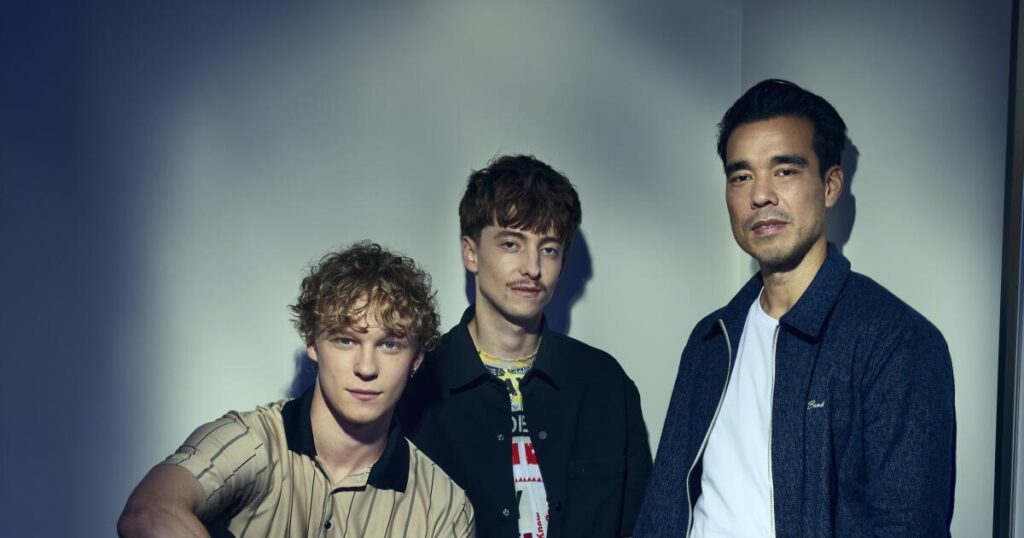
In writer-director Adrian Chiarella’s “Leviticus,” gay teens in small-town Australia are stalked by a shape-shifting monster that takes the form of whomever they most desire. For cautious newcomer Naim (Joe Bird), that’s Ryan (Stacy Clausen), the classmate he’s been stealing kisses with in an abandoned mill, making it dangerous not only for the boys to be alone together but to act on their budding feelings.
“I wanted to make a film that embraced the fear and anxiety of being a young queer person with the fear and anxiety that’s inherent in every horror movie,” says Chiarella, whose striking debut feature uses genre to reflect traumas experienced by LGBTQ people around the world.
Built around Bird and Clausen’s impressive performances and produced by Causeway Films (“The Babadook,” “Talk to Me,” “Bring Her Back”), the film’s tense blend of chilling metaphor, coming-of-age drama and tender romance made it an instant breakout at the Sundance Film Festival, where it earned the buzzy if not entirely accurate moniker of “Heated Rivalry” meets “It Follows.” (Chiarella, who’s written and directed for Australian television and calls those comparisons “encouraging,” had seen the hockey romance while he was in postproduction: “Who hadn’t?” he says with a grin.)
Neon acquired the film out of Sundance and opens the film Friday, adding another must-see debut to a banner year for new voices in horror following Curry Barker’s “Obsession” and Kane Parsons’ “Backrooms.” The socially pointed “Leviticus” also arrives with added gravity in a moment when support for LGBTQ rights has seen a marked backslide in the U.S.
Bird stars as 17-year-old Naim, who’s just moved to a dreary conservative community with his religious mother Arlene (Mia Wasikowska, giving a chilling portrayal of parental complicity after a three-year absence from the screen), a recent widow who has found solace in a local church. When some same-sex dalliances among the congregation’s teens are exposed — including Ryan’s involvement with the pastor’s son — a “deliverance healer” (cult actor Nicholas Hope) is hired to perform a ritual to rid the town’s youths of their sins. Only instead of exorcising demons, the rite curses the boys with a vicious entity that mimics the person they want to be with and exacts a bone-crushing punishment if they succumb to temptation.
Melbourne-based Chiarella, 45, fell in love with movies growing up in Sydney with an Italian father and a Chinese mother who exposed him to Asian cinema greats such as Wong Kar-wai alongside horror classics like John Carpenter’s “The Thing,” the “Nightmare on Elm Street” movies and Kiyoshi Kurosawa’s “Cure.” All of them would later influence “Leviticus”’ visceral atmosphere of romance, paranoia and dread. First working as a film editor with artists like Baz Luhrmann, Chiarella dreamed of directing and started making short films, but never fully made the leap.
Then in 2016, his father died. Chiarella questioned what he wanted to do with his life. “I thought: What are the stories that I want to tell? And I started writing them,” he says over video chat, back in Sydney for the Australian premiere before embarking on a U.S. press tour.
Chiarella had learned of modern day “exorcisms” performed on queer youth across the globe and, also drawing on his own experiences, decided to tell a story that examined homophobia as its central fear. At first he considered a queer spin on “The Exorcist,” but found that his attempts were reinforcing the same toxic views he was trying to subvert — “which is that there’s this gay demon inside you,” he says.
So he began workshopping a twist, landing on a monster that is used by an oppressive community as a tool of coercion. In “Leviticus,” the evil isn’t queerness itself but a supernatural force conjured to scare LGBTQ youth straight and internalize their fear and shame. It can be read as a direct allegory for conversion therapy and for other ways that homophobia can alter behavior and cause lasting psychological and emotional damage. Give in to your feelings and risk your safety; repress your true self and you might survive. But at what cost?
Chiarella proudly places “Leviticus” within a tradition of queer art that has always existed within horror, from Mary Shelley to F. W. Murnau and beyond. “A lot of them were exploring otherness and self-discovery through the archetypes of the genre because it was a way to express it at a time when those ideas were taboo,” he says. “With this project we wanted to reclaim a part of that genre back.”
Raised in Adelaide, Bird was no stranger to horror, having made a scene-stealing turn in the Philippou brothers’ teen possession hit “Talk to Me” when he was 15. Receiving Chiarella’s “Leviticus” script while in Sydney on a bus to Bondi Beach, he became so engrossed in reading it he promptly missed his stop.
“It was one of the most authentic, raw and honest scripts I’ve read,” Bird, 19, says over video chat from Los Angeles. “Every actor has that gut feeling when they read something and think: This is special and I need to be a part of it. These characters were so multifaceted and complex — they just felt human. And that’s important because when they feel real, you care about the characters and what the story’s trying to say.”
Bird’s audition, exposing Naim’s guarded vulnerability with a believable naturalism, immediately caught Chiarella’s eye. “It was apparent that he had this authenticity and felt like a real teenager, which is something that is very difficult to find,” says Chiarella. “Joe was able to be himself and let go and give all of himself to this character, and I could see that in this first tape.”
In Clausen, 21, he and casting director Nikki Barrett found an actor with range who could pull off the challenge of a highly interior and extremely physical dual role as Ryan and his supernatural double. During casting workshops, he and Bird naturally gravitated toward each other. “As soon as Joe and Stacy were together in scenes it was clear that they had an undeniable chemistry that could form the heart of this film,” says Chiarella.
The actors spent time forging the kind of intimate charge that could be felt in wordless glances between their closeted characters. “We knew that the love story was the heart of the film and if the love story works, the horror will work,” says Bird. Roadtripping across regional Victoria with Chiarella, they bought each other $10 gifts in character and did escape rooms together, practicing hiding Naim and Ryan’s connection from everyone around them.
And an uncomfortable moment in a mall also lent insight into how the outside world might treat the pair.
“We were in this shopping center as Ryan and Naim and there were these boys looking out of the corner of their eye,” recalls Clausen, sliding into a quiet nook at Mirate in Los Feliz after reuniting with Chiarella and Bird in L.A. to introduce a special screening. “And I could literally see someone side-eyeing me and judging me. Letting that land and feeling that was so helpful when it came to translating that on camera.”
Named after the book of the Bible that contains a passage often interpreted as demonizing homosexuality, “Leviticus” uses motifs of nature clashing with man-made industrial ruin to invite the audience to question where repressive societal notions about homosexuality come from. Cinematographer Tyson Perkins gorgeously captures the harsh landscape of Naim’s world in rural vistas marred by human-made power lines and blazing oil refineries, shooting on widescreen anamorphic lenses that swallow Naim and Ryan up in their hostile surroundings.
Chiarella also pays homage to queer history onscreen. One scene has Naim and Ryan separated by a screen door, an intentional nod to Jean Genet’s erotic 1950 masterpiece “Un Chant d’Amour,” in which two prisoners express their yearning for each other through a shared wall. Another wrenching sequence, in which Ryan is brutally attacked by an invisible force, is staged inside a photo booth, “inspired by the fact that photo booths used to be the only safe space for men to come together and to explore their intimacy with each other,” Chiarella says.
At the film’s aching core is the romantic tether between the boys that refuses to die even in the face of gory attacks, painful betrayals and even uncertainty among the two of them. “This film at its heart was an exploration of queer trauma,” says Chiarella. “There had to be a sense that sometimes when you experience homophobia it can bury deep inside and become something you carry with you for a long time.”
Arguably the most romantic line of the year comes when one boy tells the other that if he’s going to be haunted, “I want it to look like you.” Chiarella had heard a similar sentiment in his personal life. “Sometimes when I’m hanging out, particularly with gay men, this conversation comes up, almost like a dinner party game,” he says. “If they had a pill that could make you straight, would you take it? And someone gave the most romantic answer, which was, ‘I wouldn’t, because then I wouldn’t be with my partner.’”
So it was important that some solace counter the horrors that Naim and Ryan experience. “I hope that what people can take from the film is that they’re choosing to live in hope and not fear,” says Bird. A track he listened to on repeat during filming, Frank Ocean’s “Self Control,” found its way into the movie itself after Chiarella wrote a heartfelt letter to the singer, its inclusion adding a bittersweet grace note to the uncertainty that remains.
In recent weeks, the filmmakers and Neon have embraced an online fandom that’s already made viral TikTok edits and fan art of the characters’ romance even before the film is released. Chiarella, Bird and Clausen also cherish the emotional reactions they’ve heard from early audiences.
“It’s heartwarming to have people come up and say, ‘I wish I had this film when I was younger,’” says Clausen. “To have gay couples come up crying, saying thank you is incredible and it’s what you do it for. The best feeling in the world is to know that we’ve comforted someone.”
The post Making the queer horror romance ‘Leviticus’ was an exploration — and a reclamation appeared first on Los Angeles Times.