In ancient Siberian graves, scientists have discovered the oldest traces of one of humanity’s greatest enemies. Examining skeletons of hunter-gatherers who lived 5,500 years ago, the researchers have isolated DNA from the bacteria that cause the plague.
The findings suggest that the plague, which would later devastate Europe in the “Black Death,” was already a lethal threat early in human history. That would be a big change from the earlier view of scientists: that these bacteria were originally relatively mild, and only later produced deadly outbreaks.
“It doesn’t fit the model,” said Eske Willerslev, a geneticist at the University of Copenhagen and an author of the study published on Wednesday. “But we have to accept the data.”
The bacteria that cause the plague, called Yersinia pestis, mostly live today in rodents. Fleas take up the bacteria in their bites and pass them along to other animals. If those fleas happen to bite people, the victims develop swellings in their lymph nodes, called buboes, and risk about a 50 percent chance of death in a matter of days.
Across the world today, a few hundred people contract the plague each year. But historians have chronicled enormous epidemics from the Roman Empire onward. The disease seemed to be intimately tied to the rise of farming and cities.
Rats were drawn to stores of grain and other foods, bringing them into close contact with people. Fleas jumping from the rats could pass the bacteria to people. And then fleas on people could spread the disease further, starting an epidemic.
About 30 years ago, geneticists began adding fresh evidence to this history. As it turned out, when people die of plague, their bodies may contain so much bacteria that some travel into teeth and bone.
There, the DNA can survive for thousands of years. In 2015, Dr. Willerslev and his colleagues set a new record for ancient Yersinia DNA, finding it in 5,000-year-old teeth. It was a surprising discovery in many ways.
For starters, the people who had this early form of the plague were not city dwellers or even farmers. They were nomadic pastoralists who herded cattle and sheep on horseback across the steppes in what is now Russia and Ukraine.
Moreover, these early Yersinia lacked crucial genetic adaptations found in more recent strains, mutations that account for the bacteria’s deadliness today. Stranger yet, they did not carry a gene that today’s Yersinia need to survive in fleas.
Dr. Willerslev and his colleagues came up with new hypotheses to explain what they had found: Maybe plague first spilled over to humans not on farms or in cities, but in the grasslands of Central Asia, as herders and livestock came into contact with wild infected rodents.
But if that were true, humans at the time could not have been infected by fleas. And it appeared that this early form of Yersinia was mild. The evidence suggested that over 1,000 years passed before the bacteria evolved into an epidemic-causing, flea-driven threat.
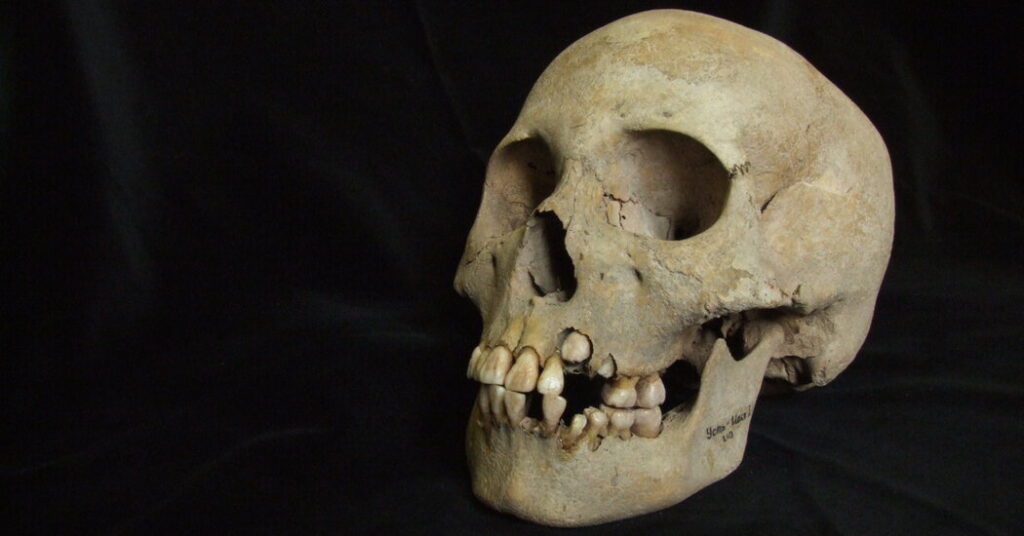
More recently, Dr. Willerslev and his colleagues examined the bones of hunter-gatherers interred in cemeteries near Lake Baikal. The researchers obtained DNA from the teeth of 46 skeletons at three sites, discovering Yersinia DNA in 18 individuals. The oldest dated back 5,500 years, a new record.
But the great age of these bacteria was just one remarkable finding. The victims here were not herders or farmers, but nomads who moved in small groups across the Siberian landscape, catching fish, hunting game and collecting plants for food.
The deadliness of the bacteria was unexpected. The researchers found plague DNA in 39 percent of the hunter-gatherers they studied, which is about the same detection rate in studies of the remains of people who died in the Black Death.
The results hint at a devastating die-off among ancient Siberians.
“To the best of my knowledge, it’s the first evidence that these early strains of plague were in fact deadly,” Dr. Willerslev said. “This actually was a dangerous thing.”
He and his colleague also found some telling clues about the plague’s victims. A striking number were children. Many of the dead belonged to the same families or were close relatives.
Comparing the ages of the cemeteries, Dr. Willerslev and his colleagues concluded that plague hit the region, disappeared and returned in another outbreak a few centuries later.
But that’s not to say the plague was limited to that region. The DNA of the Lake Baikal Yersinia is most similar to that in a sample isolated in 2021 about 3,000 miles to the west, from the teeth of a 5,000-year-old hunter-gatherer in what’s now Latvia.
“Higher population density and animal domestication were not an essential condition for severe outbreaks,” said Alexander Herbig, a computational biologist at the Max Planck Institute for Evolutionary Anthropology in Leipzig, Germany, who was not involved in the study.
Dr. Willerslev said that he and his colleagues did not have any obvious explanations for how a lethal plague could have struck hunter-gatherers who were spread over thousands of miles for centuries — without the help of fleas.
They suggested that rodents across Asia and Europe had harbored the bacteria, which somehow jumped directly to people.
Other experts disagreed. “That’s a big leap with no evidence,” said David Wagner, a microbial geneticist at Northern Arizona University who was not involved in the study.
Not only does Yersinia today need fleas to cross from rodents to people, he observed, but the pathogen also depends on them to jump from one rodent to another.
Dr. Wagner favors another possibility: The plague originally spread directly between people. It’s a form of transmission that happens today from time to time, known as pneumonic plague.
People dying of the plague build up so much bacteria that it gets into their lungs, and they cough the germs into the air. Bystanders may inhale the Yersinia-laced respiratory droplets and become infected.
“If you don’t get treated, it’s a death sentence,” Dr. Wagner said.
The post A Deadly Outbreak of Plague, Nearly 5,000 Years Before the Black Death appeared first on New York Times.