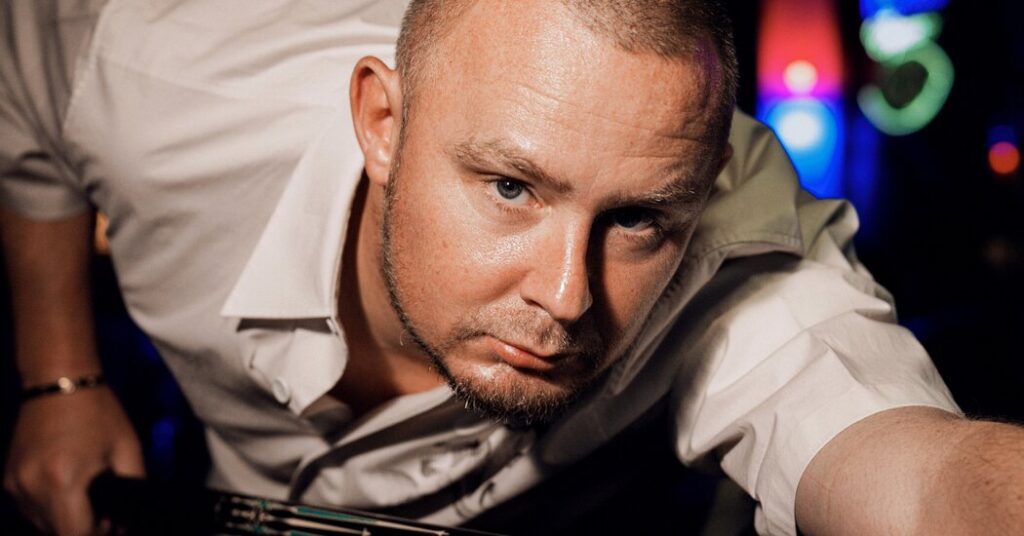
Shane Hennen is among his people. Hundreds have packed into Buffalo’s, a pool hall outside New Orleans, to compete in and wager on one of the largest billiards tournaments in America. Some are professional players; others are washed up; most everyone, he says fondly, is a degenerate gambler. “Everybody’s in here for one thing,” Mr. Hennen says with a rasp, sipping from a bottle of grape soda. “And that’s to make money.”
Mr. Hennen, a professional gambler who promotes his picks to 70,000 followers on social media, is 41 and stocky, with a short chinstrap beard that helps define his jawline a bit. He usually favors turtlenecks, but on this late night in May, he’s in an oversize white AllSaints T-shirt and gym shorts. He moves around Buffalo’s easily, dapping up friends, former adversaries and associates from the betting world, all of whom greet him like family. There’s no sign that he’s been indicted in three federal gambling cases and is facing decades in prison.
Prosecutors in the Eastern District of New York have accused Mr. Hennen of helping the Mafia rig high-stakes poker matches, and of placing bets using inside information about the National Basketball Association. Prosecutors in the Eastern District of Pennsylvania say he did the same for bets involving men’s basketball games in the N.C.A.A. and China. The basketball indictments center on insiders who are accused of leaking to sports bettors that players and teams would underperform, either intentionally or because of injury, enabling the gamblers to wager that the teams would lose games or score fewer points.
Two N.B.A. players, Terry Rozier and Jontay Porter, have been charged with participating in the schemes. Mr. Rozier has maintained he is innocent; his lawyer, Jim Trusty, said in a statement that he “never conspired with anyone.” Mr. Porter has pleaded guilty and says he has a gambling addiction; he is awaiting sentencing and has been banned by the N.B.A. for life. The cases have profoundly embarrassed the leagues and called into question the integrity of their games — the exact result the N.B.A. said it had hoped to avoid when it led the push to bring sports gambling into the mainstream.
Altogether, 58 defendants are cited in the indictments. Mr. Hennen is the only person charged in all three. Sugar Shane, as he’s widely known, has pleaded not guilty and intends to go to trial.
Mr. Hennen doesn’t deny placing the bets. (With Mr. Rozier, “I bet the points, assists and rebounds. I lost on the rebounds,” he said recently.) Nor does he deny playing in the rigged poker games.
But when discussing the cases, he tends to shift the conversation from illegality to the more benign idea of chasing an inside edge. In his view, the best gamblers must use any information they can to win a game that’s been stacked against them by the house. “That’s all sports gambling is,” he says, in one of many interviews with The New York Times this year. “It’s trying to smarten yourself up and give you as much information to help you beat the sportsbook.” A spokesman for the U.S. attorney’s office in Brooklyn declined to comment, as did a spokeswoman for the U.S. attorney’s office in Philadelphia.
Mr. Hennen has spent his life in gambling circles, from his teenage days learning to hustle in the pool halls of Pennsylvania to the moment in 2023 when he texted a fellow defendant, “Nothing guaranteed in this world but death, taxes and Chinese basketball.” The arc he has seen, in which sports gambling left the underworld and went mainstream, has brought him both opportunity and peril. More bettors have meant more money as well as an explosion of obscure bets, like on the performance of individual athletes, that can be exploited. But the increasingly public nature of the industry has also meant more scrutiny from the government, which could put him behind bars.
At Buffalo’s, Mr. Hennen makes his way to the back of the hall and sits in an office, chewing on a piece of floss. He sees his prosecution as cosmically unfair, given how widespread various kinds of insider trading are. “There ain’t one stockbroker who became rich just by guessing right all the time,” he says. “This is what the United States of America has revolved around, for hundreds of years.”
The owner of Buffalo’s, Jim Leone, who goes by Buff, listens to Mr. Hennen sympathetically. He’s in his 70s and lives in the pool hall, sleeping in a bed tucked into a loft. “Nobody here is feeling sorry for the casino,” he says. Tony Chohan, a professional pool player whose face is on a mural outside the office, is also here. “They’re mad because they see someone who’s successful,” he says.
It’s true that the sportsbooks restrict bettors who win too much — their business depends on gamblers who lose. But Mr. Hennen isn’t accused of winning too much. He’s accused of cheating. Occasionally, he has claimed to have a proprietary formula for beating the odds, but he won’t describe it.
“I really can’t give you the recipe to the chicken noodle,” he says at one point, laughing. “The recipe to the Coca-Cola classic.” Another time, he says it includes “advanced stuff that A.I. does.” There’s a simpler, well-documented alternative, one that the government intends to present at trial: that he was involved with bribes that delivered guaranteed outcomes.
Mr. Hennen says he is at peace with the possibility of going to prison. It wouldn’t be his first time. “It doesn’t matter what I do in this world,” he says. “I have skills they can never take away from me.”
In the beginning, rigged games were a way out. Mr. Hennen grew up in a modest, two-story house in Washington, Pa., a blue-collar suburb of Pittsburgh. Both of his parents struggled with drug addictions. When Mr. Hennen was 11, his father died, and his grandfather took the lead in raising him. The boy was a gifted athlete, and his grandfather began taking him to a pool hall in Pittsburgh to learn the game: how to hold the cue, how to make a bridge with the hands, how to strike with a precise level of force.
Mr. Hennen was a prodigy. After school and on the weekends, his grandfather drove him all over Appalachia for tournaments. In 2001, at age 16, he was the runner-up at the top junior tournament in America, held at Magoo’s Sports Bar and Billiards in Tulsa, Okla.; the next year, he went to Taiwan and took second place at the junior world championship. Mr. Hennen recalls the contrast: Unlike the grimy pool halls he’d known, the event in Taiwan was posh and serious, with everyone wearing tuxedos.
Even as talented as he was, a career in professional pool would not have been very lucrative. Some of the best players in the world make less than $50,000 in prize money per year. Pool culture is inextricably linked to gambling, and as Mr. Hennen spent more time in America’s pool halls, older players taught him how a person with his skill could make real money. Playing against strangers in different states, he might throw a game for a few thousand dollars, missing pockets intentionally, only to come back a few days later and easily defeat the same opponent when the stakes were higher. Mr. Hennen could engineer games so that he was barely winning, making gullible opponents think they had a shot if they kept playing. Scott Frost, a top-rated player who met Mr. Hennen around this time, says: “I don’t know that he’s done everything right. But he’s probably the sharpest person, when it comes to winning, that I’ve ever been around.”
Mr. Hennen realized he could earn even better payouts in the card games — poker, blackjack, gin — that were ubiquitous at the pool halls he visited. He studied deception and strategy. He traveled to North Carolina, Louisiana, Nevada and other states, and with each game he won, his reputation grew as someone willing to gamble a lot of money. The games, Mr. Hennen says, were typically scheduled in advance. He assumed any match played on someone else’s turf was not completely fair. Maybe the other players were conspiring against you; maybe the deck was stacked. “It’s the norm,” he says. But he usually found ways, licit and not, to gain an edge on the other players at the table.
Mr. Hennen says he has beaten bank robbers, drug dealers and stockbrokers. He was acquaintances with bookmakers who worked with Pittsburgh’s organized crime scene. But he says he played by a code: If you were a janitor, he wouldn’t take your money. “I try to use my best judgment,” he says. “Is it going to really hurt this guy if he goes broke? Like, does he have a family? Does he have kids? Because people being degenerate gamblers is a real thing.”
According to Mr. Hennen, he might pocket hundreds of thousands of dollars in a single game. When he was younger, he says, he usually gambled away his earnings as soon as he won.
In 2006, when Mr. Hennen was 21, he pleaded guilty to possessing an illegal gambling device — he had a contraption used to cheat at dice — and was sentenced to probation. Three years later, in June 2009, Mr. Hennen was charged with attempted murder after stabbing a college basketball player over a card game in a Pittsburgh bar. The athlete accused Mr. Hennen of cheating him; Mr. Hennen said he’d sliced him with a box cutter in self defense. He pleaded guilty to assault with a deadly weapon.
A detective on the case, Steve Hitchings, said of Mr. Hennen: “He seemed like an educated kid who was just caught up trying to hustle the system.” Later that year, Mr. Hennen was also charged in federal court with possessing and intending to distribute cocaine. To earn a lighter sentence, he testified against a man he sold drugs with, a local dealer with ties to organized crime. During cross-examination at trial in 2011, the man’s defense lawyer grilled Mr. Hennen over his billiards play.
“You make a living out of cheating people out of things,” the lawyer, Lee Rothman, said. Mr. Hennen agreed that he did, and pleaded guilty to two counts.
He served two years in a low-security prison in Lisbon, Ohio, and got out in 2013. An enormous opportunity lay ahead. The next year, Adam Silver, the new commissioner of the National Basketball Association, wrote an influential opinion piece for The Times calling for the legalization of sports gambling. Experts predicted that the league stood to gain hundreds of millions a year from fees, sponsorships, ads and increased fan engagement — a bonanza. “Any new approach must ensure the integrity of the game,” Mr. Silver wrote, before concluding, “But I believe that sports betting should be brought out of the underground and into the sunlight.”
After he left prison, Mr. Hennen lived for a time in Pensacola, Fla., where he cared for his aging grandfather and worked as a seafood wholesaler. Mr. Hennen violated the terms of his release by gambling and was sent back to prison for a month. By 2016, he was allowed to wager again. He moved to Philadelphia and got an apartment near Rivers Casino, where he became one of its biggest clients.
In 2018, the Supreme Court opened the door to legalized sports gambling, and Pennsylvania quickly got in on the action. In Mr. Hennen’s telling, other bettors noticed him booking winning tickets on sports bets at Rivers and started haranguing him for tips. “They would go: ‘Shane, Shane, who do you like today? Who you like?’” he recalls. (A spokesman for Rivers Casino declined to comment.)
Mr. Hennen decided to go into business as a tout, selling his picks to customers for hundreds of dollars each across college basketball, the N.B.A., the National Football League and even the Chinese Basketball Association. On social media, he styled himself as Sugar Shane and flaunted the image of a lavish lifestyle: stacks of cash, trips to the Middle East. “You either sit on the sideline and watch or ask how to get in the game!!” he once wrote on Instagram, showing what appeared to be winnings of $50,000 from betting on a college football game.
Starting in 2022, Mr. Hennen hatched a plot to defraud gambling companies, according to the government. The indictments, which do not name the companies, say Mr. Hennen helped orchestrate a gambling ring that recruited and bribed certain athletes in the N.B.A., N.C.A.A. and C.B.A. to intentionally underperform in games, allowing him and others to bet against those players’ statistics (for example, their rebounds or minutes) and the outcome. Prosecutors say Mr. Hennen and another man bribed Antonio Blakeney, a former Chicago Bull who was playing for the C.B.A.’s Jiangsu Dragons, to shave points, and then bet hundreds of thousands of dollars. (An article in Sports Illustrated that came out before the indictments cast Mr. Hennen as a central figure in the schemes.)
Prosecutors also say that before a March 2023 game, Mr. Rozier, then a guard for the Charlotte Hornets, told a childhood friend that he would be exiting early with an injury, meaning that gamblers who bet on him to play poorly would win. The friend directed Mr. Hennen to place money on Mr. Rozier’s underperformance, prosecutors say. The government also says that on Jan. 26, 2024, a co-conspirator texted Mr. Hennen with a similar tip about Mr. Porter, then a forward for the Toronto Raptors, who had signaled he would take himself off the court that night with a nonexistent eye injury. Mr. Hennen then directed a network of bettors to wager hundreds of thousands of dollars against Mr. Porter’s performance, according to prosecutors.
By the spring of 2024, the scheme began to unravel. The suspicious gambling activity was flagged by the sportsbooks and independent monitors that work with the N.B.A. Mr. Porter was barred from the league that April. The next month, federal agents brandishing a search warrant seized Mr. Hennen’s phone. They didn’t charge him then, but he was arrested the next January and released on bond. The first two indictments against him came down in October 2025 and January 2026. The third came last month.
Mr. Hennen seems relatively unfazed by the possibility that he could be going back to prison. While awaiting trial, he has traveled to golf courses, backgammon events and pool tournaments, all documented on Instagram, where his handle is @bestthatevadidit. In one recent post, he sits on the patio of a members-only club in Las Vegas, smoking a cigar.
This, along with his history of cooperating with the government, has fueled speculation among some of his co-defendants that he has struck a deal with prosecutors for a lighter sentence. Mr. Hennen denies this, along with many of the allegations made against him. “I’ve never bribed anybody to underperform in any basketball game, ever,” he says.
Mr. Hennen acknowledges that the poker games were rigged, like most games he plays. “It’s the wild, wild West.” He says his involvement in them started in 2021, during the Covid-19 pandemic. He started playing poker games in Greenwich Village, in a townhouse on Washington Place once owned by the composer John Philip Sousa.
There would be cocaine on the counters, he says. Men were cheating on their wives with prostitutes. He chuckles at the notion that there were any victims of the scheme, or “choirboys.” Everyone in that room, he said, would do whatever it took to win.
“The victims were trying to cheat the cheaters,” he says.
He claims that he stopped going to the poker games later in 2021 because he felt he was getting bilked, and that he won around $40,000 that was never paid to him. Prosecutors say he helped members of the Bonanno, Gambino and Genovese “crime families” rig those games via hidden technology that reads cards and sends that information to someone off site, who would then alert a player at the table who was in on the scheme.
The N.B.A. and its betting partners, DraftKings and FanDuel, have argued that the cases against Mr. Hennen and the other defendants, while troubling, are evidence of a system that’s working, with bad actors being rooted out and prosecuted. But a growing chorus of public health experts, academics and politicians says the league’s embrace of gambling has created more opportunity for scandal, decreased the public’s trust and brought unseemly elements of the criminal world into the open.
In March, Mr. Hennen attended back-to-back days of hearings in federal court in Brooklyn, first for the sports betting case involving Mr. Rozier and then for the poker case that includes various mob figures and small-time crooks known by the nicknames Black Tony, Albanian Bruce and the Wrestler. As the defendants mingled outside the courtroom, Mr. Hennen and his lawyer sat at the far end of the hallway. After the proceedings, he slipped away quickly.
Two months later, Mr. Hennen can be found at Buffalo’s, the billiards club outside New Orleans, where he hangs out all week for the tournament. Most days, he leaves the pool hall after sunrise. By Wednesday, he looks worse for wear — eyes bleary, reddish skin peeling. He blames it on playing golf with his buddies in the Louisiana sun, costing him $7,000 in lost bets. That nearly wipes out the $8,000 he wins one night, past 4 a.m., playing against someone from Ohio.
It’s June, and Mr. Hennen is killing time before a court appearance. He’s staying in Newark: The N.B.A. finals have raised prices for hotels in New York to $1,000 a night or more, he says. That’s a luxury he cannot afford right now.
He says he lives on $10,000 to $15,000 per month — far less than he once could spend — earned from pool and golf. And there are more indignities. He sold his Rolls-Royce.
“My living has decreased substantially,” he says, as he sips an iced caramel macchiato with an extra shot of espresso at a coffee shop near the federal courthouse in Brooklyn Heights.
What he seems to take the most offense at is the notion that he was a small-time gambler who suddenly discovered an edge with Mr. Rozier and Mr. Porter.
“It wasn’t like I was betting $10, and Terry Rozier and Jontay Porter came along and I was betting 200 K,” Mr. Hennen says. “But people don’t want to hear that.” After all, he was Sugar Shane, the king of Rivers Casino in Philadelphia.
The post Sugar Shane Links 3 Gambling Scandals. And He’s Ready to Talk. appeared first on New York Times.