President Donald Trump had mixed results with his endorsements for key races Tuesday in Georgia, where he was dealt a rare blow when his preferred candidate did not make it out of the Republican runoff for governor.
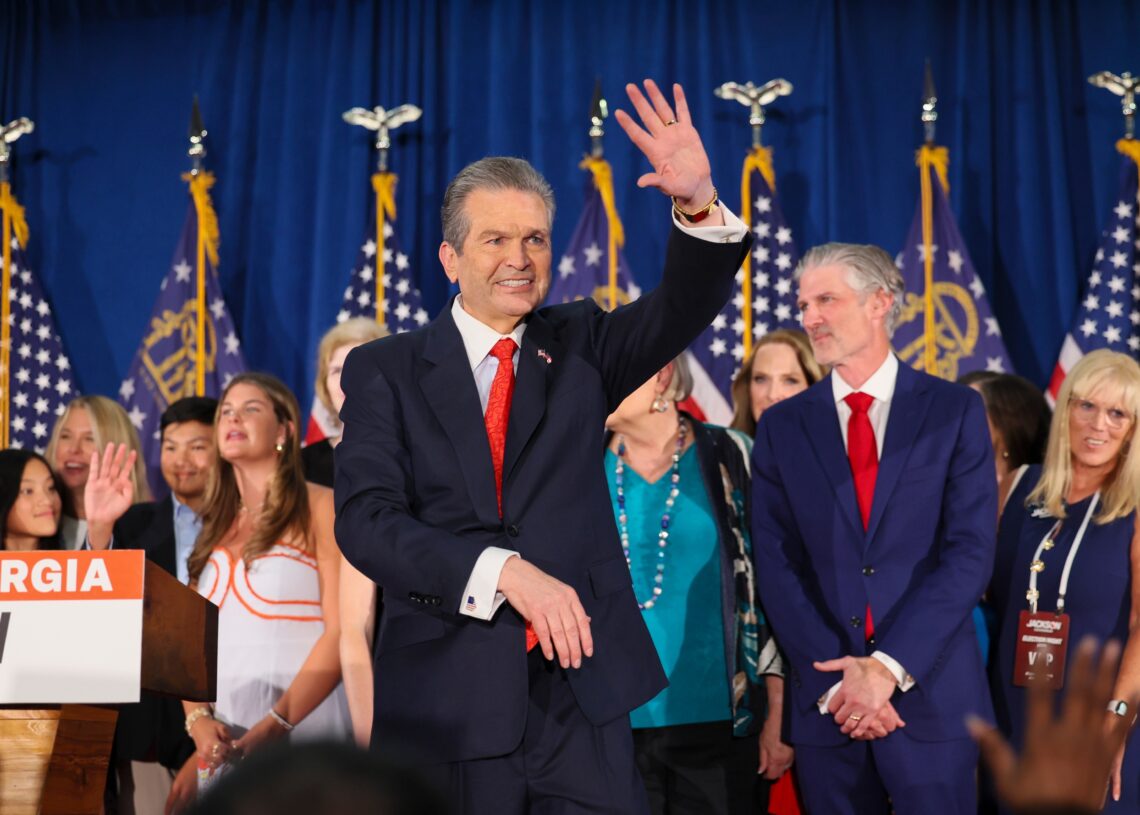
Trump’s gubernatorial pick, Georgia Lt. Gov. Burt Jones, who was also backed by the current governor, Republican Brian Kemp, lost to billionaire health executive Rick Jackson.
But in another marquee race, a last-gasp endorsement from the president helped Rep. Mike Collins secure the Republican nomination for a pivotal Senate seat. In November, Collins will compete with Democratic Sen. Jon Ossoff in a contest that is vital for control of the chamber.
The president’s support has carried immense weight in Republican primaries across the country this year, even as his standing with the broader public declines.
The Georgia governor’s race, however, is the second big primary this month where the president’s candidate suffered a loss. In Iowa, Trump’s pick for governor, Rep. Randy Feenstra, lost to businessman Zach Lahn. On Tuesday, the president’s endorsement in the Oklahoma governor’s race was not enough for his candidate to avoid a runoff.
A streak of Trump losses could undercut his strong grip on the GOP that has defined the last decade of Republican politics. But he remains a powerful force, as evidenced by races in Kentucky, Louisiana and Texas, where his preferred candidates ousted incumbents this year, and several races Tuesday where they also won.
Here are top takeaways from the primaries.
Collins advances in critical Senate race
The U.S. congressman defeated Derek Dooley, a former football coach who Kemp recruited to run for Senate.
Trump endorsed Collins on Sunday, casting him as the most loyal and MAGA-aligned candidate. Trump specifically praised Collins for his support of an aggressive immigration crackdown, and he ridiculed Dooley for not amplifying his false claims that he won the 2020 election — a factor on which the president has hung previous endorsements. Collins has boosted GOP election-denial claims and has said that the rioters who stormed the U.S. Capitol on Jan. 6, 2021 — some of whom attacked law enforcement officers and threatened lawmakers — were “peaceful,” calling them “political prisoners.”
Dooley, who publicly admitted that he did not vote in multiple past elections, had hoped portraying himself as a political outsider would sway voters. But that message, which has been successful for other inexperienced candidates, did not work.
By the time Trump endorsed Collins, the congressman was already favored in the race. In Georgia’s May 19 primary, he finished first with 40 percent. Dooley had 30 percent of the vote, and the other top-tier candidate, Rep. Buddy Carter, finished third with 25 percent.
Collins will face off in the race against Ossoff — who has built a large war chest and increased his standing in polls — as a slight underdog. Although Trump won the state in 2024, Collins must overcome the president’s declining popularity.
Billionaire takes gubernatorial runoff over Trump’s preferred candidate
Jackson’s victory Tuesday was a defeat for Trump and Kemp, both of whom endorsed Jones.
The race to succeed Kemp, who is term-limited, elicited a crowded field of candidates, including Georgia’s secretary of state and attorney general. In May, Jones and Jackson finished atop the field with 38 percent and 34 percent of the vote, respectively.
Jones’s pitch to voters built on his time as lieutenant governor, which he said gave him the chops to take the top job and carry on Kemp’s conservative work in the state.
Jackson, by contrast, highlighted his lack of political experience in his largely self-funded campaign, portraying himself as an outsider who is not beholden to politicians or special interests. He poured more than $50 million into his campaign, vastly outspending Jones.
Kemp came in with a last-minute endorsement for Jones on Sunday. His backing of the same candidate as Trump marked a notable agreement between the two men, who have shared a testy relationship.
Trump-endorsed candidate advances in Alabama
Rep. Barry Moore (R), Trump’s pick in a closely watched Alabama Senate race, defeated Jared Hudson, a former Navy SEAL, in the GOP runoff on Tuesday.
Moore will advance to the general election to replace Republican Sen. Tommy Tuberville, who chose not to seek reelection and launched a bid for governor instead.
In May, Moore and Hudson bested a handful of other Republicans vying for the seat, including Alabama Attorney General Steve Marshall, who ended the primary one percentage point behind Hudson. Hudson had branded himself as an antiestablishment candidate, while Moore’s campaign stayed on the traditional conservative course.
Moore is a heavy favorite to win the general election against Everett Wess, an attorney who won the Democratic nomination, in the deep-red state.
Oklahoma Republican gubernatorial primary heads to runoff
State Attorney General Gentner Drummond and Oklahoma state Sen. Mike Mazzei advanced to a runoff to succeed Oklahoma Gov. Kevin Stitt (R). They competed in a nine-candidate field in the Republican primary, which also included the state’s former public safety secretary, Chip Keating, former state senator Jake Merrick, and former Oklahoma House speaker Charles McCall.
Trump endorsed Mazzei in late May. The president called him a “MAGA Warrior” and commended his résumé, which included a stint as Oklahoma’s budget secretary under Stitt. The current governor did not endorse in the race.
The winner of the Republican runoff will face state Rep. Cyndi Munson, who secured the Democratic nomination for governor.
The post Four takeaways from primaries in Georgia, Alabama and Oklahoma appeared first on Washington Post.