This feature is from the spring 2026 issue of VICE magazine, THE NOT THE PHOTO ISSUE. Get four issues each year, sent straight to your door, by subscribing here.
Imagica is an oasis, but it’s also a cemetery.
Gliding over this lush, tropical island, I see ducks down below, wearing clerical dog collars and dancing to Thai rock music around a gallery of grainy photographs. I fly, Matrix-style, towards them. “Dude, half of these pictures say ‘in memory of’ or ‘rest in peace,’” whispers BigCoolTony1991, who is airborne next to me. “This is morbid.”
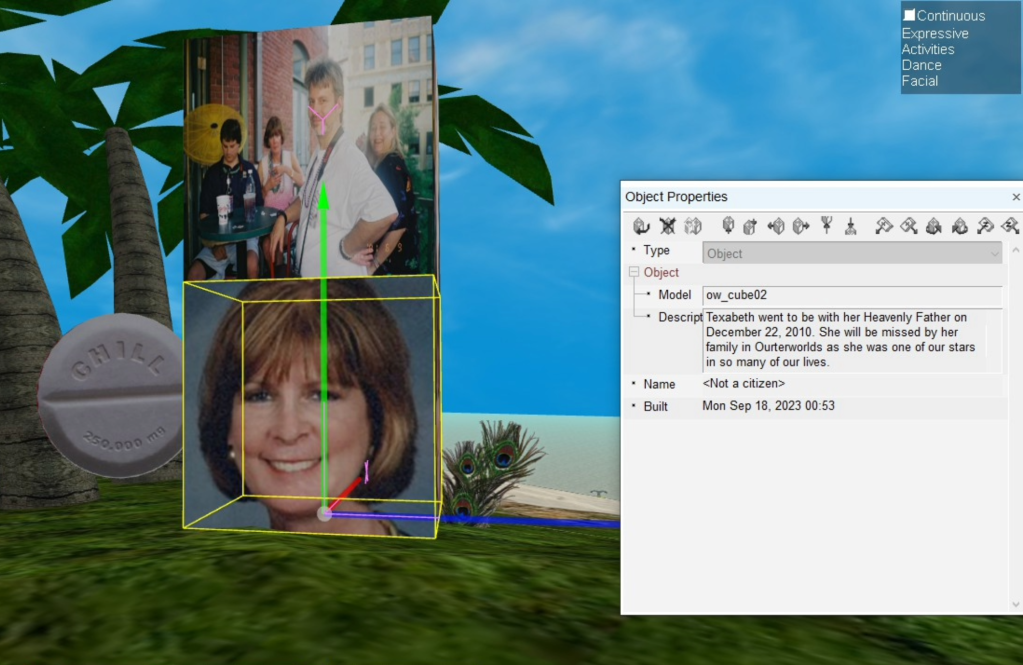
The latest portraits in the memorial gallery were added just a few weeks ago. They are vacation snaps from the kind of Caribbean cruise you once bought from a glossy catalog, shot on a digital camera. I right-click one to read the inscription. “Texabeth went to be with her heavenly Father on December 22, 2010,” it says. “She was a star in so many of our lives.”
Imagica and the archipelago it belongs to are part of Active Worlds: an online virtual world client launched in June 1995. After burning through $15 million in two years, its founding company, Worlds Inc., ran into financial difficulties and sold it off. These days, “Active Worlds” is very much a misnomer. As I wander its ghostly servers1, it’s difficult to find any activity at all. Just six or so players are online and all seem to have left their avatars floating on the spot, like dogs tied-up outside supermarkets forever. Many of the images have become dead links, leaving an epitaph in their place: “To manually place picture, refer to Help files.” I can’t find these Help files.
“‘I like that I can be alone when I want,’ she says, before taking me hoverboarding over a starry desert plain”
There would be no one to show me around this abandoned world were it not for my guide: the aforementioned BigCoolTony1991—or, as the YouTuber is known to his army of fans, Redlyne. He’s built a cult following by exploring what he, and many other denizens of the derelict internet, call “dead games”—decrepit MMOGs (Massively Multiplayer Online Games) like Active Worlds that still house tiny communities of hangers-on. Many are finally succumbing to obsolescence: a consumer movement called Stop Killing Games gained momentum in 2024, taking the fight to publishers that are pulling the plug on servers. For now, some dead games still limp along on their last legs, images erroring, the silence getting louder, waiting for the day that they are no longer there.
While dead games are, by definition, incredibly unpopular, the concept of them is gaining currency. It’s YouTube that’s driving it. Redlyne, who regularly logs upwards of a million views for his videos, recently went viral after he discovered a user called ArcticRose in Sinespace3. A 78-year-old woman who remade herself in cyberspace as a sexy young punk, she was single-handledly keeping alive a server called Club USA, a Sinespace recreation of The White House. Other dead-game explorers have been inspired by Red. One, Rye Games, has earned nearly 400,000 YouTube subscribers through his own exhumations. “I adore dead games. I go to sleep thinking about dead games and then I wake up excited to play one. It’s literally my life,” Rye tells me over Discord.
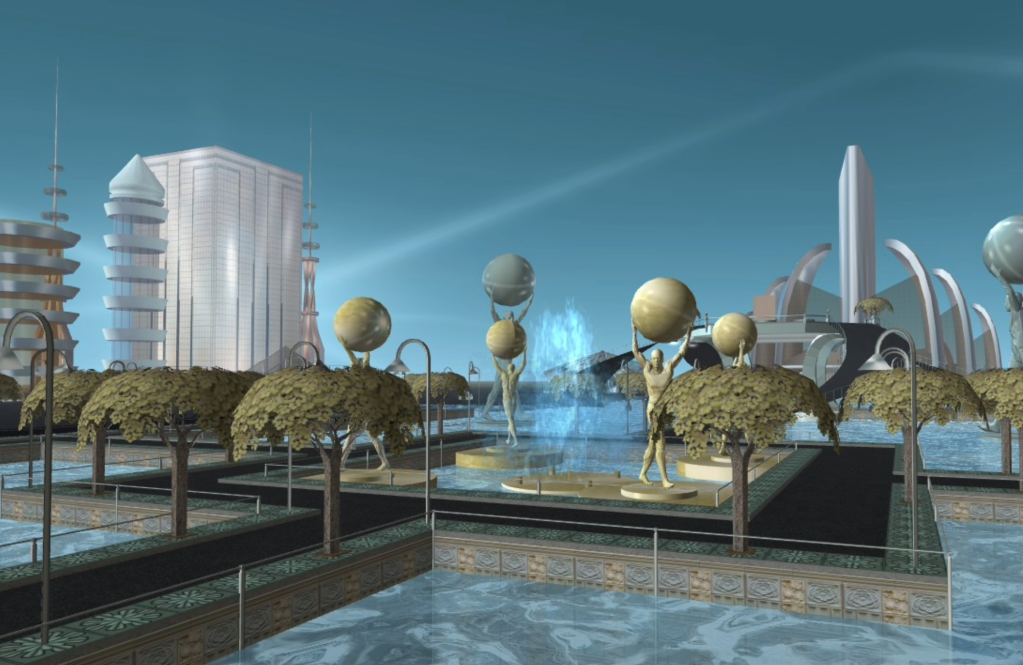
Recently, I’ve found myself watching these videos with a kind of wistful fervor. The dead games the YouTubers explore are varied; they span first-person shooters (like Counter Strike Condition Zero) and creepy chatroom classics (Habbo Hotel). But what I’m personally enticed by are the 3D virtual worlds: vast deserts with fleeting mirages of strange nomads, marooned in the sandbox4. These aren’t carefully curated private servers; they’re open to all. And these lost futures remind me of the past, when I used to spend hours on my hyperthermic desktop, staying up late as an early teen, wandering around desolate Minecraft servers. Before, for better or worse, I grew the fuck up.
Until I got in touch with RedLyne, I had only watched these dead games from afar. I wanted to enter these old, storied worlds for myself to understand why people still choose to hang out where no-one else is. In Red, I found a willing and expert fixer. And from a mate, I borrowed a wheezy PC. I downloaded some dated applications and signed-up with my old alias:Cryptico. On a Monday morning, I booted up Active Worlds with Red, beaming in from Southern Ontario, and prepared to burrow deep into cyberspace’s most forgotten realms.
“WELCOME TO JESUSTV,” a voice booms as soon as Red and I enter our first Active Worlds server, putting the fear of God in me. It’s the only loud thing the game has left. Red teaches me how to run and bound across a trompe-l’oeil red curtain floor, toward a series of Christian graphics that look like they were made on PowerPoint. Glitchy white doves flap their wings in an endless loop. Real-life photos of the server’s owner—and a certificate identifying him as Pastor Mickey Smith of the St. Luke Evangelical Christian Ministries, The First International Church of the Web—are displayed. In the middle floats a 3D emblem designed like a cheap birthday badge, declaring: “JESUS LOVES YOU.”
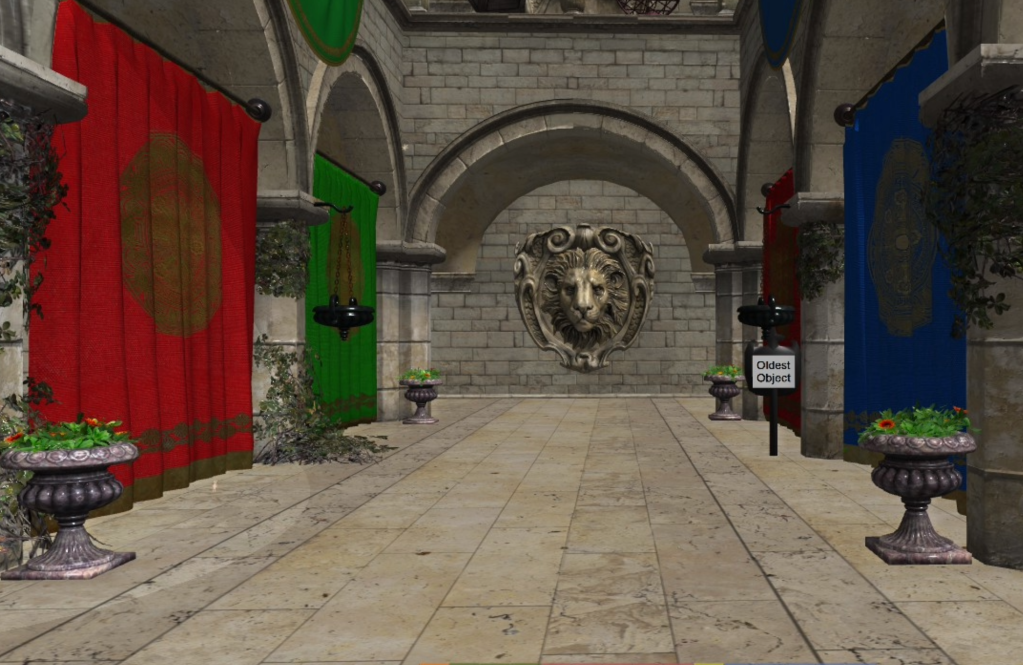
There’s no one else here on JesusTV, or any of the other worlds. “Finding people in games like this is probably the coolest part. It doesn’t happen often. I doubt it’s gonna happen today,” Red warns. And the Rapture is coming fast. Red says that last time he played Active Worlds, there were 550 worlds left, compared to the 194 currently available for us to teleport in and out of. “I was literally the last person to see some of those worlds,” he says, with gratitude in his voice. We head to AWVR, a marble-floored gallery space exhibiting reunions of Active Worlds players. They stop at 2005. “Picture Object. To manually place picture, refer to Help files,” read the embedded images in garish gold frames. I can’t find these Help files, either.

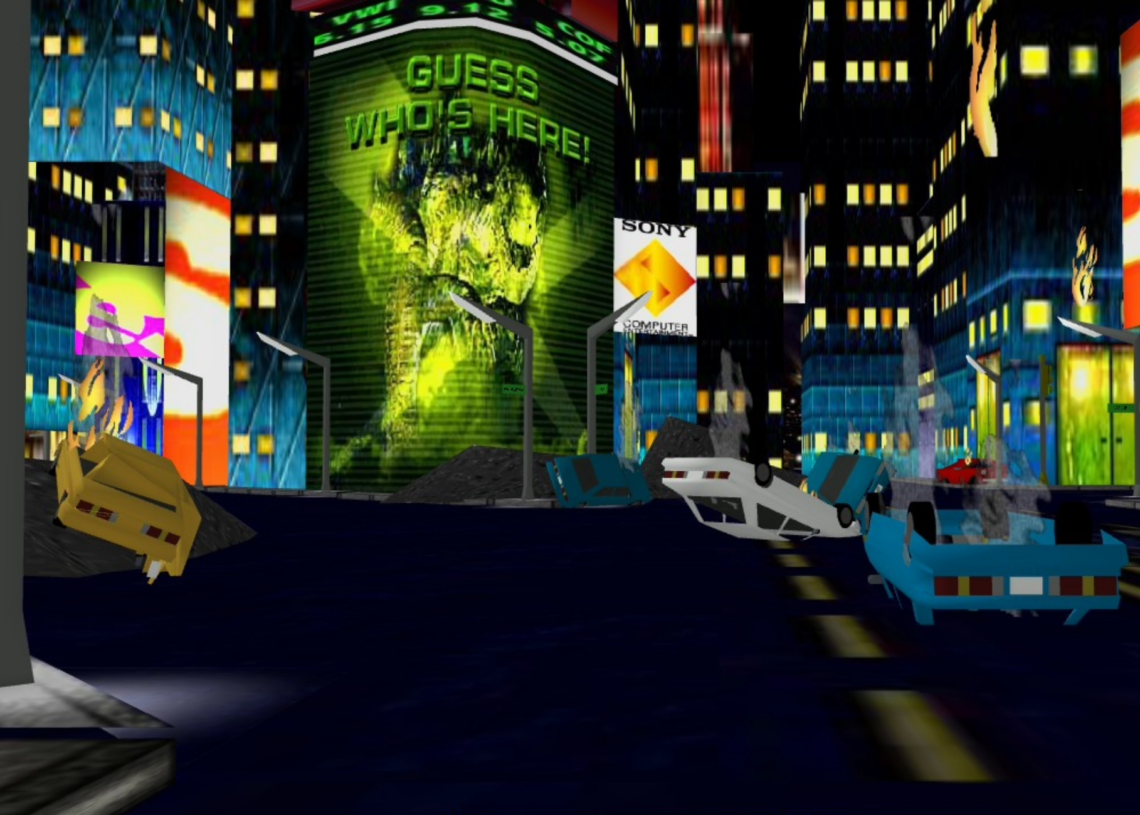
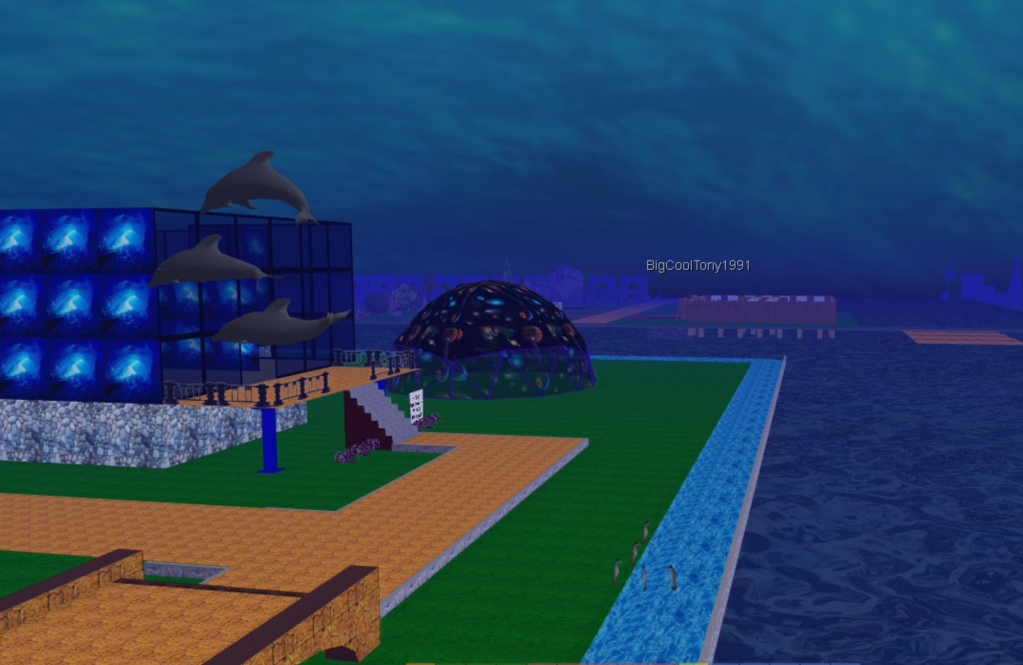
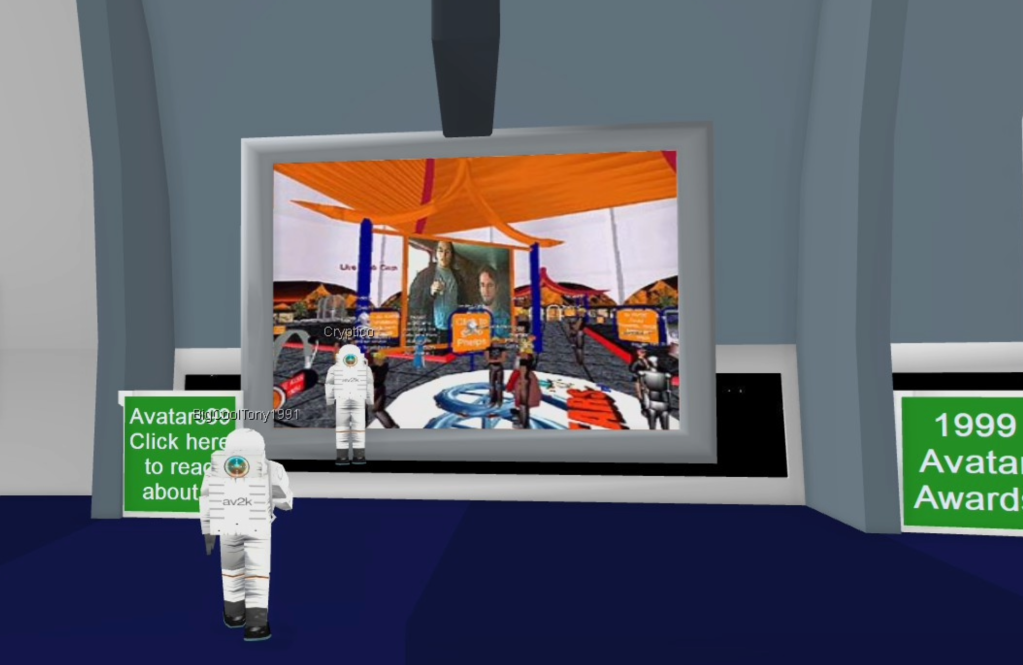
For the next few hours, we visit the game’s many miniature domains. We float underwater in Atlantis, snorkeling around a reef of broken image embeds. We head to one called AV00art, which charts the history of various conferences, held in the early ‘00s, about developments in avatars. We hit up Godzilla, a rendering of the 1998 kaiju reboot, originally made as sponsored content. Most bizarre is Arisia, a giant message board with hyperlinked signs that take you to coverage of various wars. “If a nuclear attack happens, hop on Active Worlds and you’ll have all the intel you need,” jokes Red. The same user is also behind Harp, the most comprehensive collection of resources you could ever hope to find about the instrument.
But Red’s prediction proves correct. There’s not a soul around. So it’s time to load up Jeff’s Place, a spin-off game from Sinespace, which hosts community events and is themed around a beach bar owned by a bearded talisman named (yes) Jeff. It’s a huge, sprawling environment that, these days, hosts five to ten players at any given time (or 30-40 on a really good day) and no one else is on. We hop between a desolate theme park (most of the virtual rides are shut) and a ghostly casino (the slot machines aren’t working).
“As a lonely teenager, Cameron Winter hung out on VRChat. He ended up in a gas station in Siberia that was totally barren, except for one couple having sex in the snow. They caught him watching and he asked how they knew each other… She was from Ukraine, he was from Russia—it was just before war broke out”
We’re about to call it quits. Then, something otherworldly happens. “I think somebody’s here,” Red whispers in my headset.
Dragon_Girl 2_0 is online.
Seconds later, another user joins too—this one called Misguided.
In a state of shock, we teleport to The Octopus, an environment replicating a kitsch discotheque. It turns out that Misguided (aka Mizz) is playing here tonight and she’s currently spinning some sort of esoteric rock ‘n’ roll record I can’t identify. Suddenly, I’m sweating and paralyzed, as if I’m unexpectedly meeting my partner’s parents for the first time while on an edible. I bash out some chat window small talk as we dance the blues.
Tragically, Dragon_Girl 2_0 has no interest in speaking to me. She is happier to dance alone in silence. But Mizz, who has taken on the form of a dancing zebra, is down.
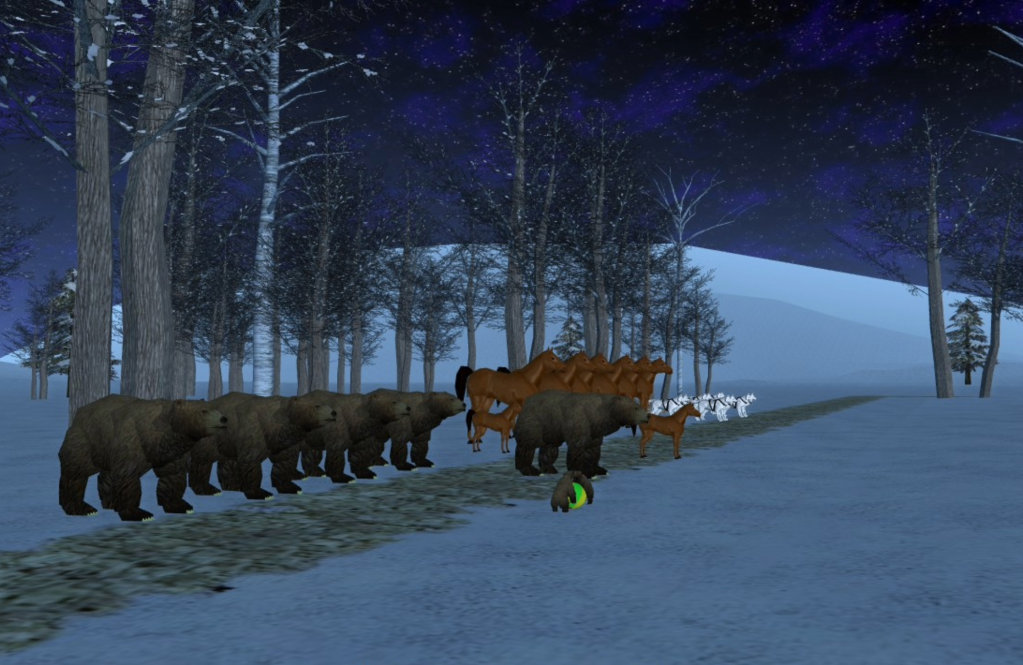
So, I ask, just who is Jeff? “Jeff is an imaginary friend,” she says. It’s time for Red to go do better things than chaperone a noob, so he logs off. I’m on my own now. I stay in the club, dancing like a goon, and make a date to voice chat with Missy later.
It turns out she’s a 70-year-old from Washington. She tells me that she DJs regularly on Jeff’s Place, which she helps run as a community manager. She’s even met a few friends from the game IRL. Was that strange, I ask? “It was fine. It was interesting and fun,” she says plainly. I try to probe more. “They were very much like how they were in the game.”
Thankfully, the more we talk, the more she opens up. She’s been playing virtual worlds since the 1990s, when she first became enamored by the web’s early promise of escape: “I thought I had discovered the best thing on the internet.” She likes the fact that the active community of Jeff’s Place barely goes over double figures—Second Life6, she says, is way too “loud.” I ask if her friends and family know that she plays. She pauses. “I don’t really have any family. And I’m retired,” she replies. “My friends know about Jeff’s Place. But they kind of look over their shoulder and go, ‘That’s weird [if I’m playing it in front of them],’” she says. I feel bad for her. “It’s OK. At least they look over my shoulder.”
The developers of these virtual realms had beautifully rendered dreams. Ever since the 1978 game MUD1—a text-based “Multi-User Dungeon” where players could role play as a wizard and interact through typed commands—zealous devs have been playing God. And they found at least some disciples; in the 1990s, virtual worlds like Active Worlds enjoyed a modest level of popularity. In 2003, the birth of the pioneering 3D world Second Life heralded a new era, growing year-on-year until 2013, when its community peaked at 1 million monthly users.
Then, the likes of Roblox, Minecraft, and Fortnite—all still ineffably popular—began to colonize the massively multiplayer online space. They introduced more gameplay and lore than just building and roaming around, and left the idealism of the early internet’s online virtual worlds behind (I don’t think talks were ever held about a Jeff’s Place Happy Meal). The nail in the coffin for early virtual worlds was the second wave of VR stuff (see, if you dare, VRChat8). Probably the closest thing to Active Worlds and its ilk is the Metaverse, Mark Zuckerberg’s dismally unimaginative wet dream of a virtual world. But it’s pretty much defunct already, having hemorrhaged 45 billion dollars in the process.
“I don’t really have any family, and I’m retired. My friends know… But they kind of look over their shoulder and go, ‘That’s weird’” —70-year-old dead games devotee, ‘Misguided’
Second Life has managed to thrive, still boasting a significant base of 620,000 monthly active users (although it’s a seriously aging population). But newer ventures like Sinespace have barely made a dent in the collective pop-cultural consciousness. Most of these servers are now just wormholes to a series of forgotten hobbies, and their creators are just as elusive, disillusioned by their idylls going idle. The creaky virtual utopias that once sprung from their imaginations are reaching their endgame, stuck in limbo. And yet I cannot get a reply from any of them. Even their makers have forsaken them.
When I finally track down the “Jeff” for which Jeff’s Place is named—in reality, a Suffolk-based developer called Paul Lincoln (AKA, DJ Les) who has been given the keys to create the first Sinespace offshoot—he laments the slow progress of the platform. “Everybody’s basically waiting for new worlds [to be created],” says Lincoln. “In the meantime, we do our best.” The small community of Jeff’s Place users are trying to recruit new members—but their horrifying AI videos of Jeff are not doing them any favors.
Yet, despite their overlords going AWOL, Zuckerberg colonizing the metaverse, and corporate lag, the aesthetic appeal of dead games is creating a revival. Anthony Bak Buccitelli, an associate professor of American Studies at Pennsylvania State University who has written about folklore in MMOGs, connects the recent YouTube fascination with dead games to the resurgent interest in other cultural forms that produce the same kind of feelings (think retro internet aesthetics, the rise of the Backrooms11 and the endless “liminal spaces” Instagram accounts). “When I watched [videos of dead games], my mind immediately went back to a moment when I was a child [in the 1980s] and I first encountered a half-empty shopping mall,” says Bak Buccitelli. “I recall being both fascinated by this and feeling that something about what I was seeing was not quite right, but in a way I couldn’t put my finger on. It can be both disorienting and slightly terrifying.”
Tomasz Gnat—a literary professor who has studied dead games—sees them as ruins worthy of archaeological survey, but with a mouse instead of a shovel. His paper, Worlds of Light, Fading. Dead Games and End-of-Life Software as Ruins of Digital Interactive Entertainment, describes them as “games that become ruins due to abandonment, technological decay, or other processes unique to digital media.” The pioneering virtual ethnographist Tom Boellstorff, who has spent decades surveying players in online worlds like Second Life, believes that even the tiny communities of dead games are worthy of study. “These small places have a lot to teach us. They help us understand the big stuff,” he says over Zoom.
“We hop between a desolate theme park (most of the virtual rides are shut) and a ghostly casino (the slot machines aren’t working)… I find a lot of decay on my travels”
For other enthusiasts, it’s about the characters. “The main appeal to the videos is the people in the videos,” Rye says, explaining that he once came across two young Bulgarian players on Söldner: Secret Wars9 who added him to a call. “One of them played their guitar, the other one sang to me. And the language barrier was ridiculous, but it was so fun and like, that’s a memory I’ll take to my deathbed.” His fans enjoy watching this “human experience”—and waiting to see whether he will actually encounter anyone. And for others still, it connects to the hauntological theories that Mark Fisher popularized—the lost futures of dead games continue to haunt the zeitgeist.
For the regulars of these games though, none of this lofty theory really matters. They’re not interested in crossover academia. They are here to experience a different world. Sometimes, it’s just about finding some peace and quiet. “A lot of people go into virtual worlds to be alone, to go lay on a beach and not be around other people,” says Bollstorff. I see this firsthand in There, a dead game attracting around 50 daily players. “To say I love There would be an understatement,” says Samantha_Cool, dressed in a baby tee emblazoned with “NO DRAMA” and ripped blue jeans (she’s actually a 48-year-old data analyst from New York). She’s been playing for 22 years after moving over with a group of pals from The Sims Online. She still finds new areas when flying solo. “I like that I can be alone when I want,” she says, before taking me hoverboarding over a starry desert plain.
But others head into these worlds to find new friends. One evening, I head back to Jeff’s Place to meet up with moderator and DJ Les, community leader Mimi Marie Beckton, and regular player Carston. “I’m an old lady. I come in here, relax, and be the Barbie I never was,” says Beckton. Do her IRL friends know she plays? “My kids pay for my virtual world. They want me to be here,” she says. She prefers the smalltown, PG-13 feel. “People say to me they go to Second Life and there are thousands and thousands of people there and blah, blah, blah.” Les chimes in: “But then they sit down and they’re only with six or eight people at a fire pit, and that’s what we do here. We have become like a family.” This strange new post-nuclear family unit plays Uno together, watches movies in the game’s virtual cinema, and hosts coffee mornings.
It’s why the preservation of these sacred spaces is so important to the players. Bak Buccitelli says there’s a sense of “vernacular heritage preservation”—“a need to preserve the community’s history and culture, even after the institutional structures have abandoned it.” Even when these dying games do, eventually, die, the communities sometimes endure. Famously, a group of players known as the Uru Diaspora, who used to play Uru: Ages Beyond Myst, have continued socializing in other virtual worlds (they refer to themselves as “Urufugees”) after the original servers were shut down.
“Tomasz Gnat, a literary professor who has studied dead games, sees them as ruins worthy of archaeological survey”
Does their tight-knit clique ever get griefed12, I ask, back in Jeff’s Place? “A bunch of people have come in and made fun of us.” To seasoned gamers, perhaps there is a stigma attached to choosing to hang out in a virtual loserville. (“I tell my [vast YouTube] audience, don’t go messing with any of these people, or, like, the buildings or anything,” Red stresses). Has it ever upset them? “We had a situation maybe a couple or three months ago where a YouTuber,”—(uh-oh)—“who goes around doing videos on dead virtual worlds”—(uh oh)—“stumbled across us and managed to get in touch with a user called—(I finish the sentence in my head)––“ArcticRose.”
I know the one, I say, playing it cool. “It was really emotional, and it did cause a lot of people to come in as newbies, right? But unfortunately, they really drifted off.” Les is more aware of the publicity that Redlyne’s video gave them, blaming himself for not capitalizing on it due to a lack of resources. But Mimi is more frustrated. “They didn’t get to see the whole world or beautiful regions or give us a chance.”
It’s here that I start to become uneasy. Am I a virtual tourist, pressing my face to the glass of the zoo, gawking at these sad zebras? Am I the indicator that your server’s rent is about to go up? As I’m just about to log-off Jeff’s Place for possibly the last time, I feel a twinge of guilt. “You should come to the gig later,” Les says hopefully. I make up an excuse. And for a second, his coyote avatar looks like the Looney Tunes’ Wile E. Coyote, when he suddenly realizes he’s already off the cliff, treading air.
I find a lot of decay on my travels. By the end of the week, I have come across dozens of shrines dedicated to lost players—these games are so old, they’re outlasting their users. But they’re also deteriorating at a rapid pace. Any updates that do finally arrive are already dated by the time they go live. There seems little hope that the tourists the YouTubers bring to dead games turn into permanent citizens. “Empires Mod, a game I played three years ago, still has like, double the players they did before I came in,” says Rye. But as Les and Mimi told me earlier, people don’t convert and commit in significant numbers.
At the same time, there’s a unique sense of humanity in these spaces. I recently saw a video from the A View From a Bridge Instagram, featuring Cameron Winter, that embodies it completely. As a lonely teenager, Winter hung out on VRChat. He ended up in a gas station in Siberia that was totally barren, except for one couple having sex in the snow. They caught him watching and he asked how they knew each other. They said they were dating and in a long-distance relationship. The woman was from Ukraine, the man was from Russia—it was just before war broke out.
“Something about that was very tragic. I logged off and never went back on again. But it was a very human moment and I think about it all the time,” he says in the video. “A lot of people tend to think that history has ended […] and now technology has gotten so sophisticated that things can never be how they once were. But I think they still are how they once were. I don’t think things have changed much in terms of people wanting each other. And needing each other. And not being able to get enough of each other.”
It’s not until the final day of my weeklong quest that I hear that dead games aren’t, in fact, dead games at all. “I actually think the phrase is misleading and both words are wrong,” Boellstorff says. First, he argues, virtual worlds aren’t games (this feels like semantics). And secondly, they’re still alive and kicking.
“Anthropologists like Margaret Mead spent 30 years studying a society of 10,000 people. Second Life has 600,000 active users. To an anthropologist, it would make no sense to think about that as remotely ‘dead.’” True; but the games I’ve been playing are more like hamlets, or perhaps shared houses, compared to, say, Manus Island, that Mead studied (now with a population of over 50,000 people). But in a strange way, they never stop existing as long as they are online. “These virtual places remain places even if they’re uninhabited,” he says.
Rather than viewing them as “games,” Boellstorff thinks of the virtual world as another form of reality. “I can lose money online. I can fall in love online,” he says. It’s true that there’s a lot of life to be found. In Jeff’s Place, I speak to Carson, who married his partner after meeting them on Sinespace. Samantha_Cool, it turns out, also met her husband playing The Sims Online. There are life-long friendships, exchanges of actual currency, and community manager roles on the line. For devoted players, there are always new experiences to be had.
For my final adventure in There, Samantha_Cool takes me to a spot she’s just found, after hearing rumors for years: a boulder with the inscriptions of the game’s developers that’s hidden on the map.It’s what Bak Buccitelli says is the in-game version of a “legend trip.” “They typically involve people, usually in small groups, traveling to the location to either enact a particular ritual or experience the site for themselves,” he says. We stand earnestly in front of the rock, surrounded by a vast digital desert, contemplating our virtual existence.
“There just feels like home. No pressure. No endgame. No endless grind. I meet people from all over the world,” she says, as we stare into the abyss. My borrowed computer, on its own deathbed, crashes, so I boot it back up, log back on, and ask her to continue with what she was saying. “I have wondered,” she types, pausing, before another speech bubble floats into the endless sky. “What would There be without these people?” Turning off my desktop, I wonder if she means the game—or the world beyond it.
Footnotes:
1 Distinct virtual environments with dedicated hosts, contained in the same game.
2 The internet that once was: MySpace pages, Cheezburger cat memes, Miniclip. See also Dead Internet Theory, which posits that the internet is in the process of being entirely taken over by bots.
3A new virtual world launched in 2016, written in Unity 3D. It’s never kicked off and now has just a few thousand dedicated users.
4Immersive virtual environments designed for roaming. Not to be confused with the fake beach Brian Wilson placed his piano on.
5Launched in June 2003, Second Life’s 360-approach to a 3D virtual world proved successful, with its user base peaking at 1 million in 2013. It’s still significant.
6A virtual world platform launched in 2014 designed for weirdos with headsets.
7A 2004 first-and-third-person shooter that received “generally unfavorable reviews” according to the all-seeing, all-knowing Metacritic.
8A fictional online realm, first imagined on 4chan, comprising empty corridors decorated with stale yellow wallpaper and beige carpets. Apparently, you could exit reality and end up in these expansive levels. A creepypasta followed, leading to fake found footage of roaming Backrooms created by filmmaker Kane Parsons. His horror shorts earned him a fervent following and he’s now directing a Backrooms A24 film. 11To be ‘griefed’ in a game is to be intentionally annoyed, trolled, and harassed.
This feature is from the spring 2026 issue of VICE magazine, THE NOT THE PHOTO ISSUE. Get four issues each year, sent straight to your door, by subscribing here.
The post Dead Games: Searching for Signs of Life in the Early Internet’s Abandoned Worlds appeared first on VICE.